Product/Market Fit vs Model/Market Fit: Why Building Something People Want Isn't Enough
Product/Market Fit vs Model/Market Fit: Why Building Something People Want Isn't Enough
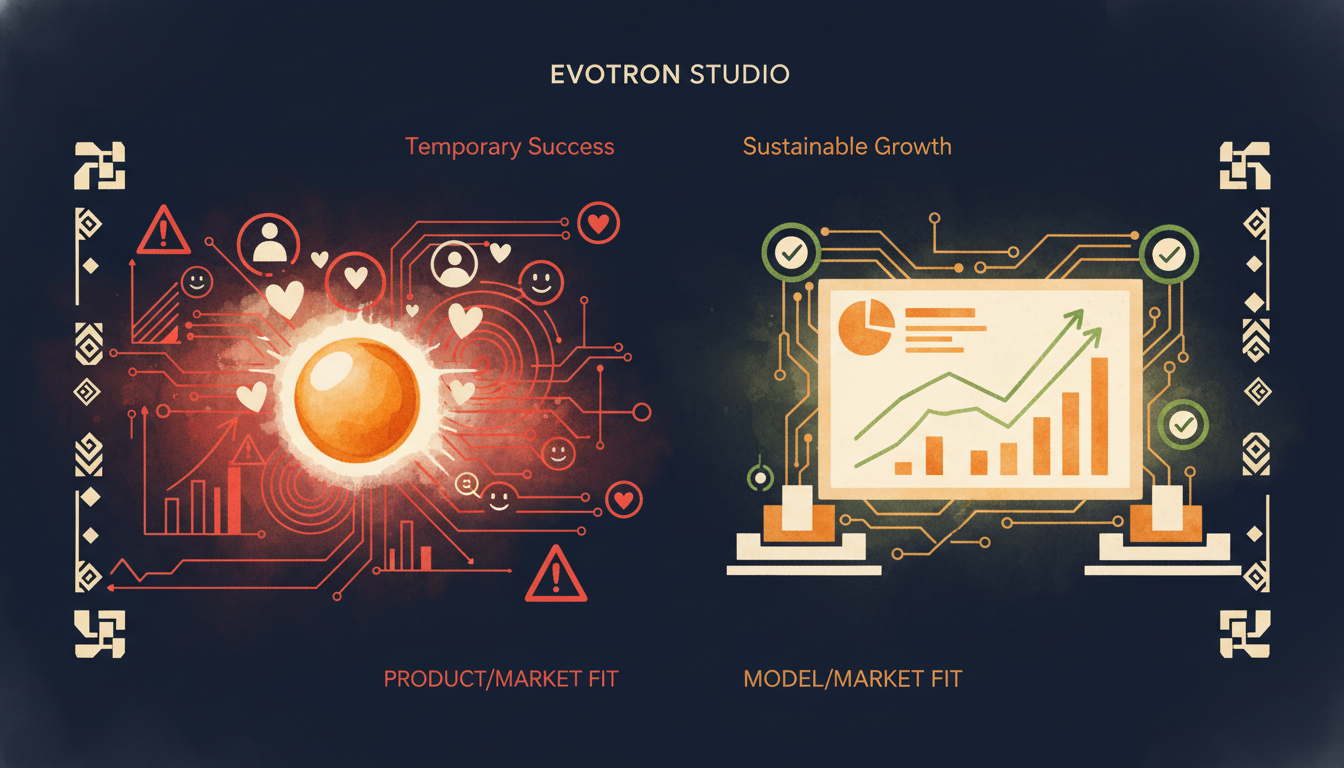
Every founder knows the holy grail: product/market fit. Product market fit measures the size of the market demand for your product, how customers respond to it, and the gap it fills in the current market. But here's the uncomfortable truth: having customers love your product isn't enough to build a successful company.
In 2026, as AI transforms how we build and scale businesses, the startup playbook is evolving beyond PMF. There's a deeper layer founders must understand: Model/Market Fit (MMF). While product–market fit validates desire, model–market fit validates durability.
What is Model/Market Fit?
Model Market Fit is the concept that your market (and # of customers within your market) influence your model. It's the alignment between your business model and the economic realities of your target market.
Your Model Market Fit hypothesis revolves around some simple math: ARPU x Total Customers In Market x % You Think You Can Capture >= $100M. This isn't just theoretical—when you do this for a lot of early stage startups the simple math tells you that you don't have a $100M company.
The Critical Difference: Desire vs Durability
Product/Market Fit asks: "Do people want this?"
Model/Market Fit asks: "Can this actually work as a business?"
Consider Casper, the poster child for why PMF alone isn't enough. Casper reached $1 million in sales in its first month and $100 million in cumulative sales within two years. By every surface metric, Casper had product–market fit.
But the model was fundamentally broken:
- Retrospective analyses show that by the time of its 2020 IPO, Casper was losing hundreds of dollars per mattress sold after marketing and returns.
- More than 175 competitors entered the market with similar foam mattresses, driving up marketing costs and eliminating pricing power.
- Mattresses are a low-frequency, "one-and-done" purchase. Without a strong repeat or expansion motion, Casper struggled to offset high CAC with sufficient lifetime value.
By 2026, the company has been forced to rethink its model through retail partnerships and tighter supply chain control in an effort to stabilize its economics.
The Four Fits Framework
Growth expert Brian Balfour expanded the traditional PMF concept into four essential alignments:
- Market/Product Fit: Understanding the market before building the product
- Product/Channel Fit: A product that requires high-touch sales but only generates $10 MRR lacks Product-Channel fit.
- Channel/Model Fit: Is your acquisition cost (CAC) sustainable given your business model (LTV)? In 2026, investors look for a 12-month CAC payback period.
- Model/Market Fit: Is the market large enough to support the revenue goals of your business model? For VC-backed startups, this usually means a $1B+ TAM (Total Addressable Market).
You need all four Fits to grow to $100M+. You can't think about the four Fits in isolation because together they form an ecosystem for growth.
Model/Market Fit in the AI Era
For AI startups, there's an additional layer: AI Model/Market Fit. For AI startups, there is a prerequisite layer beneath product-market fit: the degree to which current model capabilities can satisfy what a market demands. I call it Model-Market Fit, or MMF.
Take the legal AI explosion. Every legal startup before 2023 struggled to cross $100M ARR. Then something shifted. Thomson Reuters acquired Casetext for $650 million. The legal AI market minted more unicorns in 12 months than in the previous 10 years combined.
The market hadn't changed. The model capability threshold had been crossed.
Testing Your Model/Market Fit
Here are the key questions every founder should answer:
Unit Economics Reality Check:
- If you lose money on every transaction, growth only accelerates failure. LTV must meaningfully exceed CAC.
- Can you command your target price point once you're actually in market?
- If pricing is consistently negotiated down, CAC keeps rising, or sales cycles feel unpredictable, you may have PMF—but not MMF.
Market Size Validation:
- Take the average annual revenue per customer/user, multiply it by total number of customers/users in your target market, then multiply that by the percentage you think you can capture.
- If you are a SaaS startup and this variable comes out to 50%+ then you should be worried. For SaaS businesses where there aren't strong network effects, I use 10% as a rule of thumb.
Defensibility Assessment:
- Defensibility protects pricing power. Products that are easy to copy inevitably face rising acquisition costs and eroding margins.
- Do you control your cost structure through vertical integration, pricing leverage, or operational efficiency?
Why This Matters for NZ Founders
At Evotron Studio, we see too many founders build something people want, then struggle to make it financially viable. The AI-powered tools in our portfolio—Evotron, Supramono, CenterOS, InfraIris—were all designed with Model/Market Fit from day one.
Without model–market fit, growth feels fragile—easily disrupted by rising costs, competition, or operational complexity. This is why we don't just help founders build products; we help them build businesses that can scale profitably.
In 2026, we also recognize the "PMF Decay." As markets evolve and new AI models emerge, your once-stable PMF can evaporate. Model/Market Fit provides the durability that pure product love cannot.
The Path Forward
Achieving PMF is often regarded as the most critical inflection point in a startup's lifecycle—the moment when a company transforms from a promising idea into a viable, scalable business. But Model/Market Fit is where that viability becomes sustainable.
The companies that survive and thrive aren't just those that find something people want—they're the ones that find a way to deliver it profitably, defensibly, and at scale. In the AI era, that means understanding not just what the market wants, but what the market can economically support.
Before you scale your next growth experiment, ask yourself: Do I have product love, or do I have a business that works?
Ready to build a startup with both Product/Market Fit AND Model/Market Fit? At Evotron Studio, we combine hands-on founder mentorship with AI-powered tools to help you get from idea to revenue faster than any alternative. Learn more about our venture studio approach and apply to work with us.
Evotron Studio
We help founders build and sell.
We help founders build and sell.
Learn more about Evotron Studio and get started today.
Visit Evotron Studio