The Hidden Cost of 'Wrapper' Startups in the AI Era
The Hidden Cost of 'Wrapper' Startups in the AI Era
Let's talk about something uncomfortable. 80% of AI startups will disappear by 2026—just ten months from now. That's not hyperbole; that's pattern recognition from an industry that's seen this movie before.
I'm watching founders pour their savings into what I call "wrapper startups"—companies that slap a nice UI on top of ChatGPT or Claude and call it defensible technology. If your startup's core value is "we make ChatGPT easier to use," you don't have a startup—you have a feature request.
The Great Commoditization
Launching an "AI-powered" feature often requires little more than access to a foundation model and a polished interface. In these environments, thin wrappers proliferate quickly, making the absence of defensible systems especially obvious once initial novelty fades.
Here's the brutal reality: If OpenAI releases a free update tomorrow that does exactly what my product does, do I still have a business? If the answer is no, you are a wrapper. Pivot now.
The commoditization didn't happen overnight. It followed a predictable progression:
- 2023: Building an AI feature took weeks
- 2024: AI coding assistants reduced that to days
- 2026: With Cursor, v0, Bolt, and Claude Opus 4.6, that same feature ships in a day. Sometimes in hours.
Why Most AI Startups Will Fail
When the heart of a product depends entirely on third-party APIs, value is effectively rented. Model updates, pricing changes, or policy shifts can instantly destabilise both economics and functionality.
The math is simple but painful:
- No pricing power: You're competing on commoditized intelligence
- Platform risk: Your entire business depends on someone else's roadmap
- Feature parity: Incumbents can match 80% of the wrapper's value in a month. Wrappers just can't compete against full-stack platforms with real customers and real workflows.
Building Real Defensibility: Your Two Options
So what's a founder to do? You have two paths forward, and they're not mutually exclusive.
Option 1: Drive the Agents Yourself
This is the DIY route. You build with tools like Evotron (for product building) and Supramono (for sales and marketing), but you're the one making the strategic decisions. You're learning to wield AI agents like a craftsperson learns to wield tools.
The upside? You maintain full control and learn the terrain deeply.
The downside? It's slow, and you're doing it alone.
Option 2: Partner with an Agentic Venture Studio
This is where studios like ours come in. We don't just give you access to AI agents—we drive them for you. In many domains such as legal advice, infrastructure design, and finance, full autonomy for AI still feels risky. Having a human in the loop to review, edit, or assure quality adds confidence and builds trust. Yes, it's harder to scale and margins may be lower but it's also harder to copy.
What Actually Creates Moats in 2026
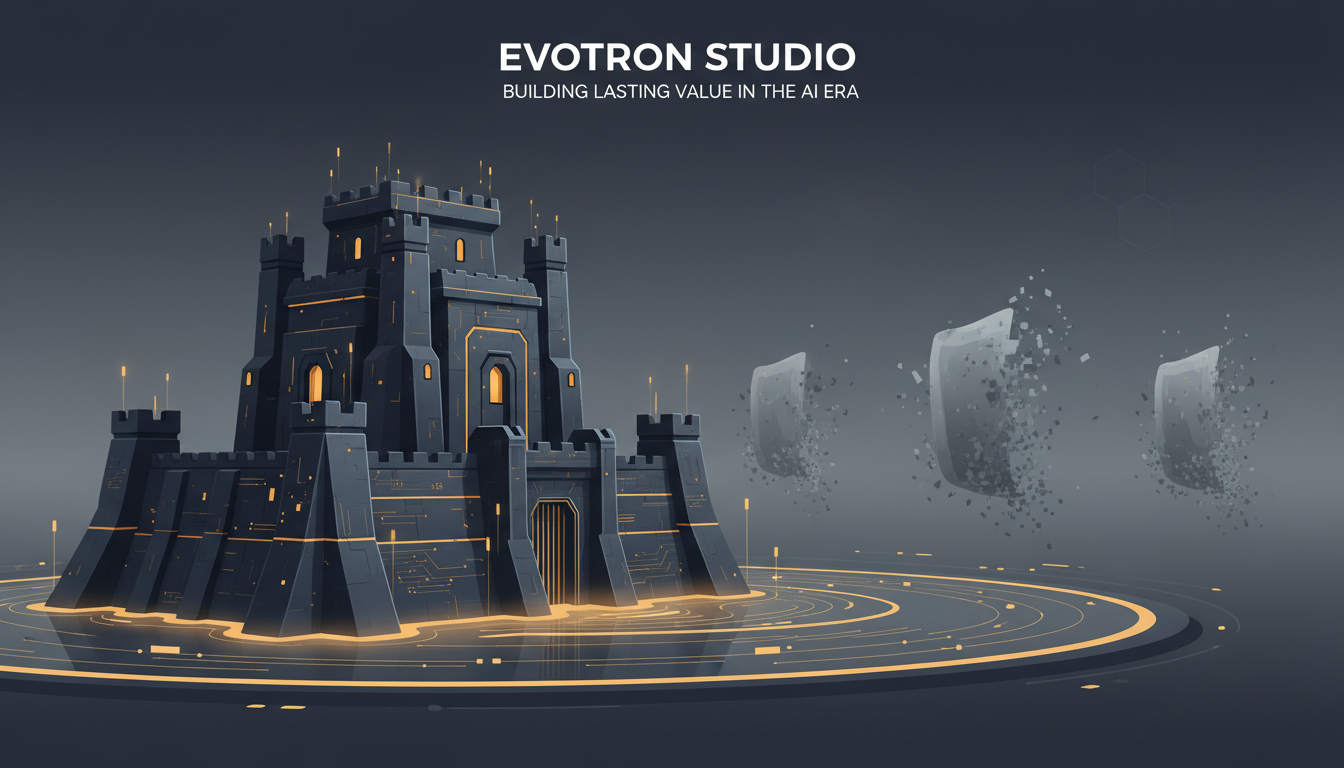
Defensibility is migrating away from the model itself and toward system architecture. This evolution changes how startups should think about growth, investment readiness, and long-term viability.
The survivors share common traits:
Vertical Depth: AI built for a defined use case often outperforms general purpose tools. A startup that understands the workflows of grid operators, architects, lawyers, or zookeepers can embed AI in ways that feel natural and necessary. That kind of domain depth and user empathy is hard to copy.
Proprietary Data: Systems built around user preferences, can be trained and refined in ways others can't duplicate. That feedback loop can produce better outcomes, attract more users, and lead to a defensible advantage.
Systems Integration: Products that move beyond conversational interfaces and operate directly within client workflows develop a different kind of resilience. Integration into internal systems, processes, and decision-making contexts creates stickiness that thin wrappers rarely achieve.
The Kiwi Advantage
At Evotron Studio, we're not trying to out-spend Silicon Valley. We're building something different: a venture studio that combines human judgment with AI execution. When you work with us, you're not renting intelligence—you're buying expertise that happens to be amplified by AI.
Our portfolio products (Evotron, Supramono, CenterOS, InfraIris) aren't wrappers around foundation models. They're purpose-built tools that we use internally and share with founders who want to move faster than the competition.
The Choice Is Yours
The window for "easy money" in AI is closing. The "Cool Demo" era is ending; the "Critical Infrastructure" era is beginning.
You can choose to build another wrapper and hope for the best. Or you can choose to build something defensible—either by learning to drive AI agents yourself or by partnering with people who've already figured it out.
The survivors won't be the ones with the prettiest interfaces. They'll be the ones who understood that in an age when anyone can build anything, the only moats that matter are the ones AI can't replicate: expertise, relationships, and the judgment to know which problems are worth solving.
Ready to build something defensible? Whether you want to learn to drive AI agents yourself or partner with an agentic venture studio, we can help. Explore your options at Evotron Studio and let's build something that lasts.

Evotron Studio
We help founders build and sell.
We help founders build and sell.
Learn more about Evotron Studio and get started today.
Visit Evotron Studio