From Innovation Budget to Paying Customer: What the Build Actually Looks Like
Most build processes don't have a finishing line.
One of the quieter reasons corporate venture builds drift is that nobody defined what 'done' looks like before the work started. There's a prototype. Then there's a refined prototype. Then there's a pilot. Then there's a 'we're almost ready to go to market' conversation that's been happening for four months.
Without a clearly defined finishing line, and without budget tranches tied to reaching it, the build just keeps going. That's not a failure of effort. It's a failure of structure.
What a milestone-gated journey actually looks like
VentureOS structures every corporate venture build as a sequence of gated stages, each with a defined evidence requirement before the next budget tranche releases. The stages aren't arbitrary. They map to the highest-risk questions that kill most ventures before they reach revenue.
Gate 1: Problem-solution fit validation. Before any product is built, the team surfaces and tests the highest-risk assumptions in the business model. This produces interview transcripts, a documented demand signal, and a go/no-go recommendation. If the demand isn't there, the engagement stops here. That's the point.
Gate 2: Architecture and compliance foundation. For regulated-sector builds, EU AI Act-aligned human oversight mechanisms and audit trail requirements are defined and embedded into the technical architecture before a single line of production code is written. Retrofitting this later is expensive. Building it in is not.
Gate 3: Agentic MVP build. The product is built with agentic AI tooling and human-in-the-loop review at every critical output. The team isn't building to a static spec; they're building to a validated problem statement with startup accountability metrics tracking alongside development.
Gate 4: Activation and early revenue. The MVP ships to a defined cohort of early users. Activation rate, Day-30 retention, and early ARR signals are captured and reported in a format that satisfies both build-level operators and investment committee reporting simultaneously.
Why 'no milestone, no next gate' matters more than it sounds
The gate structure isn't bureaucracy. It's the mechanism that makes both parties accountable to the same outcome.
When a consulting firm misses a milestone, the engagement continues because the retainer continues. When a VentureOS build misses a gate, the budget tranche doesn't release, and the team documents why. That documentation becomes the defensible post-mortem your board can read if the venture doesn't proceed. It also becomes the evidence base for a pivot decision if the original direction needs to change.
This is what makes the spend justifiable, not just in hindsight, but at every stage.
The team behind the platform
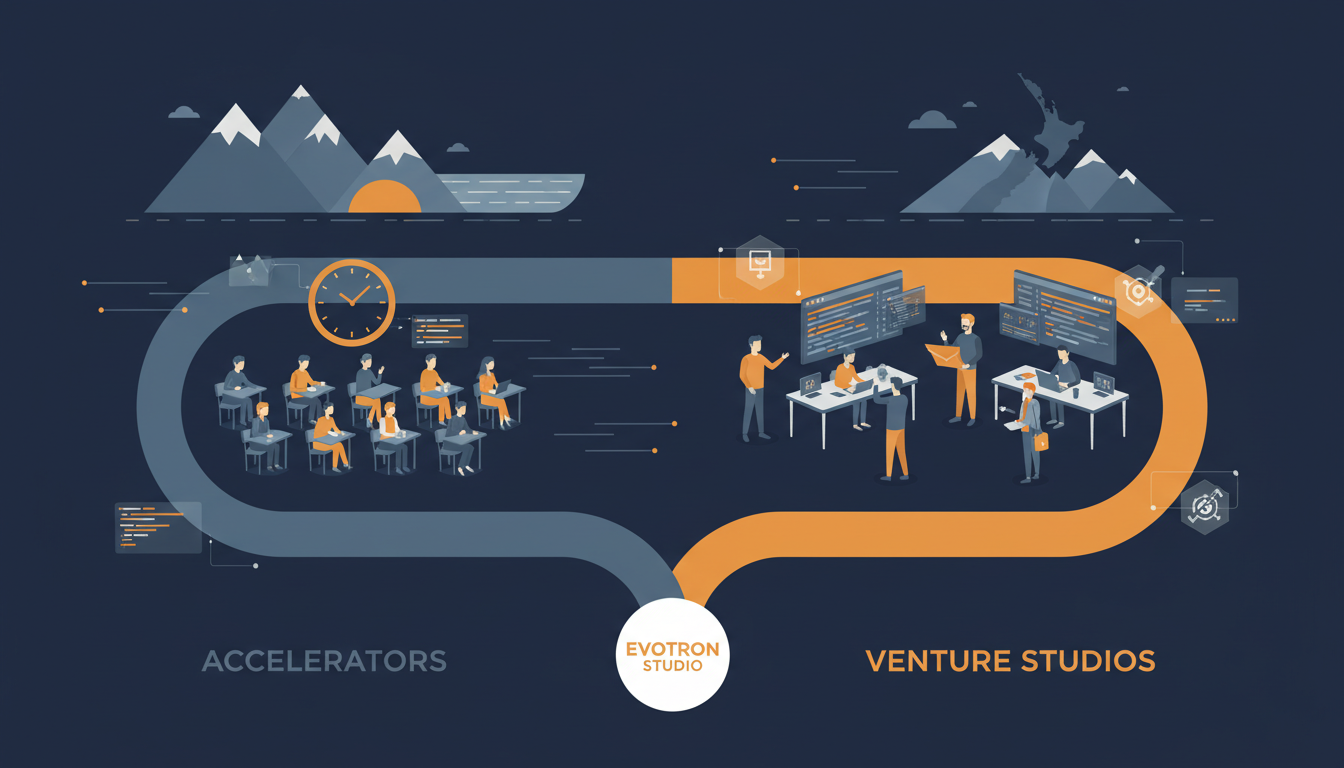
Evotron Studio runs this methodology with a small team of senior operators force-multiplied by Supramono, the agentic platform we built and dogfood ourselves. The output looks like a twelve-person team. The cycle time looks like a hackathon. The price point looks like a single senior hire.
We've used this stack to launch six live products: Supramono, Evotron, CenterOS, Infrairis, VirtualSpace, and CenterOS. Every claim links to something that exists and is running. That matters because it's the difference between a vendor who has read about agentic venture builds and one who has done them, repeatedly, under real constraints.
If you're carrying a mandate and a stalled proof of concept
VentureOS isn't a fit for every situation. It's built for corporate innovation labs and regulated-sector venture programs that have a validated AI idea, a real budget, and a board that expects to see a revenue-generating MVP within six months.
If that's your brief, the first conversation is a gate assessment: what are the highest-risk assumptions in your current build, and which of them haven't been tested yet? That's where we start.
Reach out to the Evotron Studio team to book that conversation.

Evotron Studio
Senior operator. Senior strategist. Twelve agents in the toolbox. We use AI so you don't have to.
Senior operator. Senior strategist. Twelve agents in the toolbox. We use AI so you don't have to.
Learn more about Evotron Studio and get started today.
Visit Evotron Studio