10 AI Manufacturing Startup Ideas Worth Building in 2026
The AI hype in manufacturing has mostly landed in the obvious places: quality cameras on assembly lines, chatbots bolted onto ERP portals, and generative design tools that produce shapes nobody can actually make. Meanwhile, the genuinely hard problems — the ones where real money bleeds, real engineers swear, and real companies stall — remain largely untouched.
This isn't a list of moonshots. These are ten specific, structurally sound opportunities where the market pain is real, the incumbents are either unable or unwilling to solve it, and there's a plausible moat for whoever gets there first. If you're an operator or investor looking at industrial software in 2026, here's where the signal is.
1. Manufacturability Verification: Adjudicating AI-Generated CAD
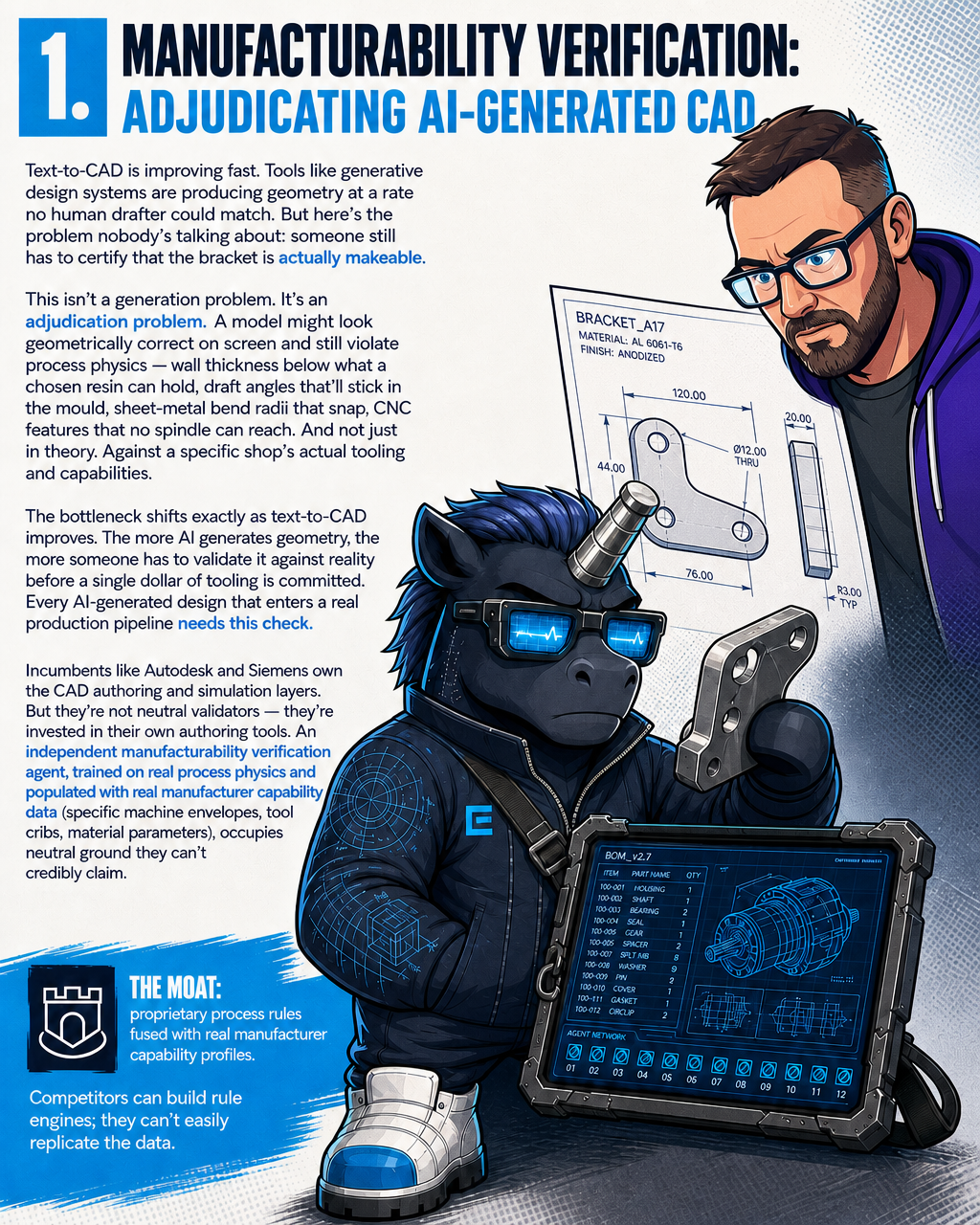
Text-to-CAD is improving fast. Tools like generative design systems are producing geometry at a rate no human drafter could match. But here's the problem nobody's talking about: someone still has to certify that the bracket is actually makeable.
This isn't a generation problem. It's an adjudication problem. A model might look geometrically correct on screen and still violate process physics — wall thickness below what a chosen resin can hold, draft angles that'll stick in the mould, sheet-metal bend radii that snap, CNC features that no spindle can reach. And not just in theory. Against a specific shop's actual tooling and capabilities.
The bottleneck shifts exactly as text-to-CAD improves. The more AI generates geometry, the more someone has to validate it against reality before a single dollar of tooling is committed. Every AI-generated design that enters a real production pipeline needs this check.
Incumbents like Autodesk and Siemens own the CAD authoring and simulation layers. But they're not neutral validators — they're invested in their own authoring tools. An independent manufacturability verification agent, trained on real process physics and populated with real manufacturer capability data (specific machine envelopes, tool cribs, material parameters), occupies neutral ground they can't credibly claim.
The moat: proprietary process rules fused with real manufacturer capability profiles. Competitors can build rule engines; they can't easily replicate the data.
2. PLM-MES-ERP Reconciliation Agent: Solving the BOM Drift Problem
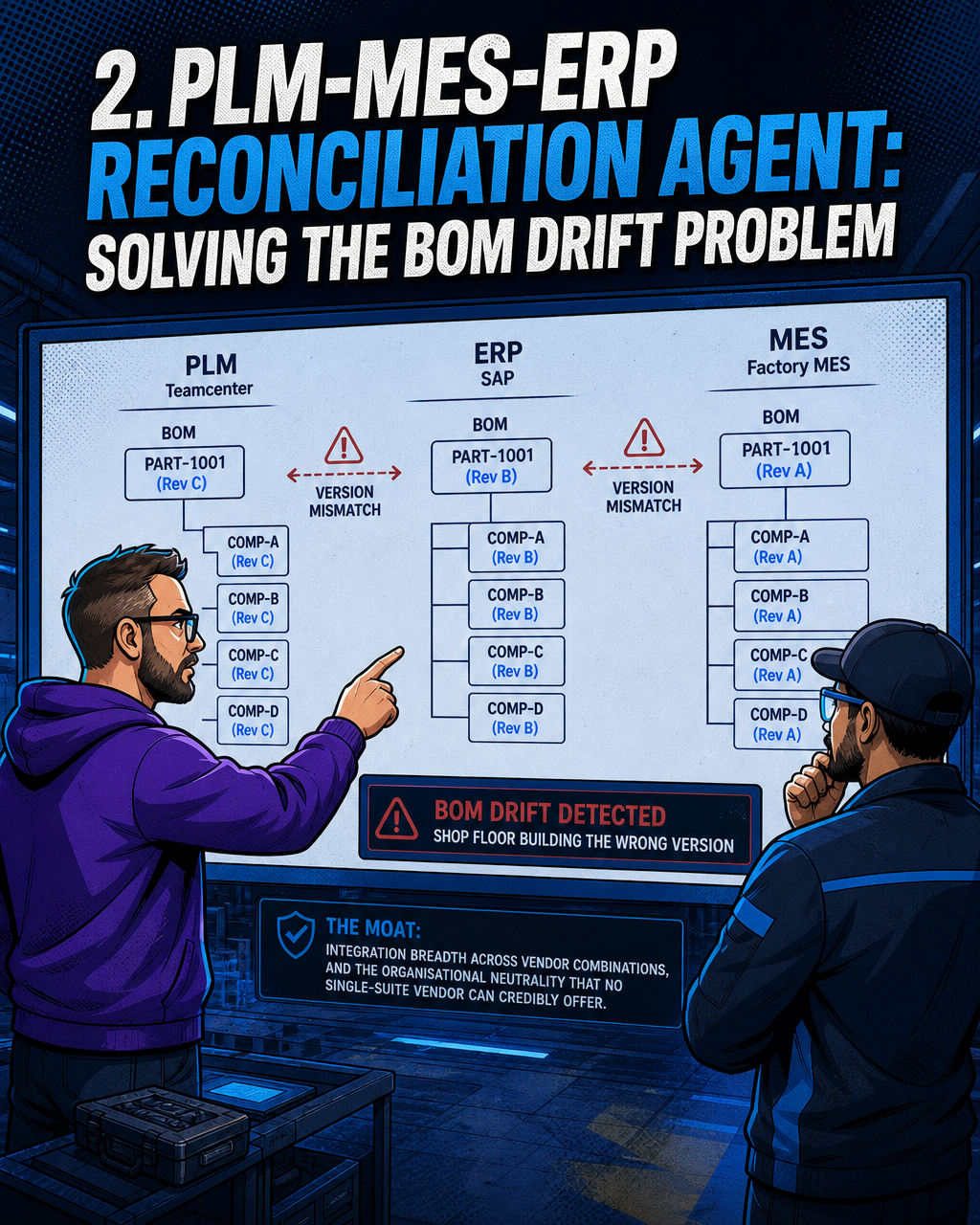
Here's a failure mode that plays out in manufacturing plants constantly: an engineer revises a BOM in Teamcenter. The change propagates into SAP. It never makes it to the MES. Three weeks later, the shop floor is building the wrong version of the part, and nobody knows why until scrap starts accumulating.
This isn't a niche edge case. It's a structural consequence of how enterprise software evolved. Each system owns its silo. PLM vendors protect their data model. ERP vendors protect theirs. The MES is often a third party entirely. Nobody is incentivised to be the neutral reconciliation layer, because that position belongs to no one's roadmap.
An agent whose sole function is detecting and resolving divergence across these systems of record — comparing the engineering BOM in PLM against the manufacturing BOM in MES against the costing BOM in ERP, flagging conflicts, and routing resolution — is something the suite vendors are structurally disincentivised to build. Siemens won't build it neutrally against SAP. SAP won't build it neutrally against Teamcenter. That neutrality is the product.
Datagrid and a handful of integration specialists have begun working this territory, but the category is still early and the integration breadth required is steep enough to create durable barriers.
The moat: integration breadth across vendor combinations, and the organisational neutrality that no single-suite vendor can credibly offer.
3. Brownfield Engineering Knowledge Graph: The Unsexy ETL Nobody Wants to Do
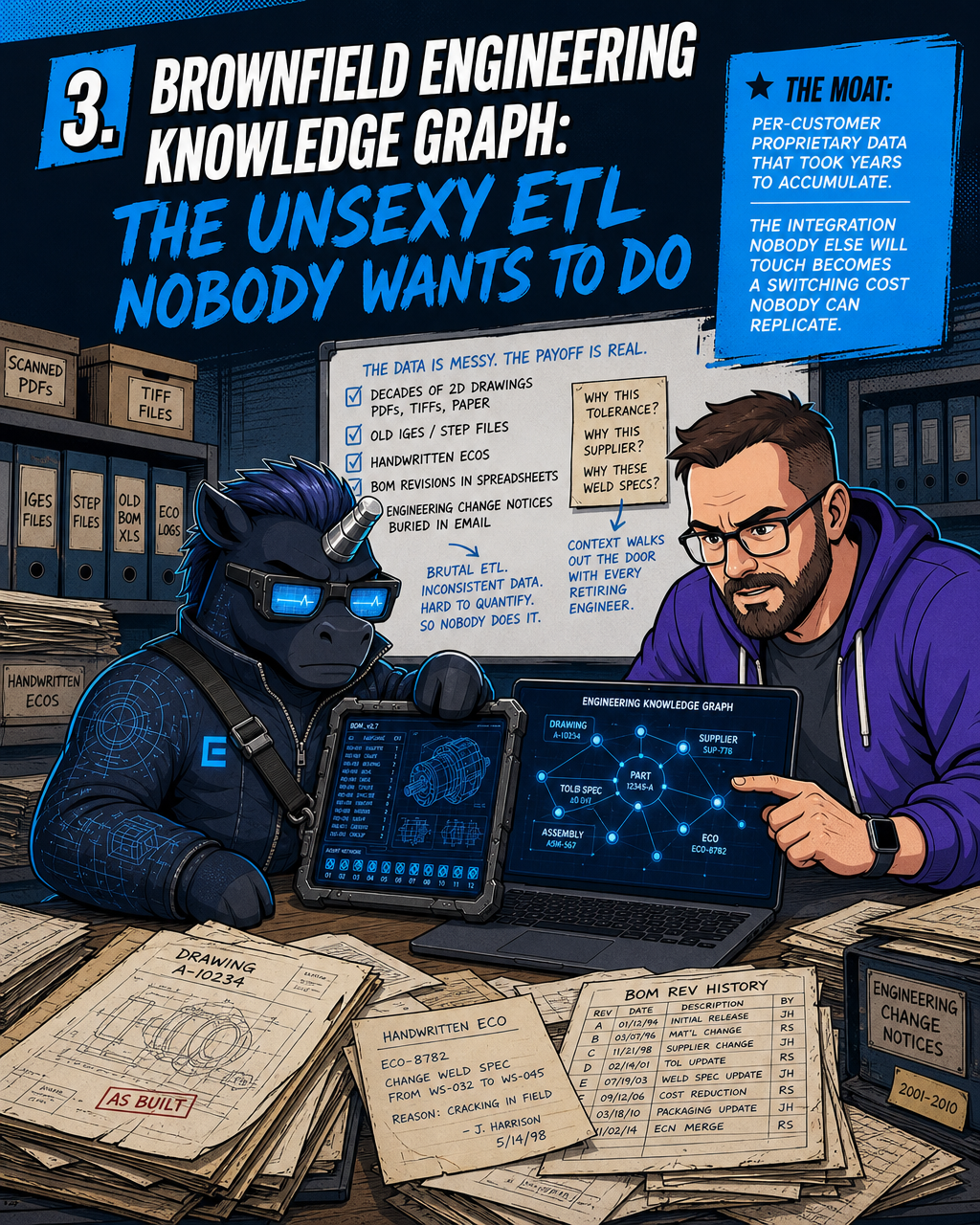
Every legacy manufacturer is sitting on decades of 2D drawings: scanned PDFs, TIFF files, sometimes actual paper, stored in file systems that predate modern PLM by fifteen years. Alongside those drawings lives a mountain of old IGES and STEP files, handwritten ECOs, spreadsheet-based BOM revisions, and engineering change notices that exist only in email threads.
Nobody wants to touch this. The ETL is brutal, the data quality is inconsistent, and the payoff is hard to quantify in a slide deck. So nobody does it. Tools like OpenBOM's Product Memory and similar offerings assume clean, reasonably current data. They're not built for the reality of a 40-year-old manufacturer with filing cabinets full of history.
But that undocumented history is where real value can live. Why was this tolerance set this tight? Why did we stop using this supplier? Why does this assembly have these specific weld specs? That context walks out the door with every retiring engineer. An agent that ingests messy historical engineering data — OCR'ing drawings, parsing old formats, reconciling part numbers across naming conventions, and surfacing it in a queryable knowledge graph — is wide open precisely because nobody else will do the dirty work.
The moat: per-customer proprietary data that took years to accumulate. The integration nobody else will touch becomes a switching cost nobody can replicate.
4. Quoting and DFM Copilot for Job Shops: Flipping the AI to the Supplier Side
Almost every AI tool built for manufacturing is built for the OEM engineer. Design for manufacturability feedback, automated tolerancing, material selection — all of it points inward at the engineering team. Flip the camera around.
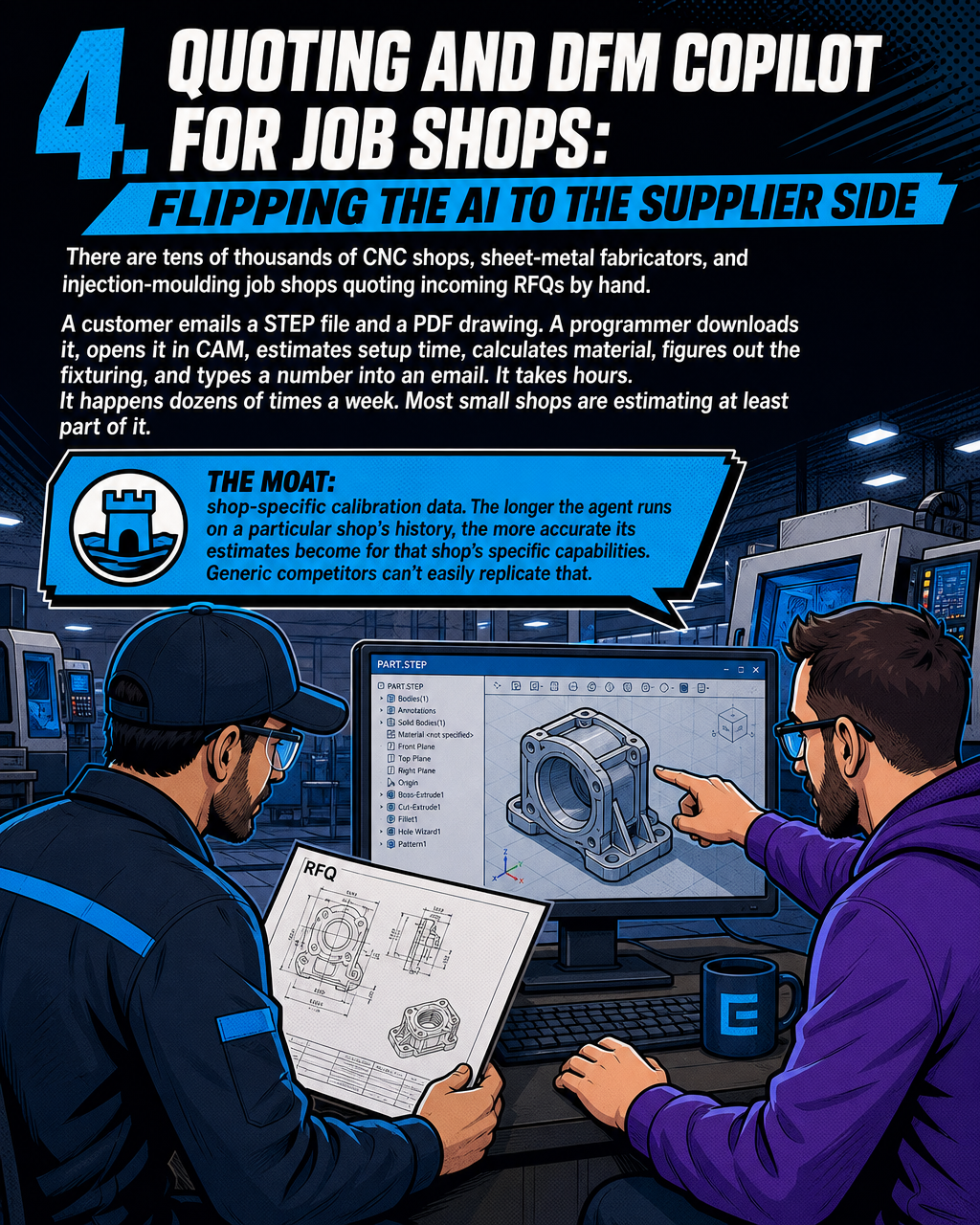
There are tens of thousands of CNC shops, sheet-metal fabricators, and injection-moulding job shops quoting incoming RFQs by hand. A customer emails a STEP file and a PDF drawing. A programmer downloads it, opens it in CAM, estimates setup time, calculates material, figures out the fixturing, and types a number into an email. It takes hours. It happens dozens of times a week. Most small shops are estimating at least part of it.
Xometry and Protolabs have solved this internally at scale. They've built proprietary quoting engines that do exactly this, and they're winning market share from regional shops on turnaround time alone. The fragmented regional long tail — the 30-person shop in Christchurch or Hamilton that does tight-tolerance aerospace work and quotes everything manually — has nothing comparable.
An agent that reads inbound CAD and drawings, runs DFM analysis, estimates cycle time and cost against the shop's specific machines and tooling, flags manufacturability issues to discuss with the customer, and drafts the quote is a textbook underserved-fragmented-market play. The customer acquisition channel is the job shops themselves, who are watching Xometry eat their lunch.
The moat: shop-specific calibration data. The longer the agent runs on a particular shop's history, the more accurate its estimates become for that shop's specific capabilities. Generic competitors can't easily replicate that.
5. GD&T and Inspection Automation: The Hinge Between Design and Metrology
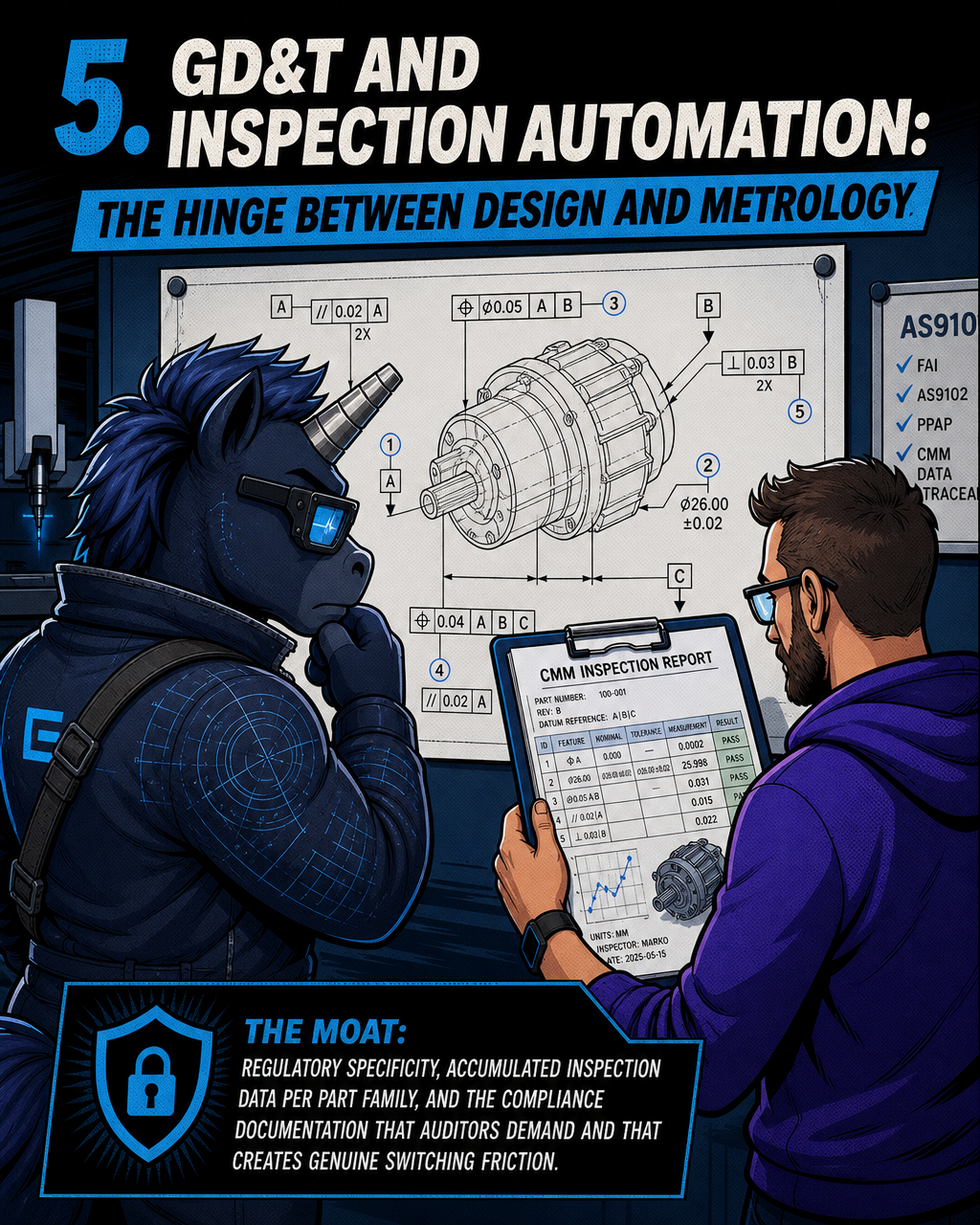
Geometric Dimensioning and Tolerancing is one of the most specialised and error-prone disciplines in manufacturing engineering. Done correctly, it defines exactly how much variation a feature can have and still function. Done poorly, it creates ambiguous drawings, inspection disputes, supplier rejections, and expensive re-spins.
Most companies doing GD&T work do it with a handful of specialists who've been doing it for years. The ballooned drawings, the CMM programs, the First Article Inspection reports, the PPAP packages — all of it is labour-intensive, document-heavy, and tightly regulated for anyone selling into AS9100 or ISO 13485 environments.
According to HighQA's case study materials, automated ballooning of complex GD&T drawings and instant population of AS9102 forms has reduced FAI preparation time by over 60% at some customer sites — though these figures are vendor-supplied and have not been independently audited. But the end-to-end agent — one that applies GD&T from design intent, checks it for completeness and ASME Y14.5 compliance, generates the ballooned drawing, writes the CMM measurement routine, and packages the full PPAP — doesn't exist as a coherent product aimed at mid-market manufacturers.
Quality is regulated, painful, and document-heavy. The regulatory artefacts themselves become a moat: once an agent has generated and stored your AS9100 inspection packages, you don't swap it out lightly.
The moat: regulatory specificity, accumulated inspection data per part family, and the compliance documentation that auditors demand and that creates genuine switching friction.
6. Compliance and Traceability Copilot for Regulated Hardware
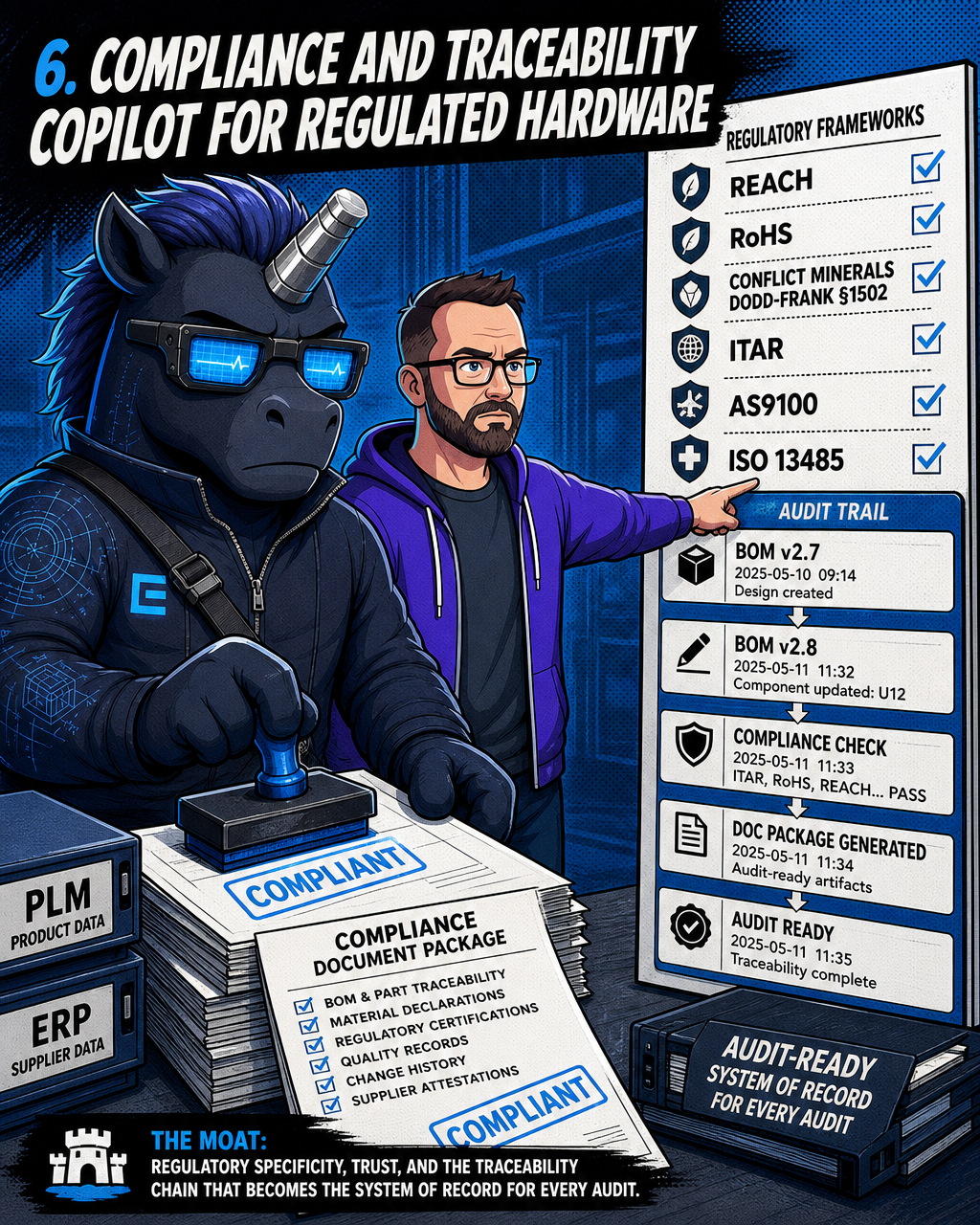
REACH. RoHS. Conflict minerals under Dodd-Frank Section 1502. ITAR. AS9100. ISO 13485. Every BOM in a regulated hardware company carries a documentation obligation that compounds with every design change.
As AI-generated designs proliferate, this problem gets structurally worse. Faster iteration means more design changes. More design changes mean more compliance re-verification. The compliance mountain grows faster than any team can manually climb it.
Makersite describes its approach as addressing complex manufacturing sectors by tackling the core issue that structured product data exists in PLM and supplier data sits in ERP, but cross-functional intelligence does not. The broader regulated-document generation and audit trail layer — spanning ITAR export controls, AS9100 quality management records, and full design-change traceability in a single audit-ready package — is still largely unaddressed by a single coherent product.
The thesis here is straightforward: compliance obligations increase as AI-generated content proliferates. The more design velocity increases, the more you need automated compliance tracking to keep pace. No human team scales linearly with that.
The moat: regulatory specificity, trust (auditors need to be comfortable with the provenance), and the traceability chain that once established becomes the system of record for every audit.
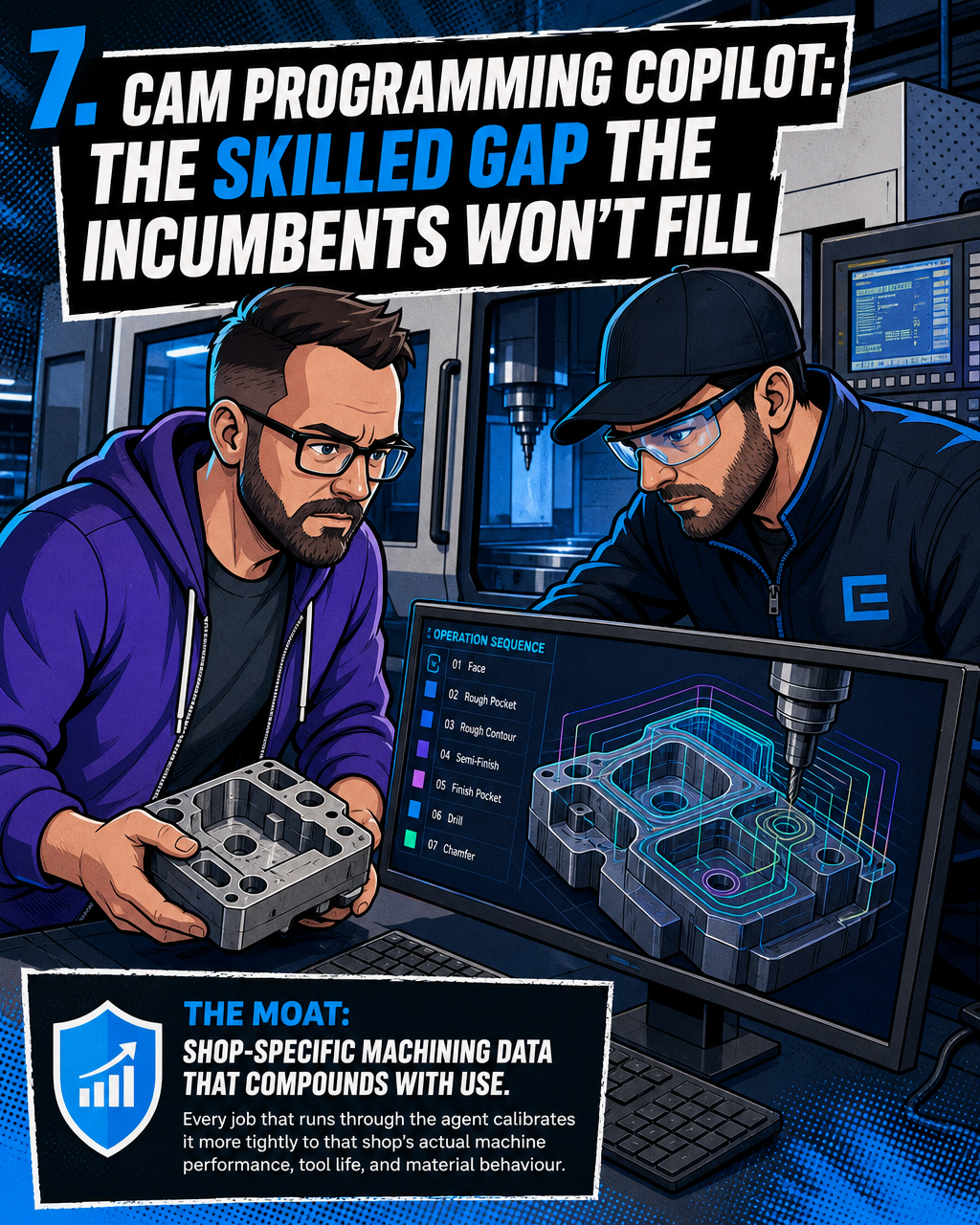
7. CAM Programming Copilot: The Skilled Gap the Incumbents Won't Fill
Going from a model and a blank to a reviewable machining setup is skilled, slow, tribal work. A programmer has to decide: what's the fixturing strategy? What's the operation sequence? Which tools from the crib? What feeds and speeds for this material on this machine with this tool condition? It takes experienced programmers hours or days on complex parts.
Reducing CNC programming time from days to hours is the core promise of AI-powered CAM tools, which aim to combine automation with human expertise to optimise toolpath generation and cutting conditions. Companies like CloudNC, Lambda Function, and Hexagon's ProPlanAI are making moves here. Hexagon claims ProPlanAI can cut programming time by up to 75% by leveraging historical machining data to improve toolpath and cutting condition recommendations — though as with all vendor-supplied figures, independent validation is limited.
So the space isn't empty. But the incumbents — Mastercam, Fusion 360 CAM, NX CAM — are bolting AI onto legacy interfaces designed for expert programmers. The UX is still oriented around someone who already knows what they're doing. A purpose-built, AI-native CAM programming agent designed for the mid-market shop, one that handles 80% of standard parts autonomously and surfaces only the genuinely ambiguous decisions for human review, doesn't exist as a clean product yet.
The opportunity isn't necessarily to beat the incumbents on complex five-axis aerospace work. It's to own the mid-market shop that's drowning in three-axis prismatic parts it can't programme fast enough.
The moat: shop-specific machining data that compounds with use. Every job that runs through the agent calibrates it more tightly to that shop's actual machine performance, tool life, and material behaviour.
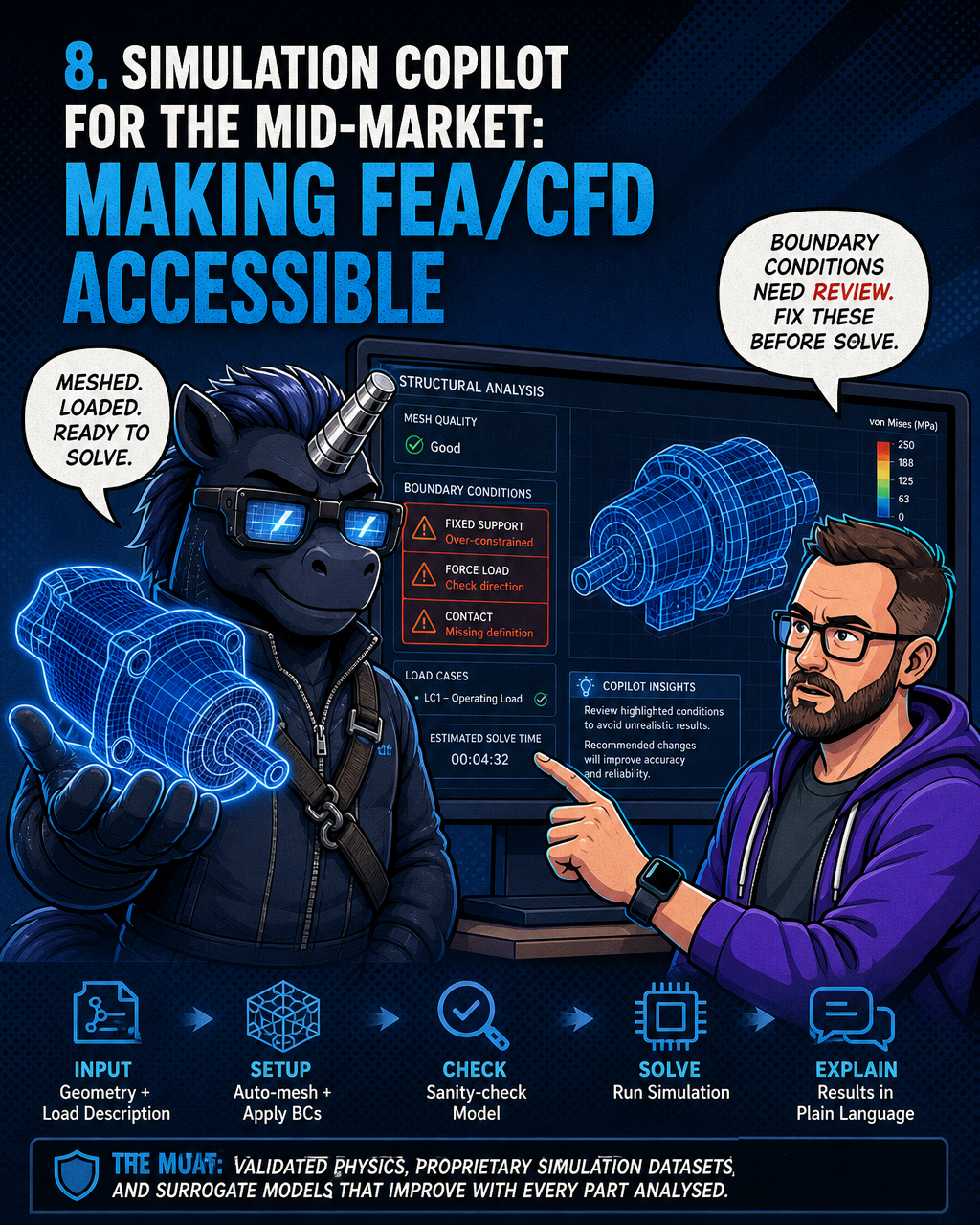
8. Simulation Copilot for the Mid-Market: Making FEA/CFD Accessible
FEA and CFD are gated behind expertise most mid-market manufacturers don't have and can't afford. Meshing a model correctly, setting boundary conditions that reflect the actual load case, understanding whether the results are physically plausible — these are skills that take years to develop and command salaries that most $20M-$100M manufacturers can't justify.
ANSYS, Siemens Simcenter, and Abaqus are priced and architected for engineering-heavy organisations with dedicated simulation teams. They're not unreasonable tools; they're just not built for a 50-person precision manufacturer whose design engineer needs a quick structural check before committing to tooling.
A simulation copilot that sets up standard analyses from geometry and load descriptions, sanity-checks meshing and boundary conditions, runs the solve, and explains the results in plain language could lower this barrier for the mid-market. Pair it with ML surrogate models — trained on validated FEA datasets — for approximate instant answers on common part families, and you have something that competes on speed and accessibility rather than raw solver fidelity.
This is the "incumbents priced for enterprise, mid-market underserved" play in a technically demanding category.
The moat: validated physics, proprietary simulation datasets, and surrogate models that improve with every part analysed. The simulation data accumulated over thousands of real customer analyses is not something a new entrant can replicate quickly.
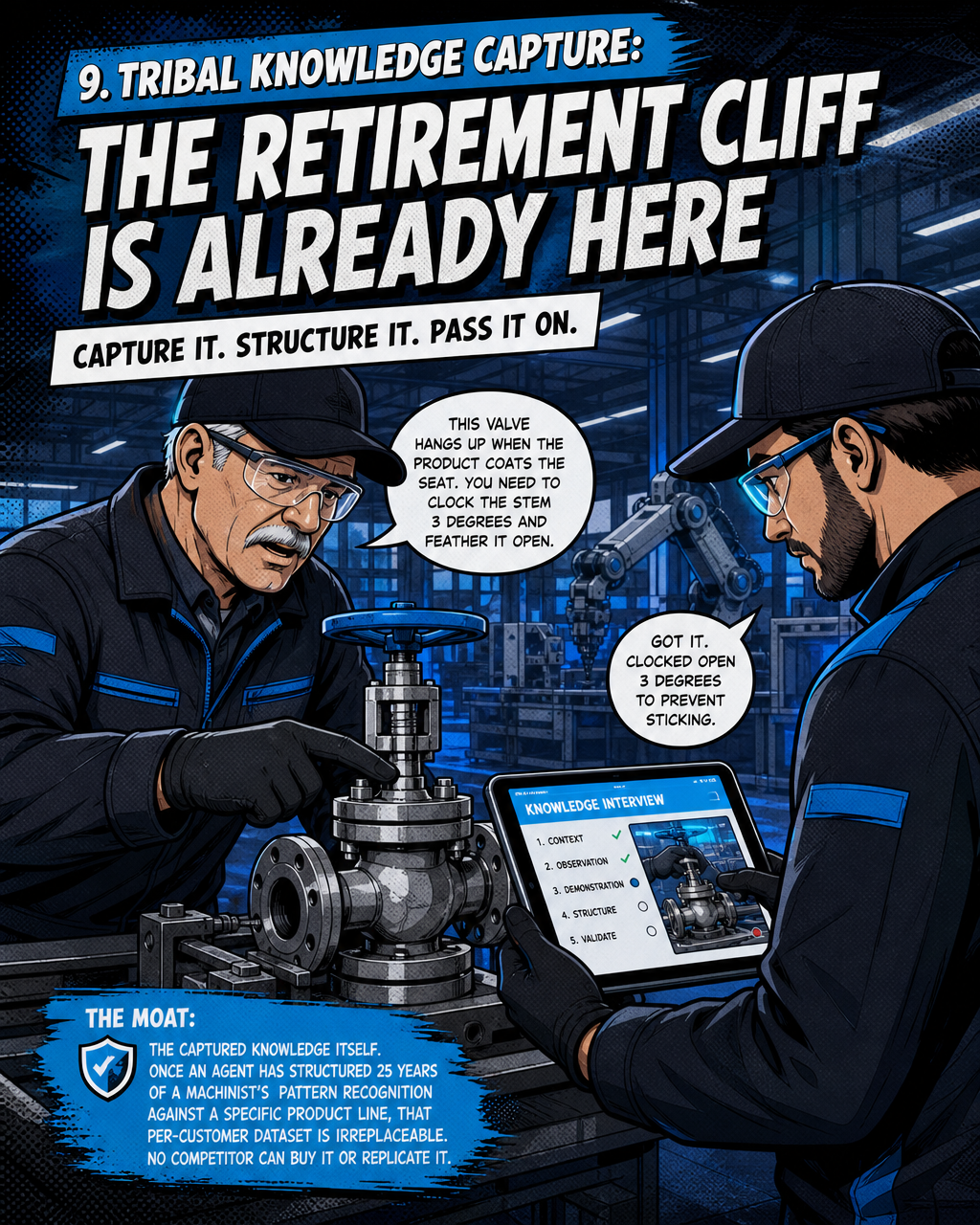
9. Tribal Knowledge Capture: The Retirement Cliff Is Already Here
This one is urgent in a way the others aren't.
BLS and Deloitte workforce data consistently show that manufacturing has an older age profile than most industries, with a significant share of workers approaching retirement age. Unlike voluntary attrition, retirement represents a permanent exit: that expertise isn't coming back. Earlier Deloitte and NAM projections estimated that millions of manufacturing workers would retire over the coming decade, though precise figures have been revised as labour market conditions have shifted — readers should consult current NAM or BLS workforce reports for the latest estimates.
The knowledge that walks out the door isn't in any SOP or CMMS. It's the hands-on, experience-based insight that doesn't exist in any manual — how to finesse a temperamental valve, work around a finicky raw material, or maintain throughput during a bottleneck. Industry observers widely note that human error contributes meaningfully to unplanned downtime, and that a substantial portion of operationally critical knowledge is never formally documented — though specific percentages vary across studies and should be treated as rough indicators rather than precise measurements.
An agent that proactively interviews senior engineers and machinists, observes their workflows (via video or structured interaction), structures the captured knowledge against specific parts and operations, and makes it queryable by the next generation of technicians is addressing a problem every manufacturer with an aging workforce is quietly working around.
Existing knowledge management platforms assume you're starting from text. This agent starts from people. It's a fundamentally different motion — closer to ethnography than documentation.
The moat: the captured knowledge itself. Once an agent has structured 25 years of a machinist's pattern recognition against a specific product line, that per-customer dataset is irreplaceable. No competitor can buy it or replicate it.
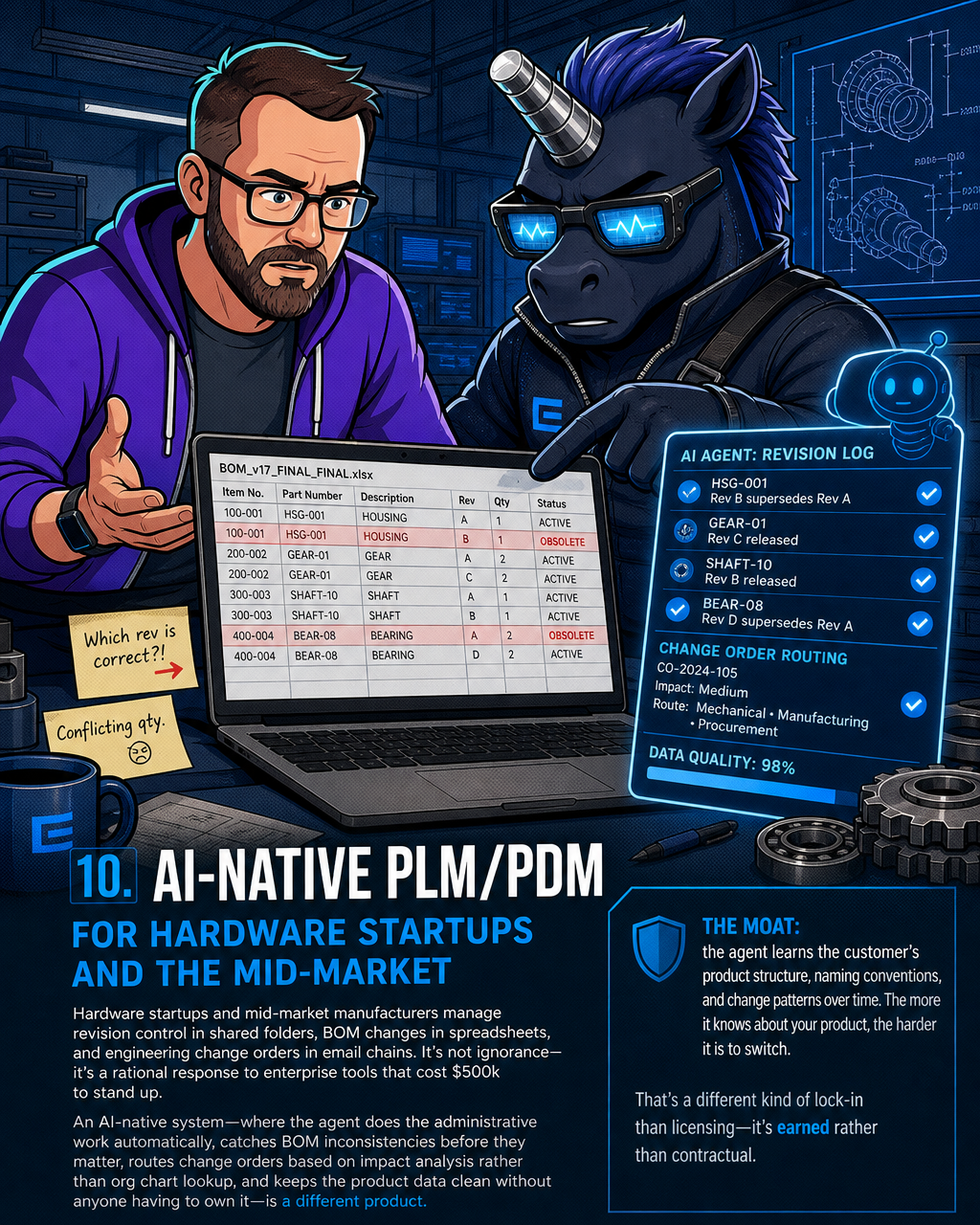
10. AI-Native PLM/PDM for Hardware Startups and the Mid-Market
Teamcenter starts at a price point and implementation complexity that assumes you have a dedicated PLM administrator, a system integrator on retainer, and six months before you need anything working. Windchill is similar. They're great products for the companies they were designed for. Those companies have a thousand engineers and a nine-figure IT budget.
Hardware startups and mid-market manufacturers manage revision control in shared folders, BOM changes in spreadsheets, and engineering change orders in email chains. It's not ignorance — it's a rational response to enterprise tools that cost $500k to stand up.
Arena and OpenBOM exist and are useful. But they're still fundamentally bolting a cleaner interface onto the same underlying paradigm: a human fills in the fields, maintains the structure, and drives the routing. An AI-native system — where the agent does the administrative work automatically, catches BOM inconsistencies before they matter, routes change orders based on impact analysis rather than org chart lookup, and keeps the product data clean without anyone having to own it — is a different product.
This challenge is particularly acute in high-mix, low-volume discrete manufacturing, where every job can be one of a kind, routing across dozens of work cells, with the real state of the operation living in human memory rather than in any system of record.
The mid-market and hardware startup segment is fragmented, underserved by enterprise tools, and increasingly capable of adopting SaaS-native products. That's the opening.
The moat: the agent learns the customer's product structure, naming conventions, and change patterns over time. The more it knows about your product, the harder it is to switch. That's a different kind of lock-in than licensing — it's earned rather than contractual.
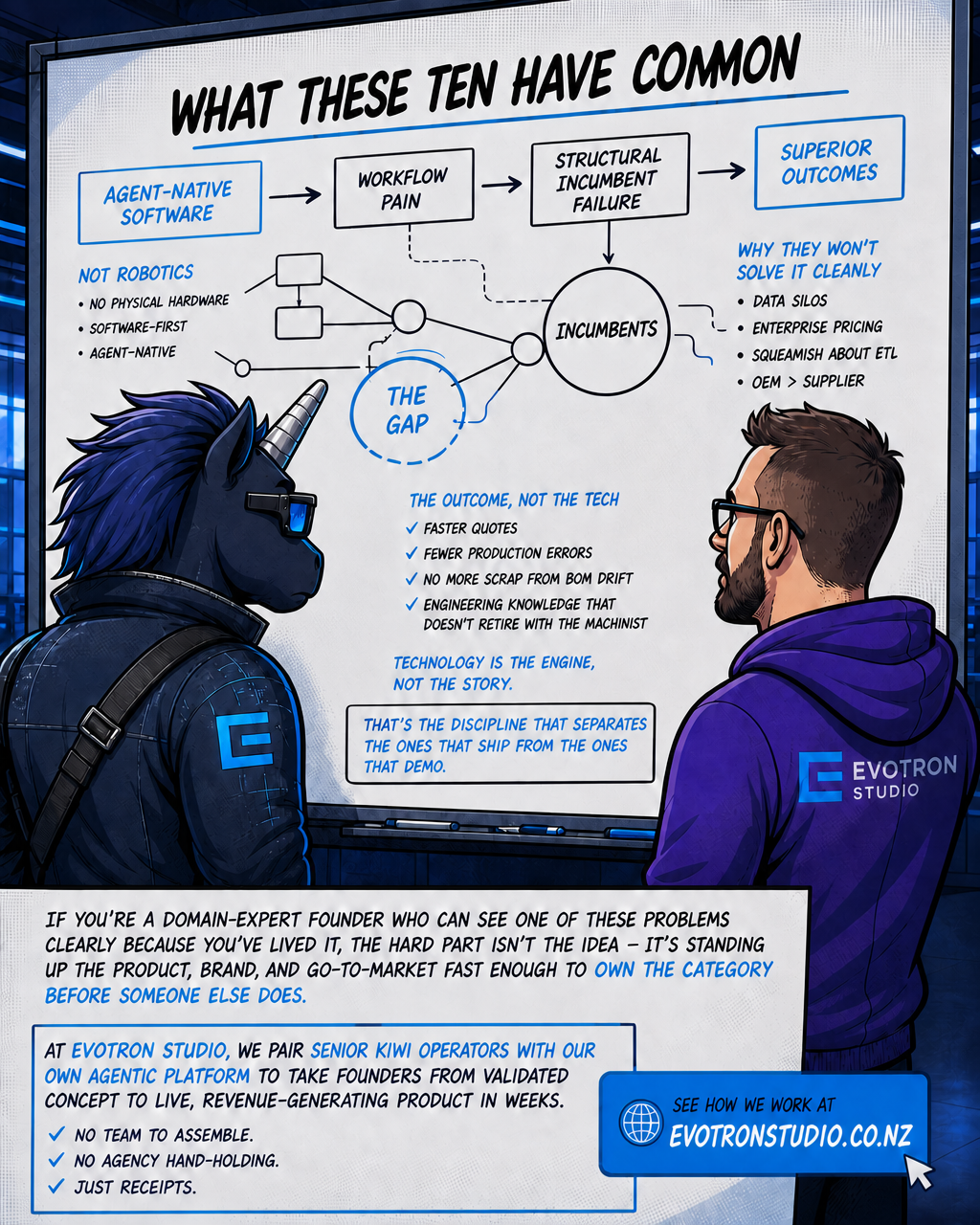
What These Ten Have in Common
None of these are robotics. None require physical hardware. They're all software, they're all agent-native rather than AI-bolted-on, and they all sit at the junction of a genuine workflow pain and a structural reason why the incumbents won't solve it cleanly.
The incumbents are either too invested in their own data silos to build neutral layers (PLM-MES-ERP reconciliation), too focused on enterprise pricing to serve the mid-market (PLM for SMBs, simulation), too squeamish about the unsexy ETL work (brownfield knowledge graphs), or structurally oriented toward the OEM rather than the supplier (quoting and DFM for job shops).
The best startups in this list won't pitch themselves as AI companies. They'll pitch the outcome: faster quotes, fewer production errors, no more scrap from BOM drift, engineering knowledge that doesn't retire with the machinist. The technology is the engine, not the story.
That's the discipline that separates the ones that ship from the ones that demo.
If you're a domain-expert founder who can see one of these problems clearly because you've lived it, the hard part isn't the idea — it's standing up the product, brand, and go-to-market fast enough to own the category before someone else does.
At Evotron Studio, we pair senior Kiwi operators with our own agentic platform to take founders from validated concept to live, revenue-generating product in weeks. No team to assemble. No agency hand-holding. Just receipts.

Evotron Studio
We build and run our own AI-amplified ventures — and bring the same capability into yours.
We build and run our own AI-amplified ventures — and bring the same capability into yours.
Learn more about Evotron Studio and get started today.
Visit Evotron Studio