Spec Driven Development for Corporate Innovation Labs


What is spec driven development, and why does your innovation lab need it now?
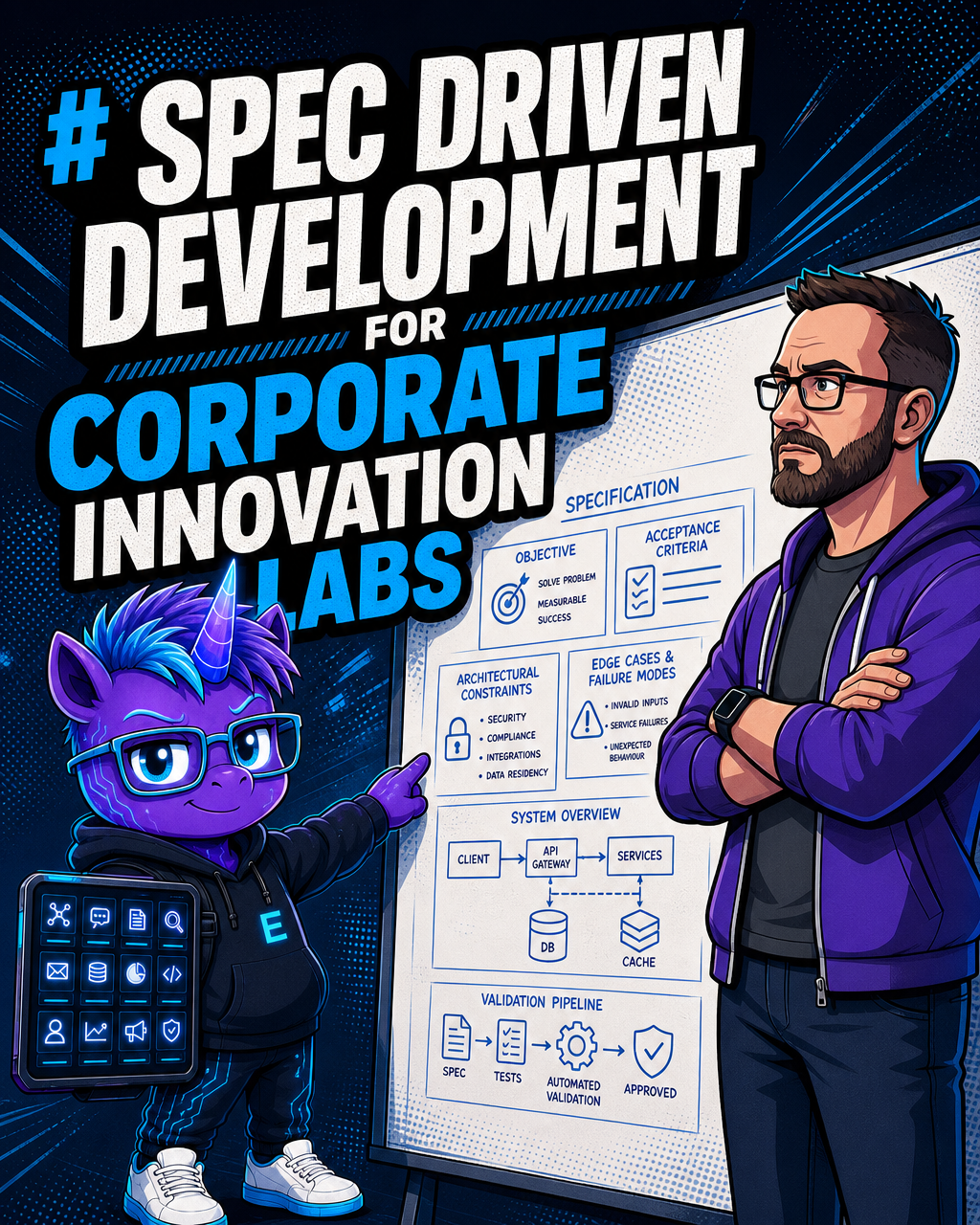
Most corporate innovation labs run fast. They're under pressure to produce a demo-ready prototype before the next board review, and the instinct is to start building immediately. Get a developer in the room, open a Figma file, start prompting an AI coding tool, and see what comes out.
The problem is that speed without structure produces the wrong thing faster. And in a corporate environment, building the wrong thing doesn't just waste sprint capacity. It creates rework, compliance exposure, and the kind of credibility damage that makes the next funding conversation harder.
Spec driven development (SDD) is a methodology that flips this sequence. It inverts the traditional relationship between intent and implementation. Instead of writing code and hoping the intent can be reconstructed from it later, SDD insists that intent is captured first, completely, unambiguously, and in a form that outlives any individual codebase.
That sounds simple. In practice, it changes almost everything about how innovation labs should run.
Start with the specification, not the prototype
Specification-driven development is an approach where specifications are authored before any code is written. This specification serves as the single source of truth, used across developers, testers, and stakeholders throughout the project lifecycle. SDD ensures engineering efforts are grounded in structured intent, not guesswork.
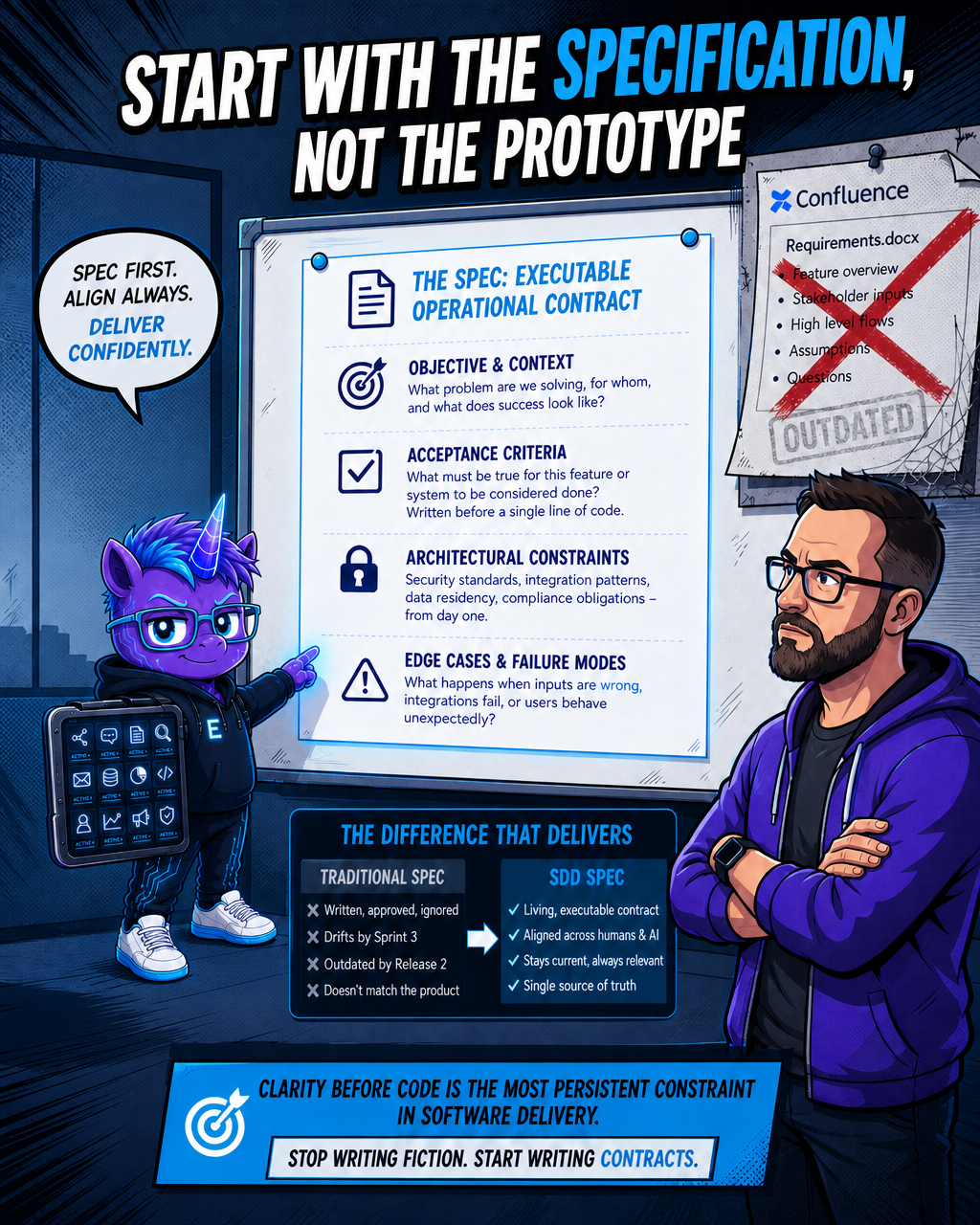
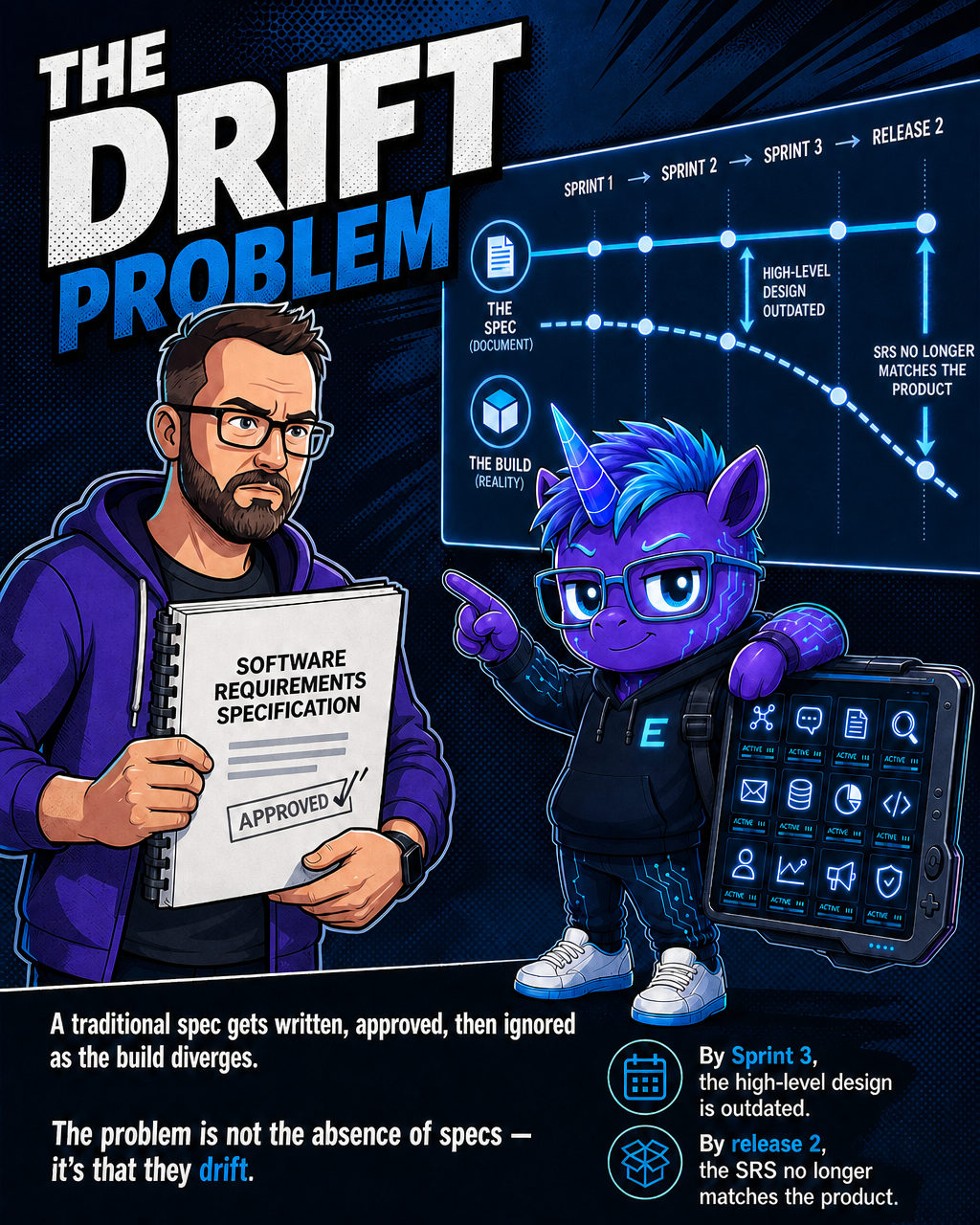
This is different from writing a requirements document and filing it on Confluence. A traditional spec document gets written, approved, and then ignored as the build diverges. The problem is not the absence of specs — it's that they drift. By Sprint 3, the high-level design is outdated. By release 2, the software requirements specification no longer matches the product.
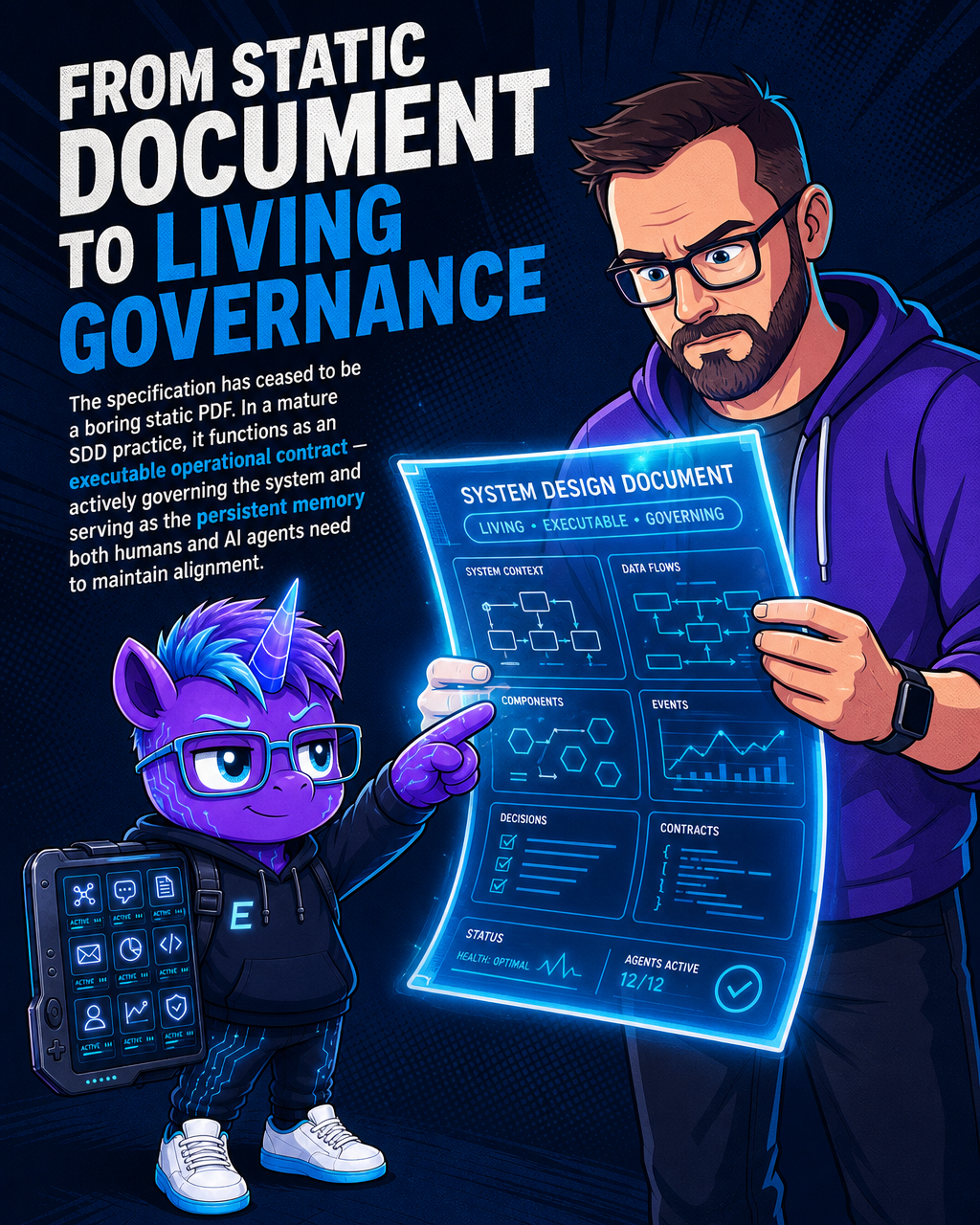
SDD treats the spec differently. The specification has ceased to be a boring static PDF document or a forgotten page on Confluence. In a mature SDD practice, the specification can function as an executable operational contract. It does not merely describe the system passively; it actively governs it, serving as the persistent memory and shared context that both humans and AI agents need to maintain alignment.
For a corporate innovation lab, this distinction matters. You're not writing fiction for a board slide. You're writing a contract between what the business wants, what the engineers will build, and what the validation pipeline will check.
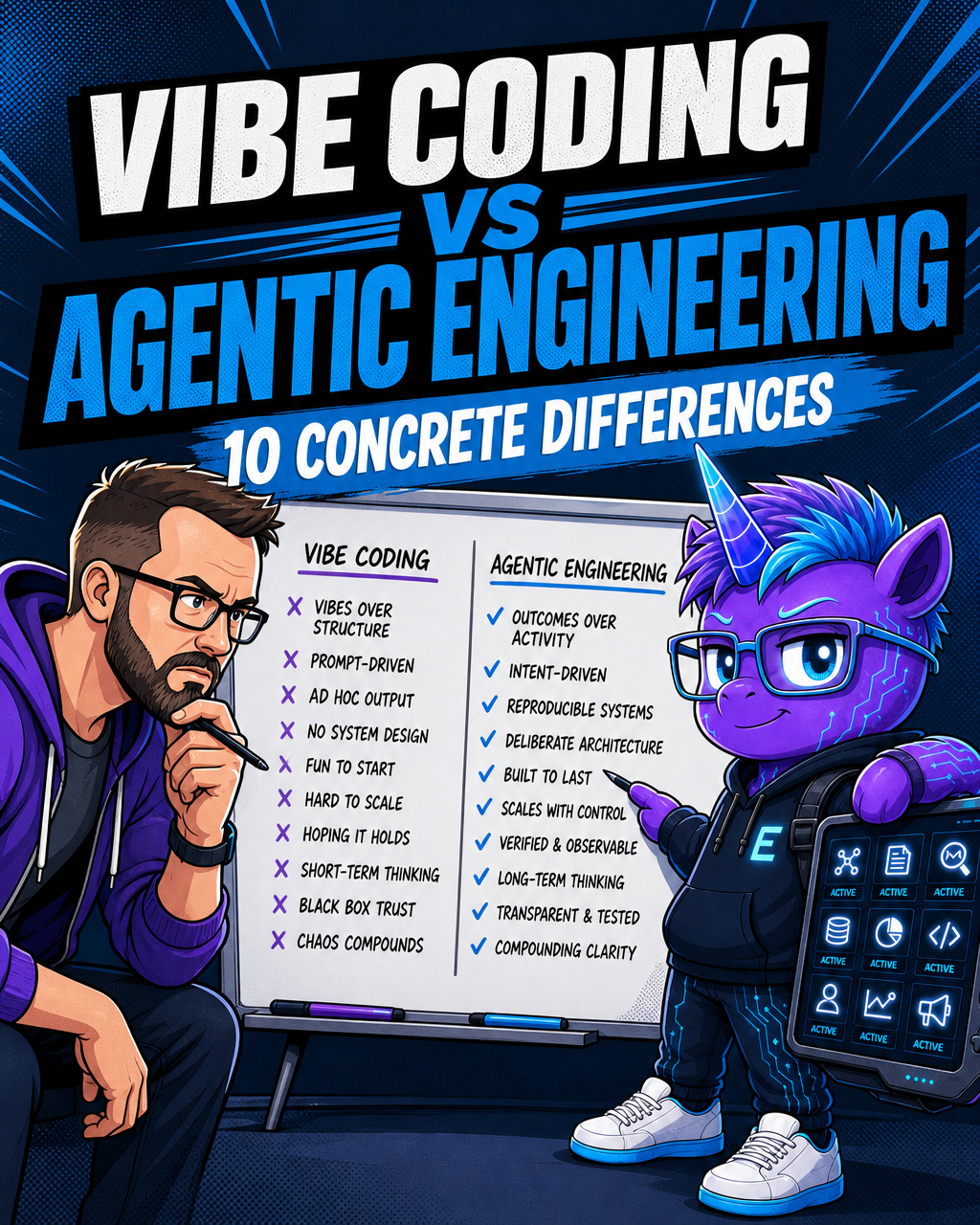
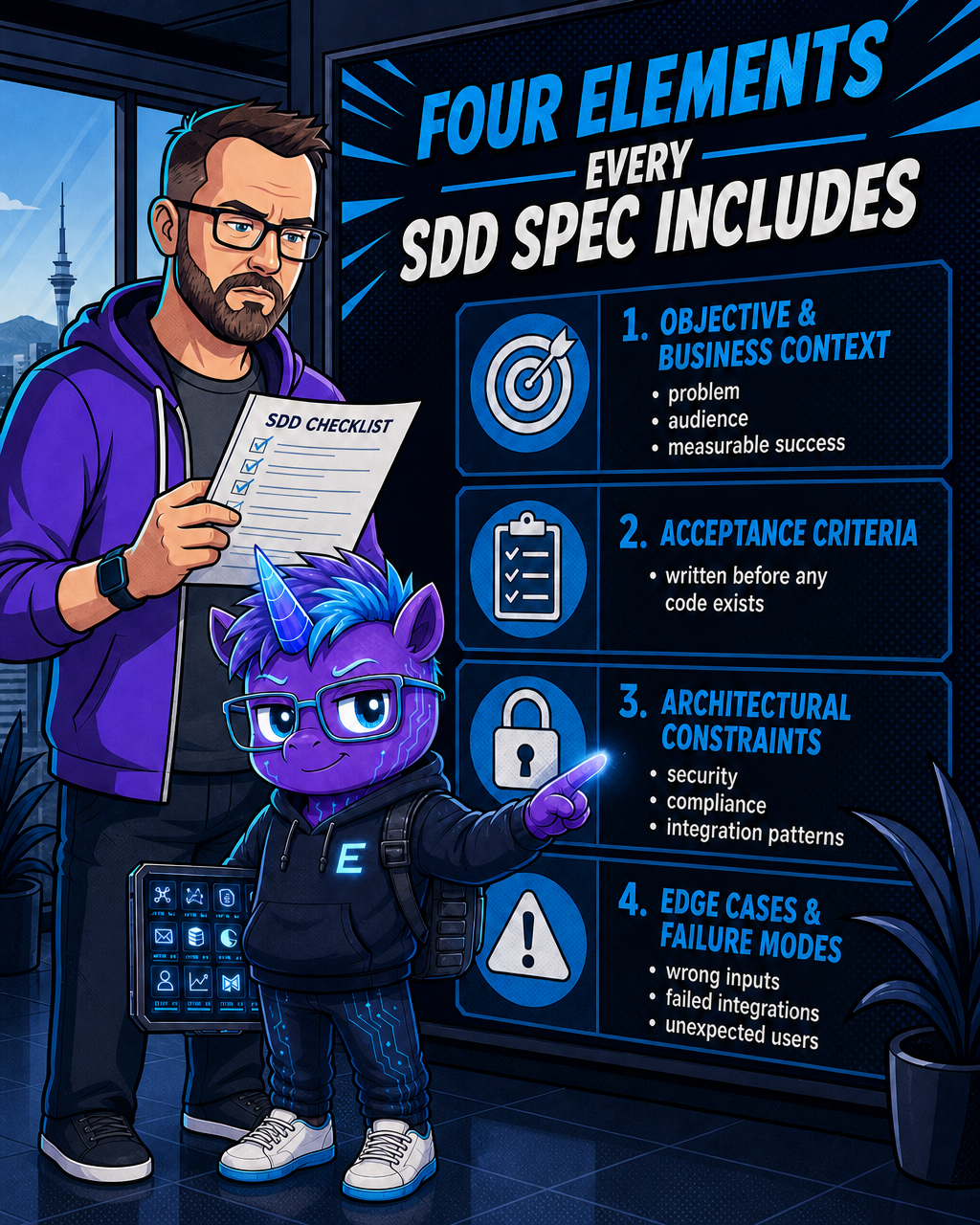
Practically, this means the spec document covers:
- The objective and business context. What problem are we solving, and for whom? What does success look like in measurable terms?
- Acceptance criteria. What must be true for this feature or system to be considered done? These are written before a single line of code exists.
- Architectural constraints. What security standards, integration patterns, data residency requirements, or compliance obligations apply from day one?
- Edge cases and failure modes. What happens when inputs are wrong, integrations fail, or users behave unexpectedly?
One of the most persistent constraints in software delivery is the clarity of what gets built before a single line is written, and specifically the quality of the specification layer.
Your lab probably already suspects this. The demos that fell apart before the board presentation didn't fail because the engineers were slow. They failed because nobody agreed on what the thing was supposed to do until it was already built.
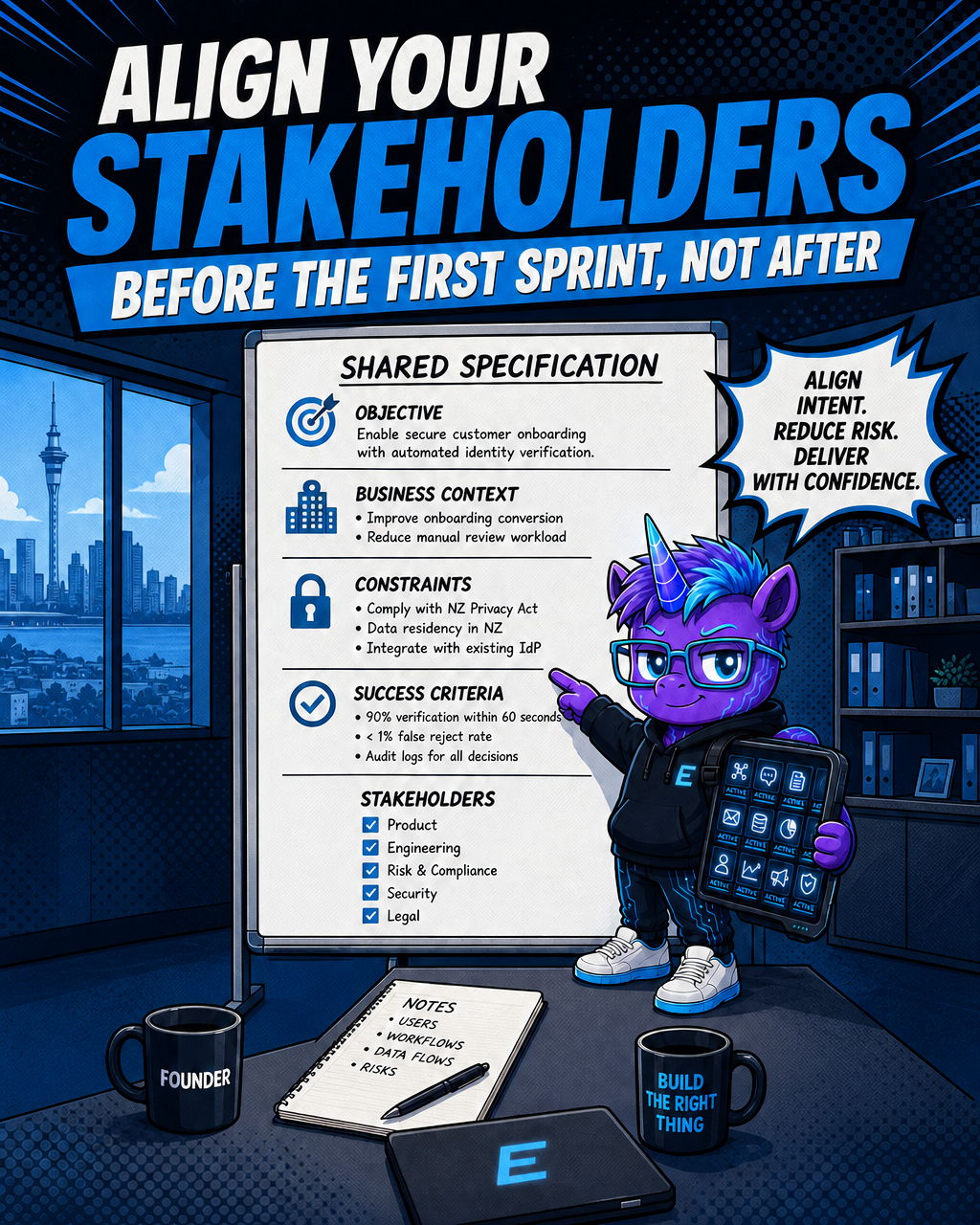
Align your stakeholders before the first sprint, not after
The most expensive misalignment in corporate innovation isn't the one you catch in production. It's the one you catch at week eight when the head of risk sees the prototype for the first time and asks a question nobody considered.
Spec-driven development shifts AI-augmented software delivery from tactical prompting to collaborative intent articulation. Enterprises face gaps in tooling, workflow integration, multi-repo coordination, and cross-functional collaboration.
The spec authoring process is where that collaboration actually happens. Writing a precise specification forces the business stakeholder, the product owner, and the architect into the same conversation early, about the same document, with the same facts in front of them.
The starting point is not writing technical instructions, but establishing the objective, business context, constraints, and success criteria. This defines the intent, prioritizes needs, and sets system boundaries.
In a corporate innovation context, this means your legal, compliance, and security colleagues can review the specification before anything is built. They're not being asked to audit a running system for problems. They're being asked to contribute to a document. That's a much easier conversation.
A shared spec ensures everyone — from product to development — understands the scope and objectives, reducing miscommunication. Documenting requirements upfront reveals misunderstandings or technical gaps before they become costly issues.
For Corporate Innovation Chris, this is the practical payoff. The six-week delivery pressure doesn't disappear, but the risk of a late-stage pivot drops when engineering, product, and business have signed off on the same document at the start. The board demo is more credible because the spec that governs the build was agreed by the people who'll be in that room.
The spec as single source of truth for governance and onboarding
Corporate environments have governance obligations that startup labs don't. There's a risk committee. There's an audit function. There are vendor management requirements, data handling policies, and occasionally a regulator who wants to understand how decisions were made.
Spec-anchored development adds governance layers, constitutional constraints, and supervision checkpoints. This pattern is appropriate when regulatory requirements demand audit trails, multiple teams coordinate across services, or AI-generated code needs human approval before merging.
A well-structured specification document becomes the evidence layer for all of this. Compliance professionals generally find that retrofitted audit trails — assembled after an auditor asks — are harder to defend than evidence built from day one.
Spec driven development bakes this evidence in from the start. The specification records why architectural decisions were made, what constraints were applied, what the acceptance criteria were, and who approved what at which point. That's not bureaucracy. That's the difference between a three-hour audit and a three-week one.
Onboarding is the same story. When a new developer joins the project at month three, or when the lab hands the prototype to a production engineering team, the specification is the document that makes that transition possible without a month of knowledge transfer. One of the best summaries for SDD is: "Version control for your thinking." Instead of huge specs that are stale and buried in a knowledge repository somewhere, SDD looks to make them a first-class citizen within the development lifecycle. Architectural decisions, business logic, and intent can be captured and versioned as a product evolves.
The spec doesn't just tell new contributors what the system does. It tells them why it does it that way, and what would break if they changed it.
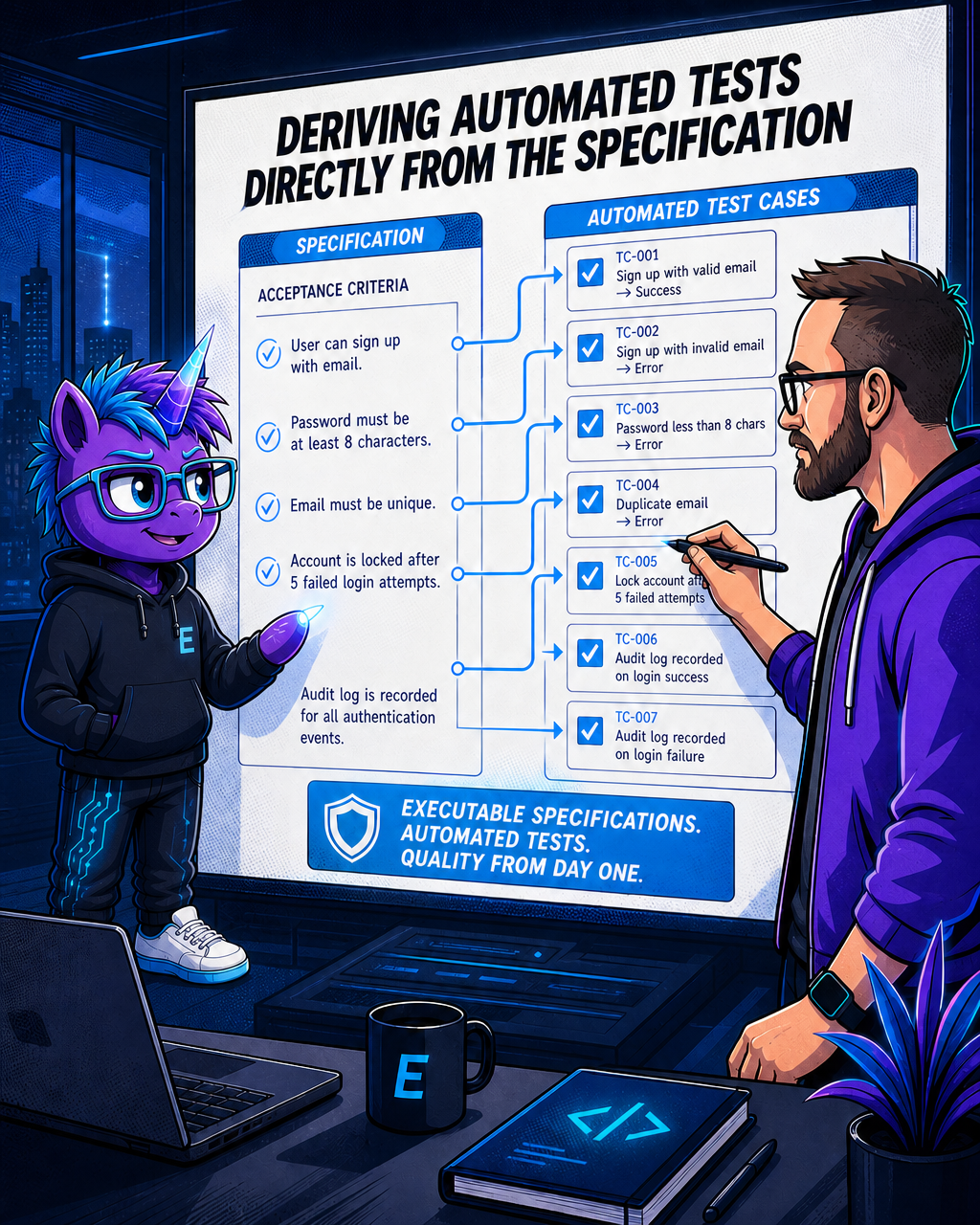
Deriving automated tests directly from the specification
One of the most practical advantages of spec driven development for innovation labs is what it does to your test coverage.
In a typical lab build, tests are written after the fact, by the same engineers who wrote the code, to verify the behaviour they intended. That's not testing. That's confirmation bias with a green tick.
The core distinction SDD proponents draw is that traditional specs are read by humans, while SDD specs can execute as validation gates.
Executable specifications become automated tests, ensuring quality from day one. Because the acceptance criteria were defined in the spec before the build started, test cases can be derived directly from those criteria. The tests verify that the implementation matches the original intent, not that the implementation does what it happens to do.
Unit tests verify individual functions; they don't catch architectural violations, API contract drift, or security anti-patterns that emerge across service boundaries. SDD specifications operate at the system level, catching defect classes unit tests structurally cannot.
For compliance-sensitive builds, this matters. A test suite derived from the specification is auditable evidence that the system was built to the agreed standard. If the behaviour changed after approval, the test pipeline catches it. If the test pipeline passes, you have traceable proof that the system does what the specification said it should.
By requiring verification before executing any plan in production, and automatically auditing the results post-implementation, an entire category of business errors is completely eliminated: those that are not strictly technical programming errors, but conceptual misalignments between the business purpose and the technical execution.
This is the kind of assurance that lets you present a prototype to a risk committee with confidence. Not "we think this is right" but "the automated validation pipeline runs against the agreed specification on every build."
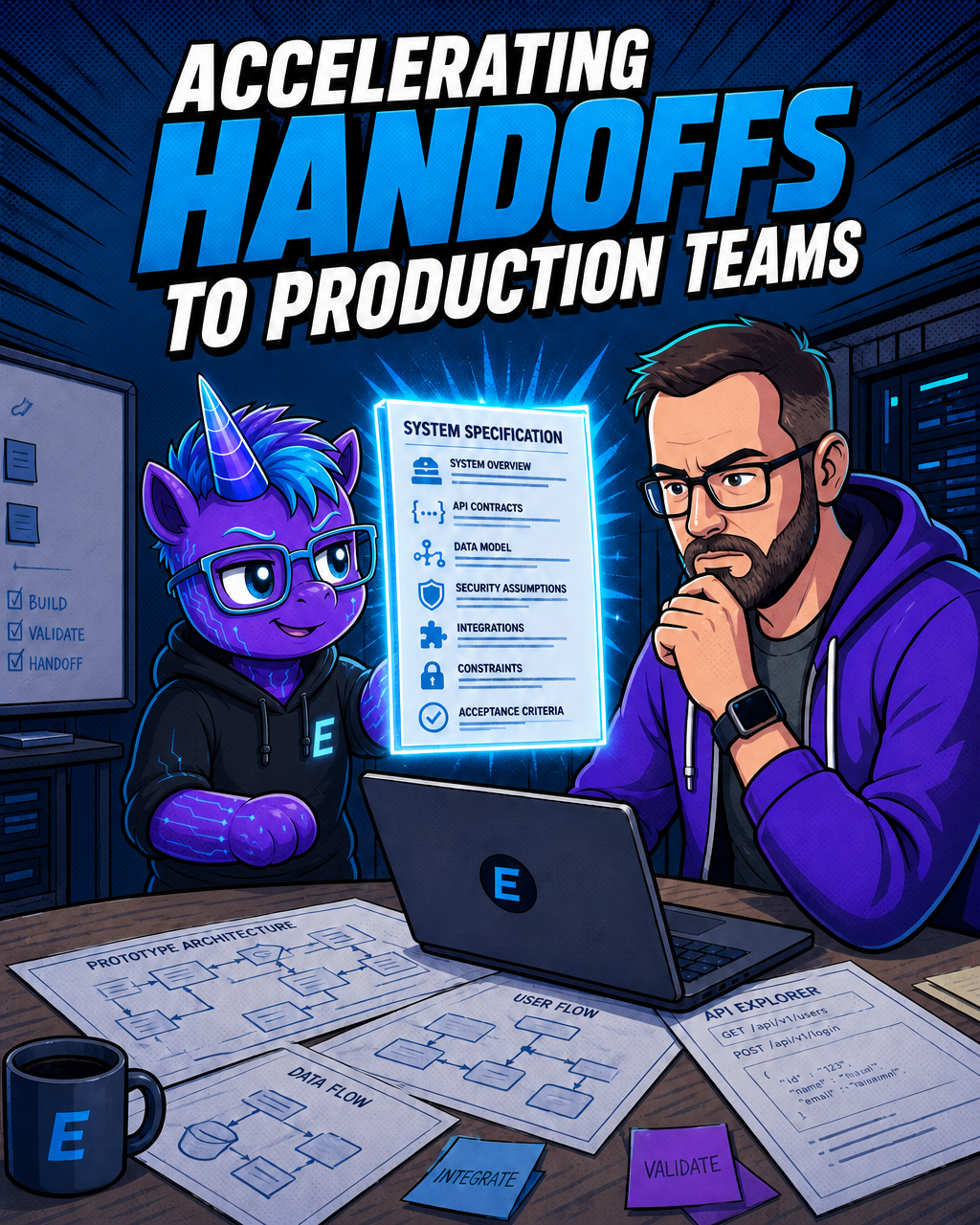
Accelerating handoffs to production teams
The hardest moment in most corporate innovation projects isn't building the prototype. It's handing it over.
A production engineering team looks at a lab prototype and sees a lot of things they need to know before they can take responsibility for it. How does it integrate with existing systems? What are the API contracts? What were the security assumptions? What does the data model look like, and why?
Without a specification, the answers to those questions are locked in the heads of the people who built it. The handoff becomes a multi-week knowledge extraction exercise, and something important always gets lost.
With a well-maintained spec, the handoff is a document review. Platform and product teams building shared services or internal tooling require clear contracts, versioning discipline, and predictable integrations across squads. The specification provides exactly that: a machine-readable contract that describes the system's behaviour, interfaces, constraints, and acceptance criteria in a form that both humans and downstream tools can consume.
Spec-as-source is well-established in some domains, such as generating API server stubs from OpenAPI specifications. The production team doesn't have to reverse-engineer the prototype to understand what it's supposed to do. They can read the spec, run the validation pipeline, and make informed decisions about what to adopt, what to rebuild, and what to change.
Teams that invest in upfront specification tend to report faster handoffs — the receiving team has a precise document to work from and doesn't spend cycles reconstructing intent. They spend them on execution.
A practical note on getting started
Spec driven development doesn't require a six-month transformation programme. It requires discipline at the start of each project.
Many practitioners argue that "vibe coding" approaches work reasonably well for early prototypes but create significant risk when applied to production systems. AI-assisted development dramatically raises the cost of ambiguity — unclear intent doesn't just slow things down, it actively creates risk. Without structured specifications, you risk what enterprises call "automating the creation of legacy mess."
That said, SDD is not without real costs. Specification authoring takes time and requires skilled practitioners who can capture intent precisely. In genuinely exploratory research phases, highly detailed upfront specs can constrain discovery. And maintaining living specs as a first-class artefact requires ongoing team discipline that is harder to sustain than it sounds. SDD works best when the problem space is well enough understood to specify, and when the team has the commitment to keep the spec aligned with the build.
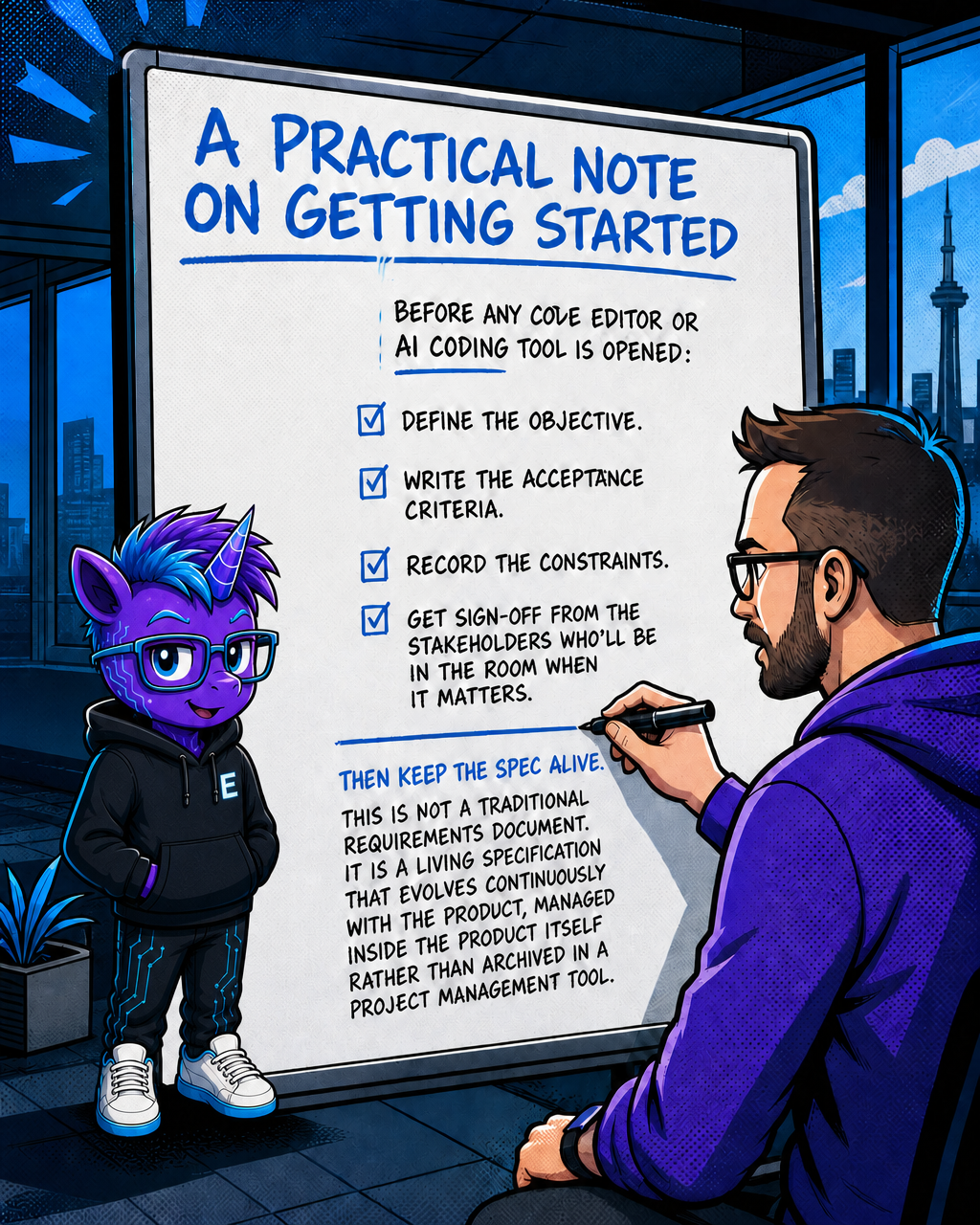
Start with the next project that meets that bar. Before anyone opens a code editor or fires up an AI coding tool, write the specification. Define the objective. Write the acceptance criteria. Record the constraints. Get sign-off from the stakeholders who'll be in the room when it matters.
Then keep the spec alive. This is not a traditional requirements document. It is a living specification that evolves continuously with the product, managed inside the product itself rather than archived in a project management tool.
The investment is real but manageable. The payoff at week eight, when you're presenting to a board that asks hard questions, can be meaningful.
The bottom line
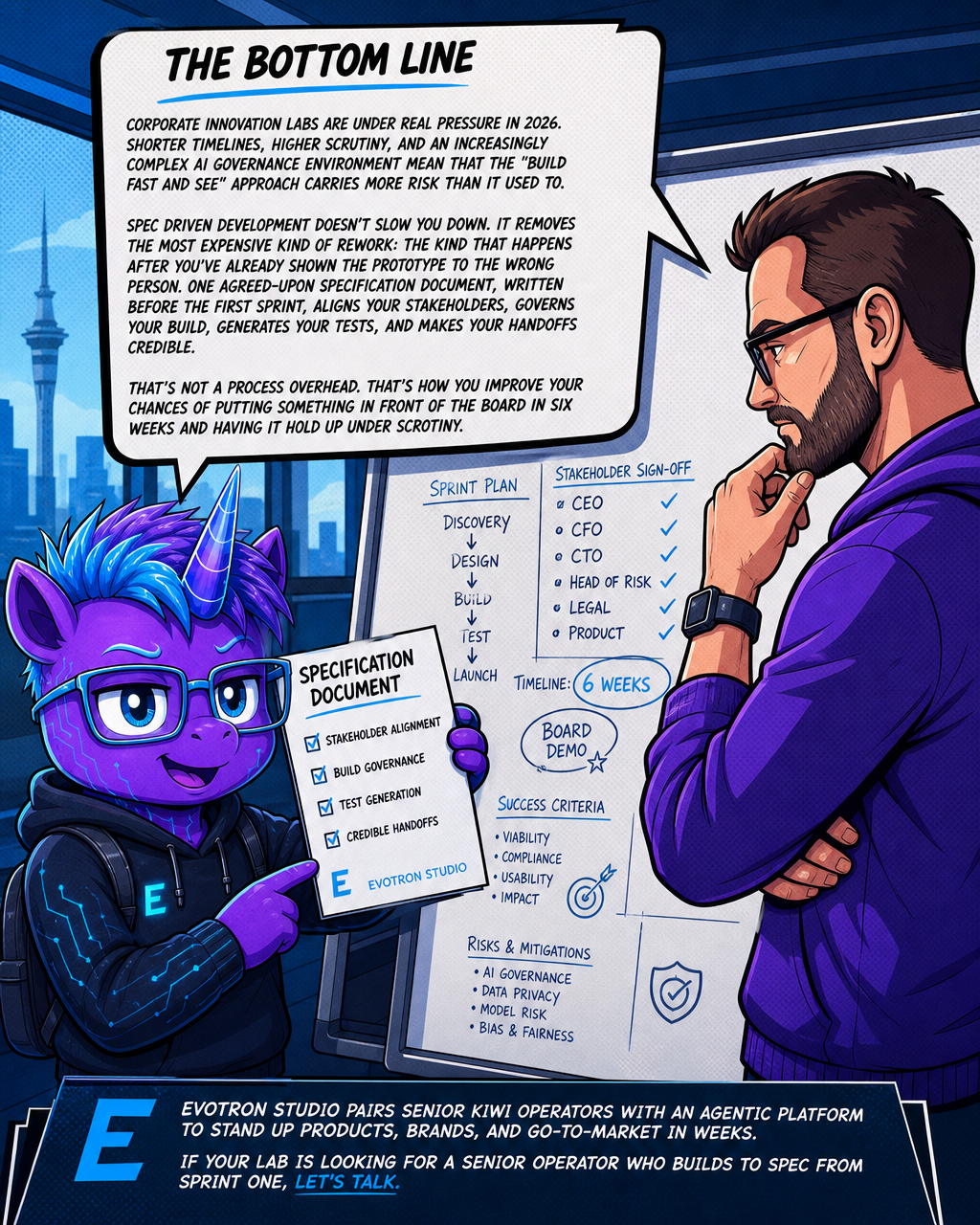
Corporate innovation labs are under real pressure in 2026. Shorter timelines, higher scrutiny, and an increasingly complex AI governance environment mean that the "build fast and see" approach carries more risk than it used to.
Spec driven development doesn't slow you down. It removes the most expensive kind of rework: the kind that happens after you've already shown the prototype to the wrong person. One agreed-upon specification document, written before the first sprint, aligns your stakeholders, governs your build, generates your tests, and makes your handoffs credible.
That's not a process overhead. That's how you improve your chances of putting something in front of the board in six weeks and having it hold up under scrutiny.
Evotron Studio pairs senior Kiwi operators with an agentic platform to stand up products, brands, and go-to-market in weeks. If your lab is looking for a senior operator who builds to spec from sprint one, let's talk.
Related reading

Evotron Studio
We build and run our own AI-amplified ventures — and bring the same capability into yours.
We build and run our own AI-amplified ventures — and bring the same capability into yours.
Learn more about Evotron Studio and get started today.
Visit Evotron Studio