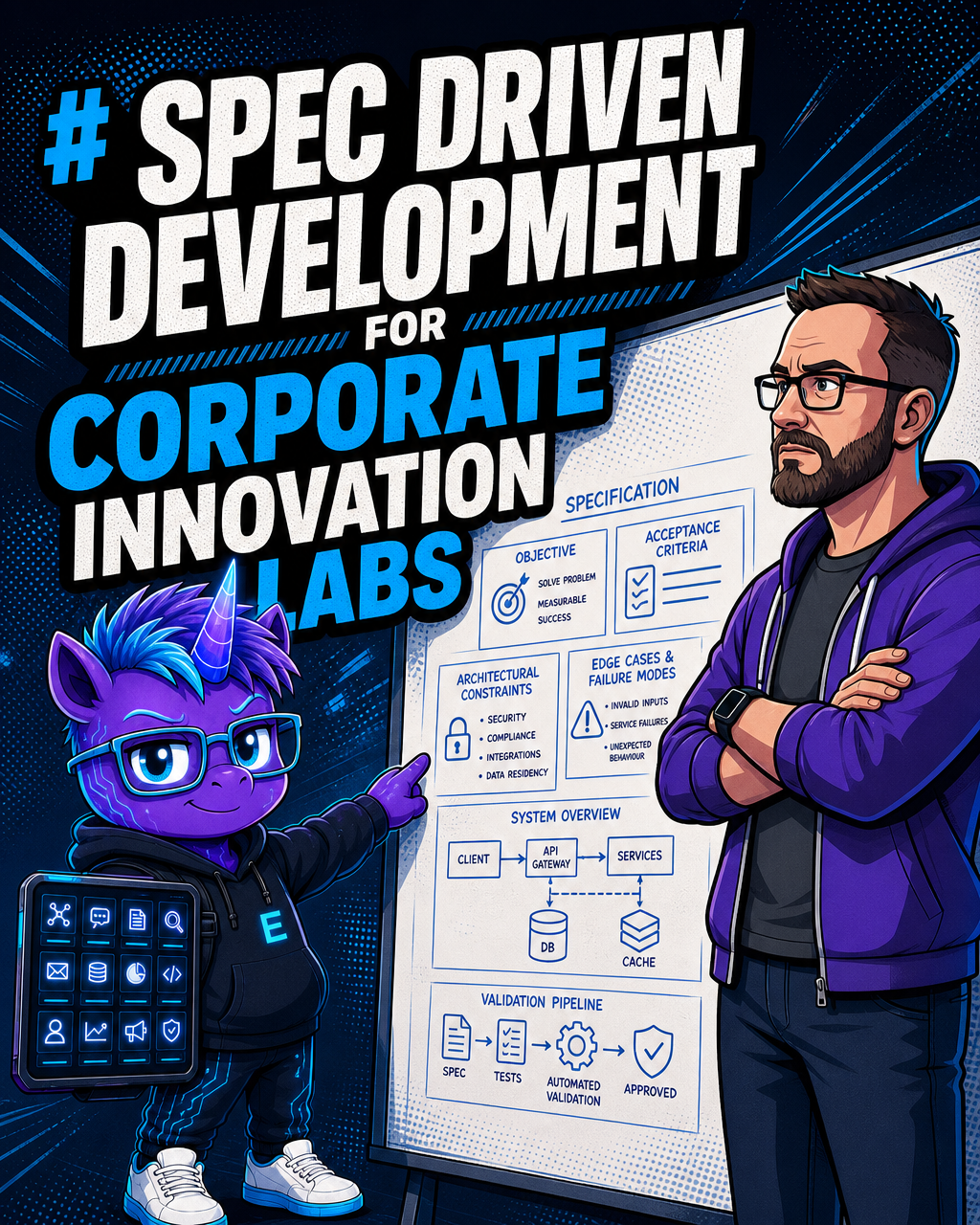
From Validated Idea to Live Company: What the First 8 Weeks Look Like

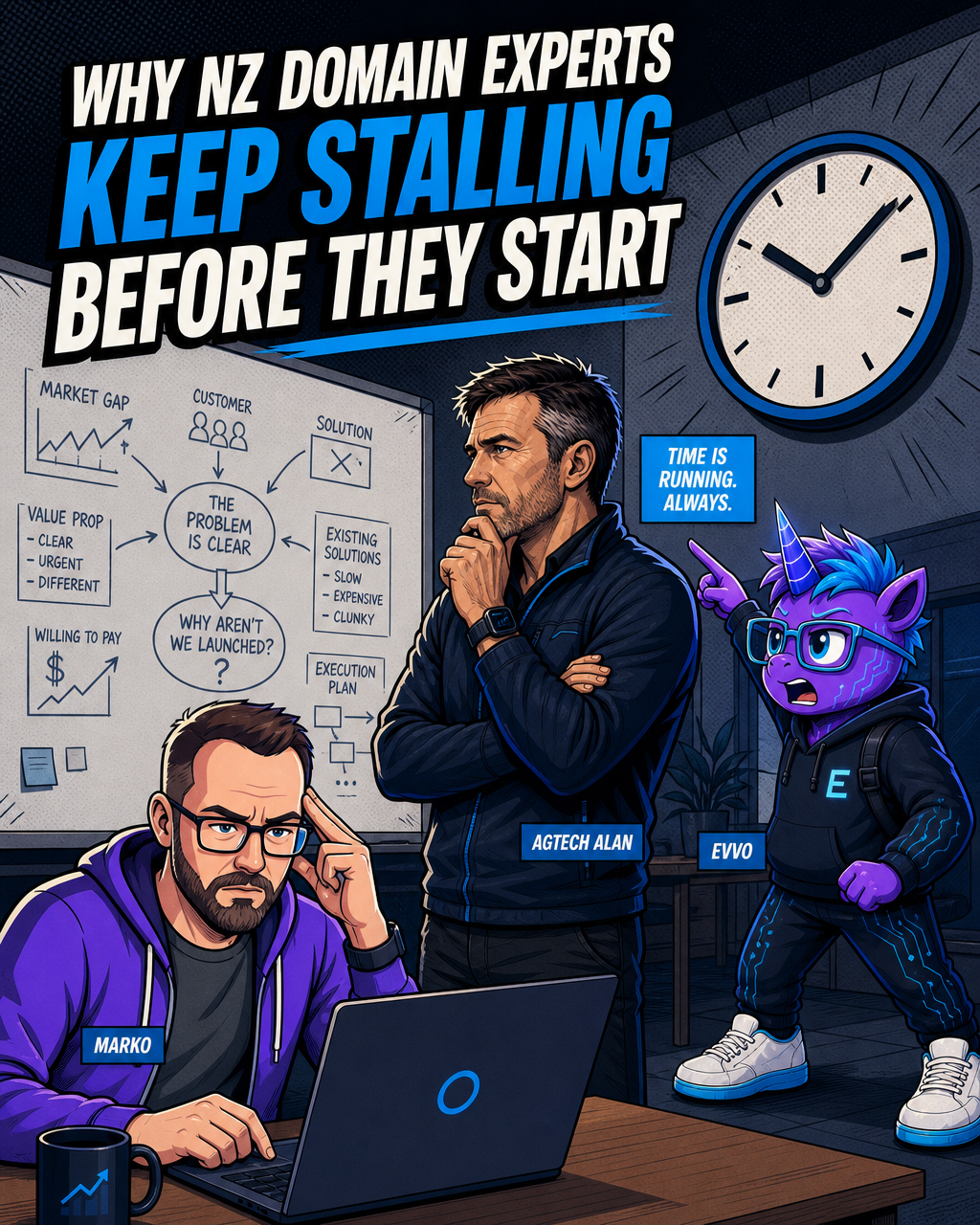
Most NZ founders with a real idea spend the first six months doing everything except building. They interview freelancers who go quiet after week two. They book calls with agencies that quote $150k and a nine-month timeline. They join an accelerator and get mentorship without a product. Then they look up and their first-mover window is closing.
This post explains exactly what happens when you work with Evotron Studio. Week by week. No vague phases, no indefinite discovery, no hand-wavy timelines. Just the work.
Week 1: The Diagnostic
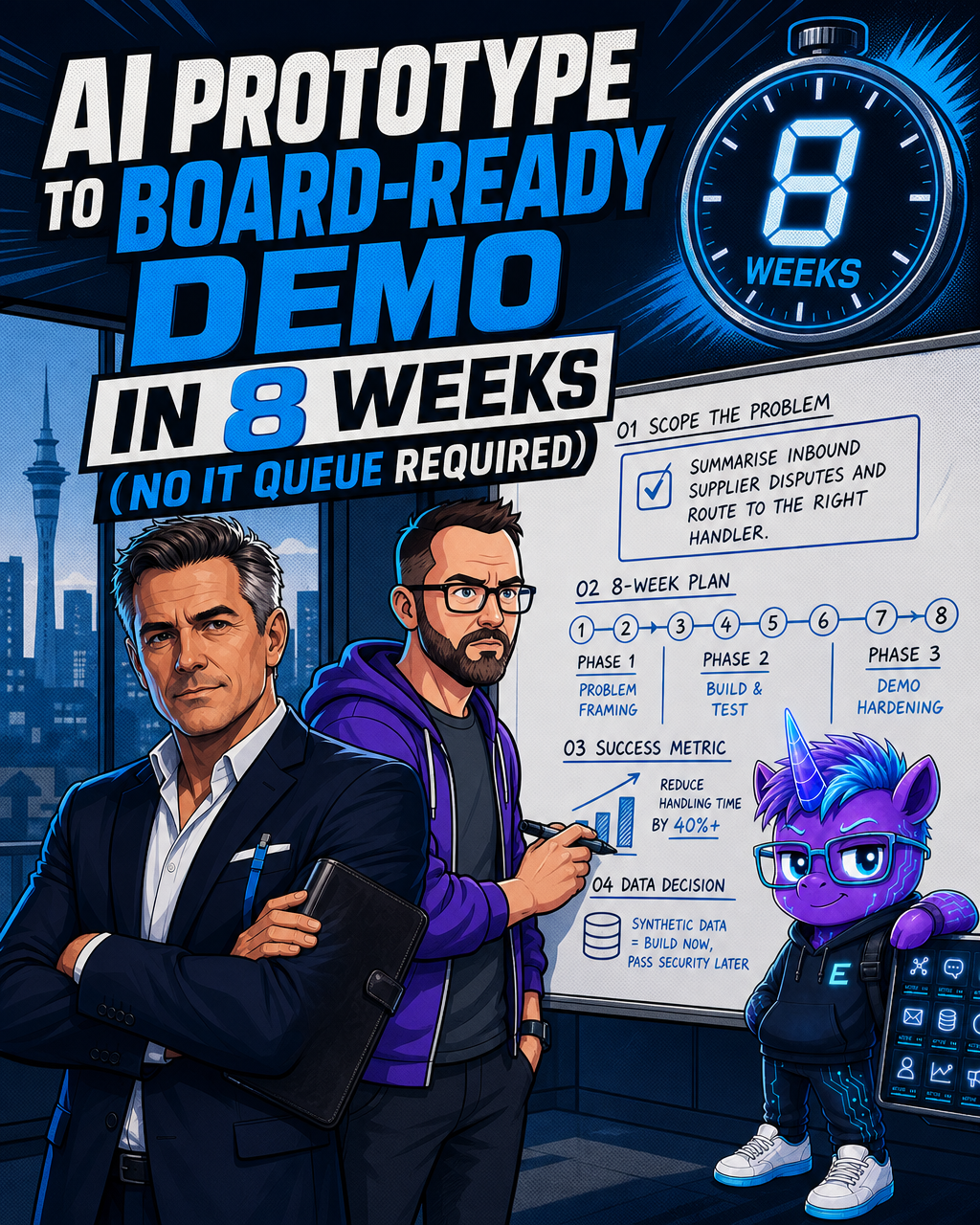
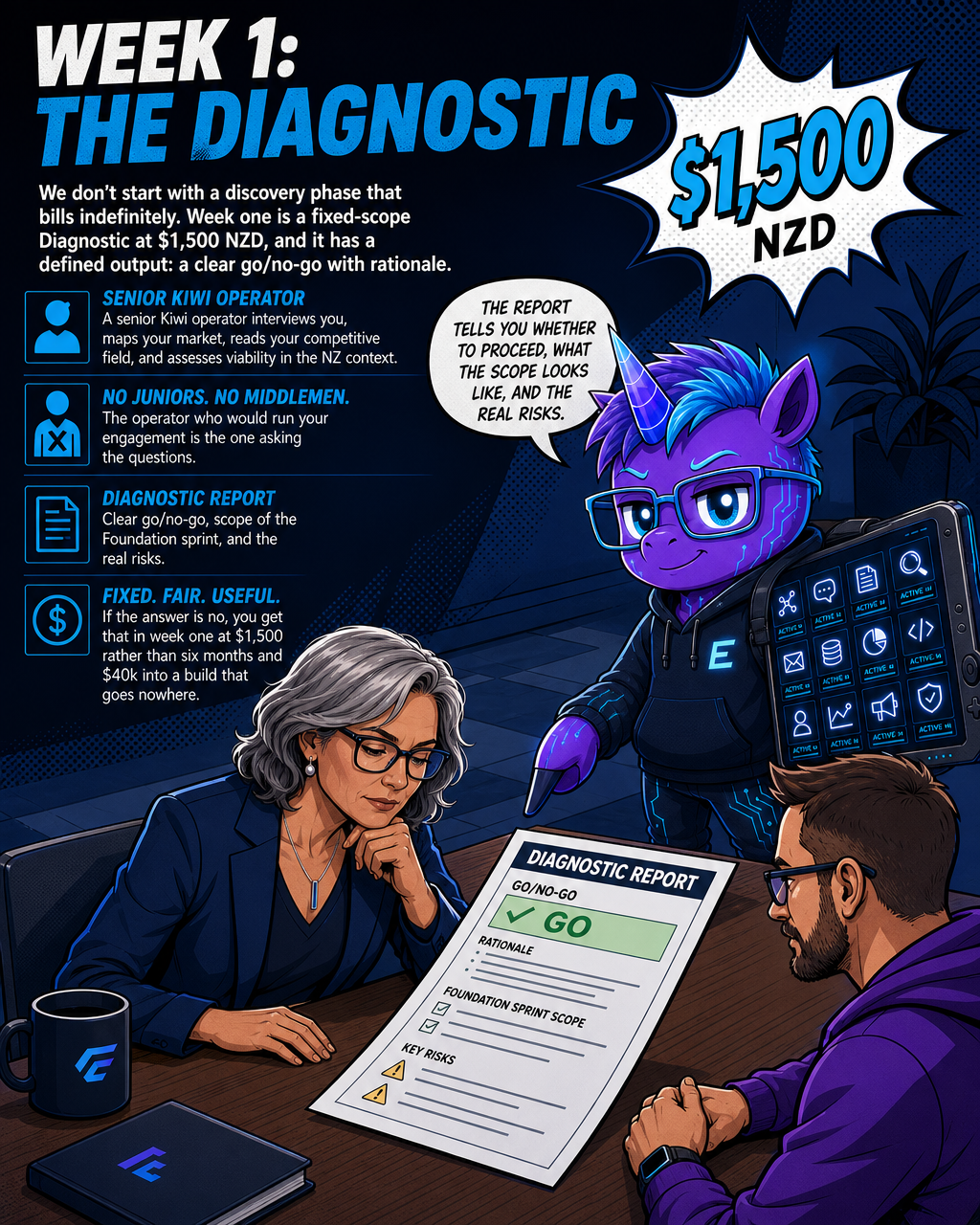
We don't start with a discovery phase that bills indefinitely. Week one is a fixed-scope Diagnostic at $1,500 NZD, and it has a defined output: a clear go/no-go with rationale.
Here's what actually happens. A senior Kiwi operator interviews you, maps your market, reads your competitive field, and assesses whether your concept has a viable path to revenue in the NZ context. No junior analyst. No account manager relaying notes. The operator who would run your engagement is the one asking the questions.
The output is a Diagnostic Report. It tells you whether to proceed, what the scope of the Foundation sprint would look like, and what the real risks are. If the answer is no, you get that in week one at $1,500 rather than six months and $40k into a build that goes nowhere.
Weeks 2–4: The Foundation Sprint
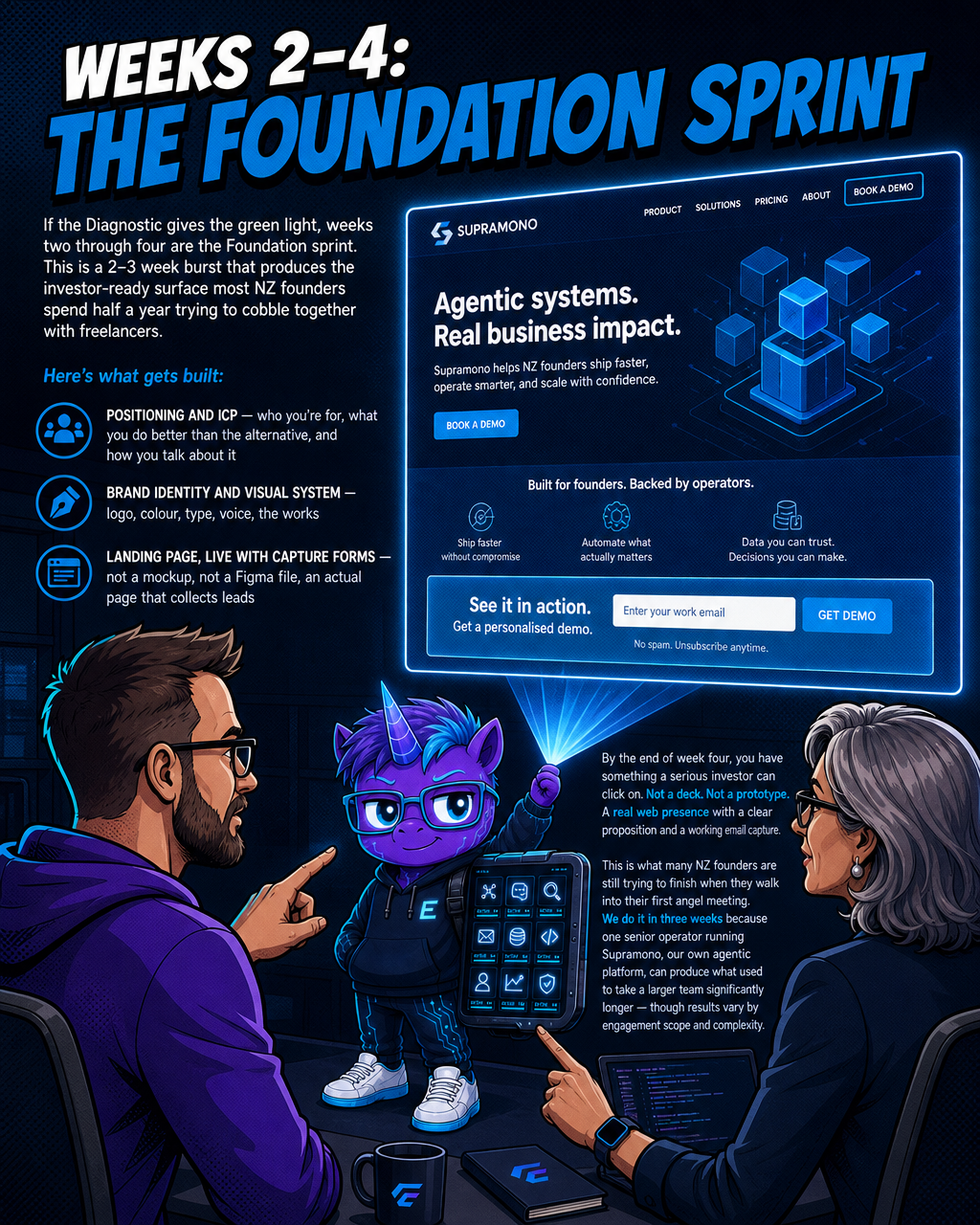
If the Diagnostic gives the green light, weeks two through four are the Foundation sprint. This is a 2–3 week burst that produces the investor-ready surface most NZ founders spend half a year trying to cobble together with freelancers.
Here's what gets built:
- Positioning and ICP — who you're for, what you do better than the alternative, and how you talk about it
- Brand identity and visual system — logo, colour, type, voice, the works
- Landing page, live with capture forms — not a mockup, not a Figma file, an actual page that collects leads
By the end of week four, you have something a serious investor can click on. Not a deck. Not a prototype. A real web presence with a clear proposition and a working email capture.
This is what many NZ founders are still trying to finish when they walk into their first angel meeting. We do it in three weeks because one senior operator running Supramono, our own agentic platform, can produce what used to take a larger team significantly longer — though results vary by engagement scope and complexity.
Weeks 4–10: The Launch Sprint
Weeks four through ten are where the company actually gets built. The Launch sprint runs in parallel with the end of Foundation so there's no dead time between brand and product.
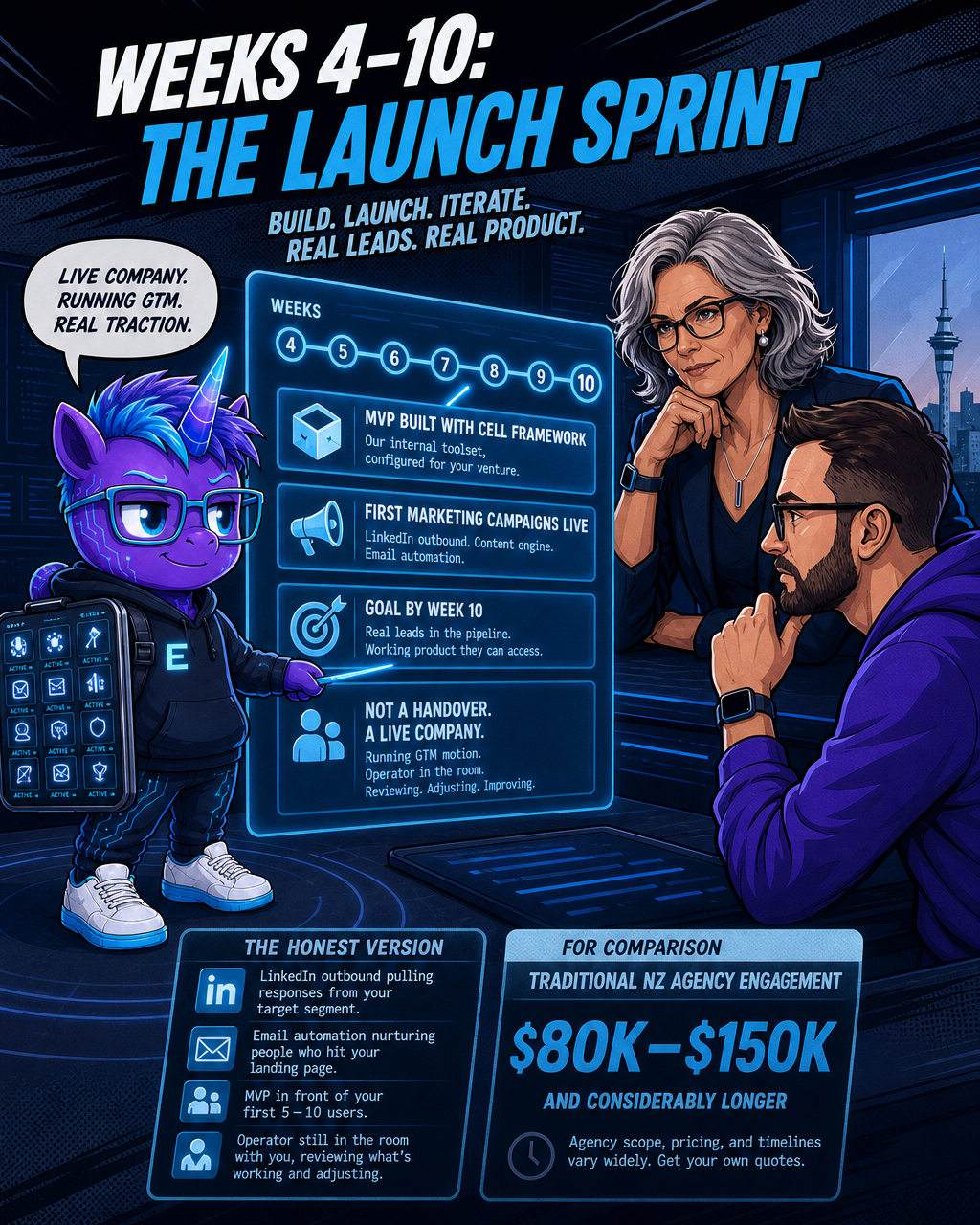
The MVP is built using the Cell framework, our internal toolset configured specifically for your venture. First marketing campaigns go live on Supramono: LinkedIn outbound, content engine, email automation. The goal by week ten is to have real leads in the pipeline and a working product those leads can access. The number of leads will vary depending on your industry, target segment, ICP definition, and outbound strategy — in our experience, early-stage clients have seen meaningful early pipeline within this timeframe, but we don't quote a fixed number as a standard deliverable.
This is not a handover of code. It's a live company with a running GTM motion.
The honest version of what that looks like: your LinkedIn outbound is pulling responses from your target segment. Your email automation is nurturing the people who hit your landing page. Your MVP is in front of your first five to ten users. The operator is still in the room with you, reviewing what's working and adjusting.
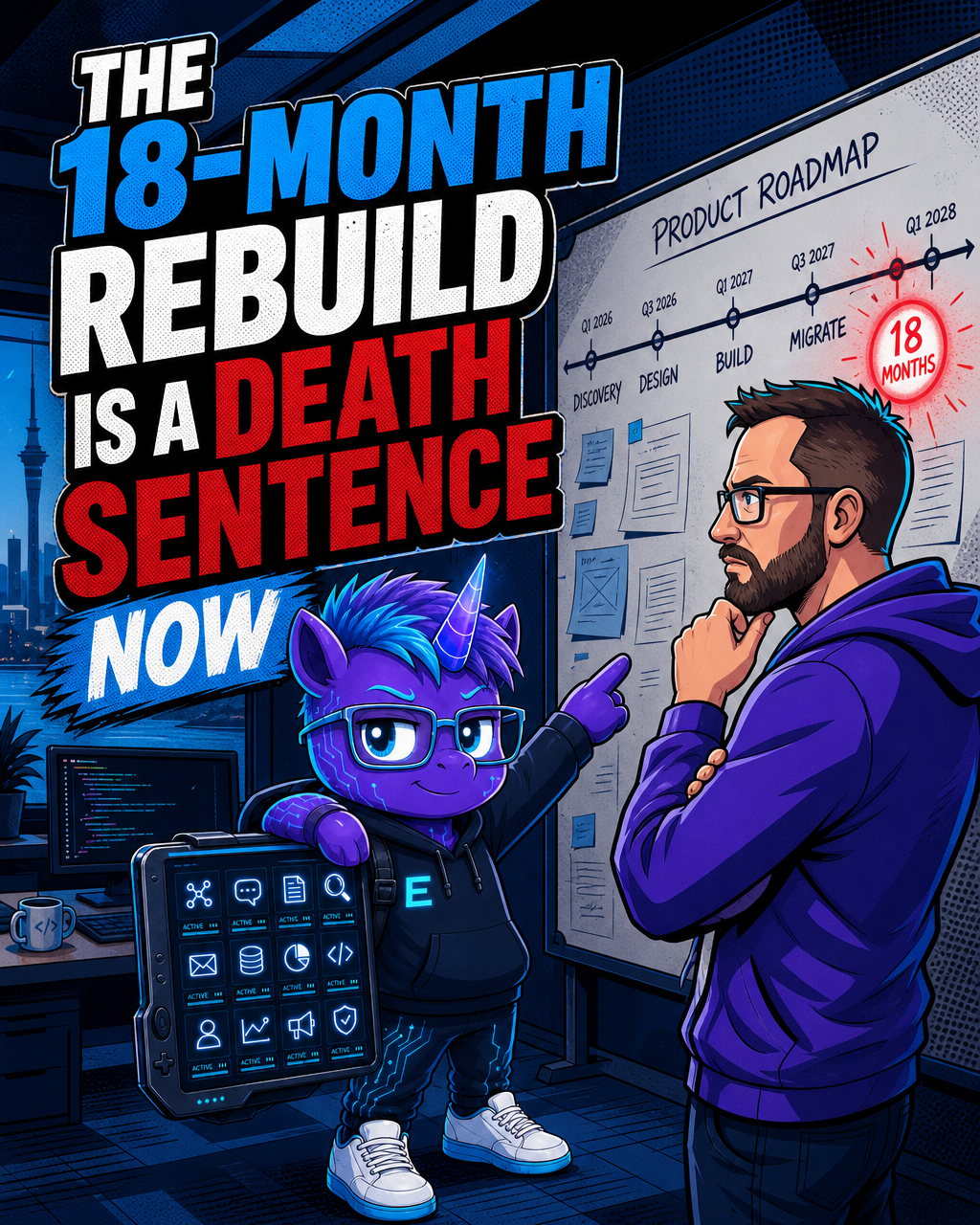
For comparison, based on our market experience, a traditional NZ agency engagement covering equivalent brand-plus-MVP scope would typically range from $80k–$150k and run considerably longer — though agency scope, pricing, and timelines vary widely and founders should get their own quotes.
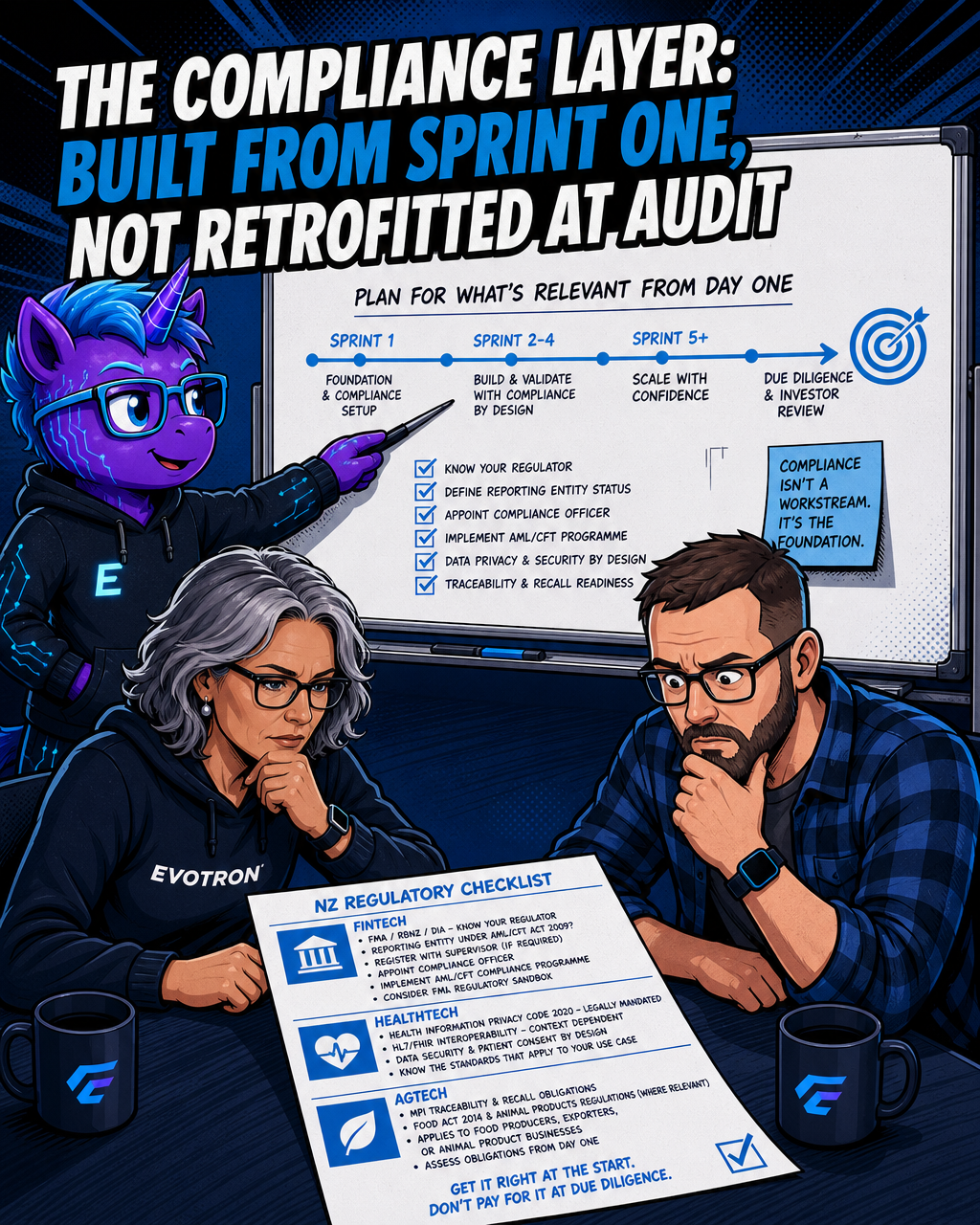
The Compliance Layer: Built from Sprint One, Not Retrofitted at Audit
This is the part most NZ founders don't think about until it's expensive.
If you're building in fintech, healthtech, or agtech, you have compliance obligations that are genuinely painful to retrofit. NZ fintech founders, for instance, need to understand whether they're regulated by the FMA, RBNZ, or DIA — and those distinctions matter before you write a single line of code. If your business is classified as a reporting entity under the Anti-Money Laundering and Countering Financing of Terrorism Act 2009, you will be required to register with the appropriate supervisor, appoint a compliance officer, and implement a full AML/CFT compliance programme. Not all businesses building in fintech are automatically reporting entities — obligations vary significantly by entity type and risk profile — so founders should obtain specific legal advice to determine whether and how the Act applies to their model. Getting that wrong at due diligence doesn't just cost legal fees; it can end the raise.
The FMA operates a regulatory sandbox for early-stage NZ fintechs, and has signalled interest in reducing barriers to market entry for innovative financial services. Founders should check the FMA's current publications directly for the latest on available support programmes and any licensing pathway developments, as the regulatory landscape continues to evolve. That said, sandbox access and innovation support don't eliminate the need to know which compliance obligations apply to your specific model before you build.
Our operators have done this before. Compliance isn't a separate workstream we add at the end. It's woven into the first sprint because the cost of getting it right at the start is a fraction of the cost of fixing it when a potential investor runs due diligence.
The same principle applies to healthtech: the Health Information Privacy Code 2020 is a legally mandated requirement that governs how health information must be handled, and it is not something you bolt on after MVP. HL7/FHIR interoperability is a separate matter — it is an emerging standard being progressively adopted in the NZ health sector, and compliance may be required in specific integration contexts (for example, connecting with Te Whatu Ora APIs), but it is not a universally mandated legal requirement for all healthtech startups. We'll help you understand which standards are relevant to your specific use case.
For agtech, MPI traceability and recall obligations — arising from legislation such as the Food Act 2014 and animal products regulations — are directly relevant if you're building for food producers, exporters, or animal product businesses, and will shape your technical architecture in those contexts. Many agtech products outside those regulated categories are not directly subject to these requirements. We assess which obligations apply to your specific venture from day one, rather than discovering them at audit.
We plan for what's relevant from day one, because we've been here before.
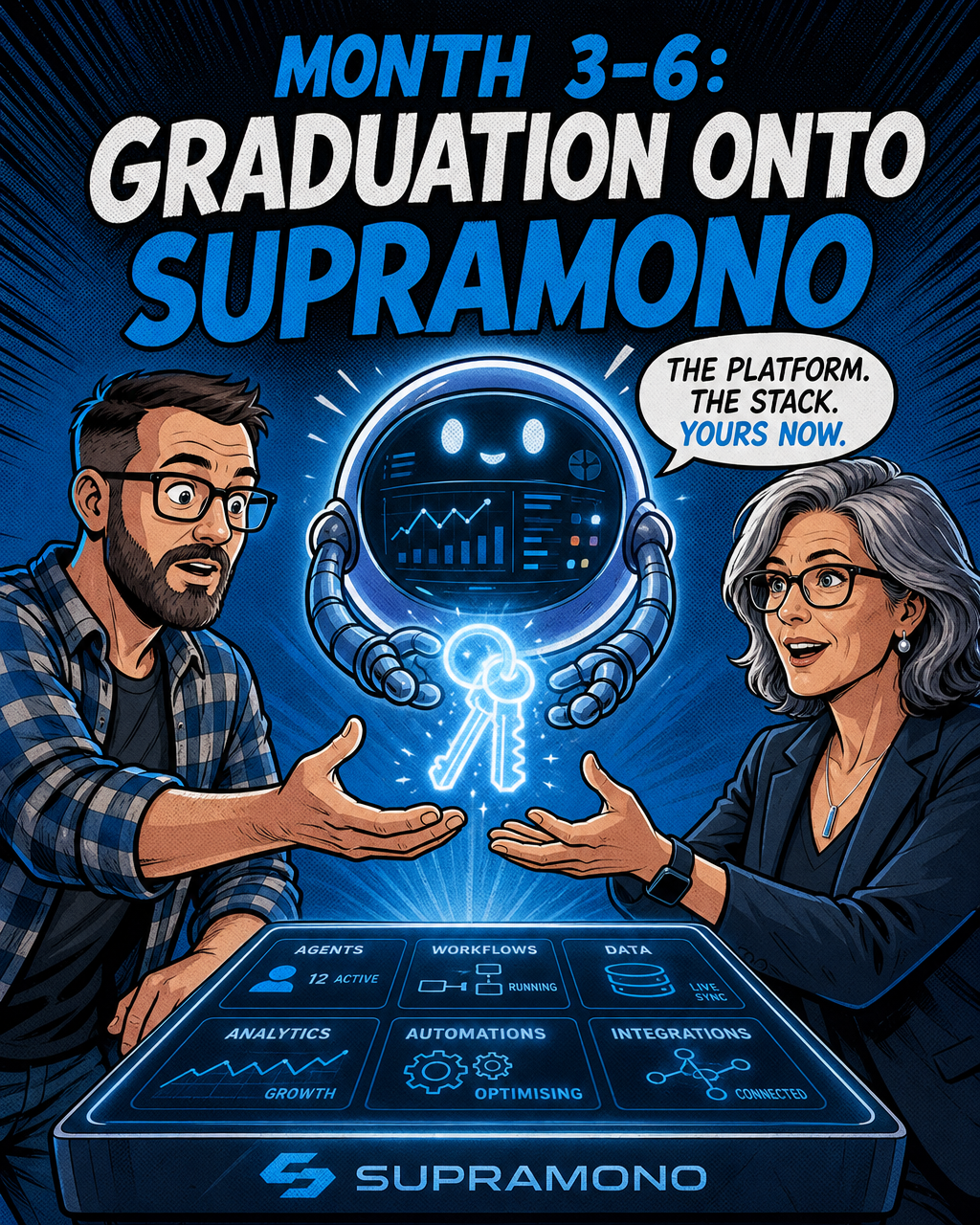
Month 3–6: Graduation onto Supramono
At month three to six, the studio relationship changes shape. The intensive build phase is done. You have a working product, a running GTM motion, and real leads in the pipe. Now the question is how you operate independently.
This is where you graduate onto Supramono. The platform you've watched your operator run on your behalf becomes the platform you run yourself. You're not handed a document and wished well. You're handed the keys to the same agentic stack that built your company, with a clear picture of how to use it.
Every Evotron Studio engagement is designed to end this way. We don't want you on a retainer indefinitely. We want you running your own company, using Supramono as your operating platform, and referring the next founder who's stuck where you were eight weeks ago.
The studio relationship converts to a platform subscription. You stay on Supramono. You refer one more founder. That's how the model compounds.
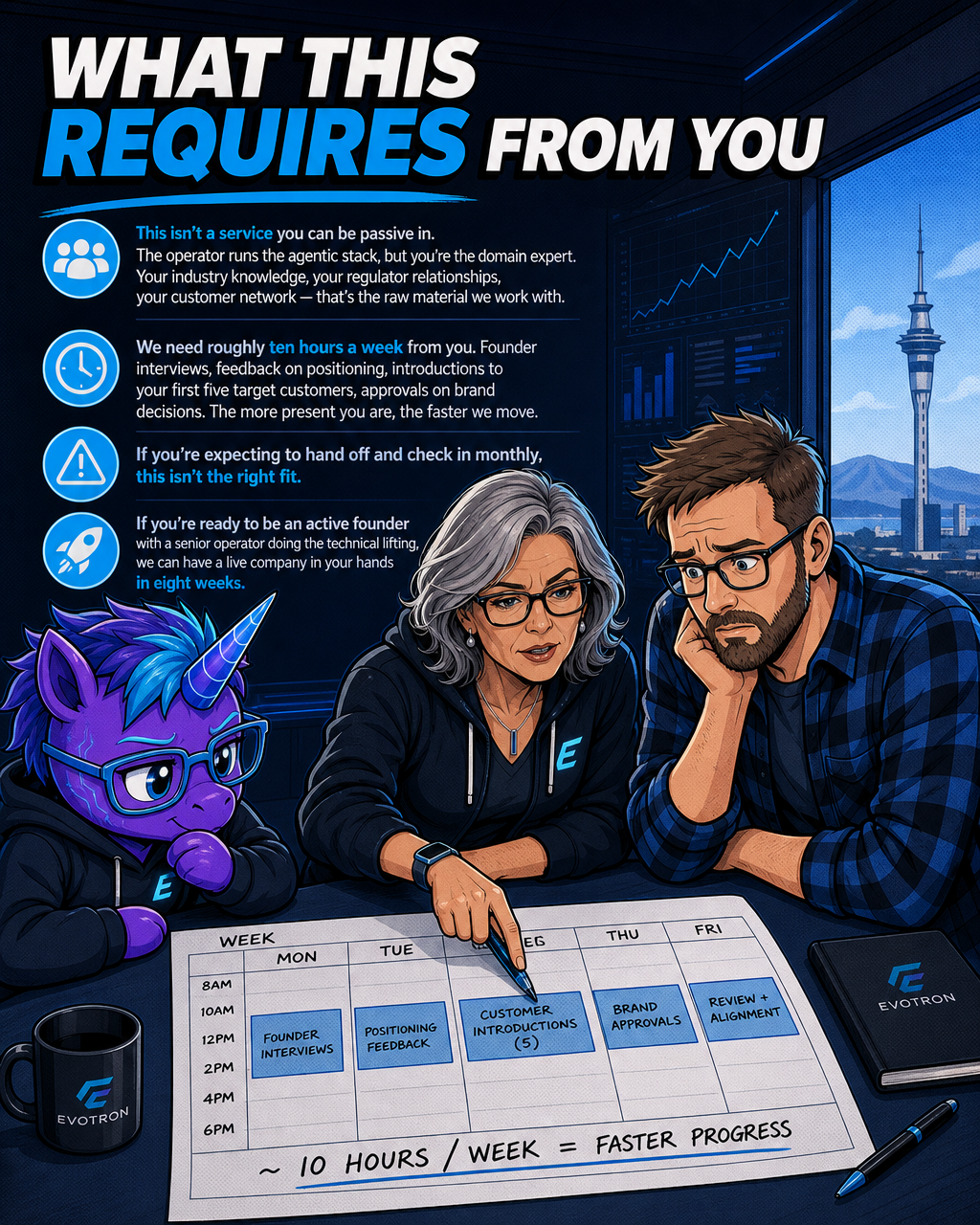
What This Requires From You
This isn't a service you can be passive in. The operator runs the agentic stack, but you're the domain expert. Your industry knowledge, your regulator relationships, your customer network — that's the raw material we work with.
We need roughly ten hours a week from you. Founder interviews, feedback on positioning, introductions to your first five target customers, approvals on brand decisions. The more present you are, the faster we move.
If you're expecting to hand off and check in monthly, this isn't the right fit. If you're ready to be an active founder with a senior operator doing the technical lifting, we can have a live company in your hands in eight weeks.
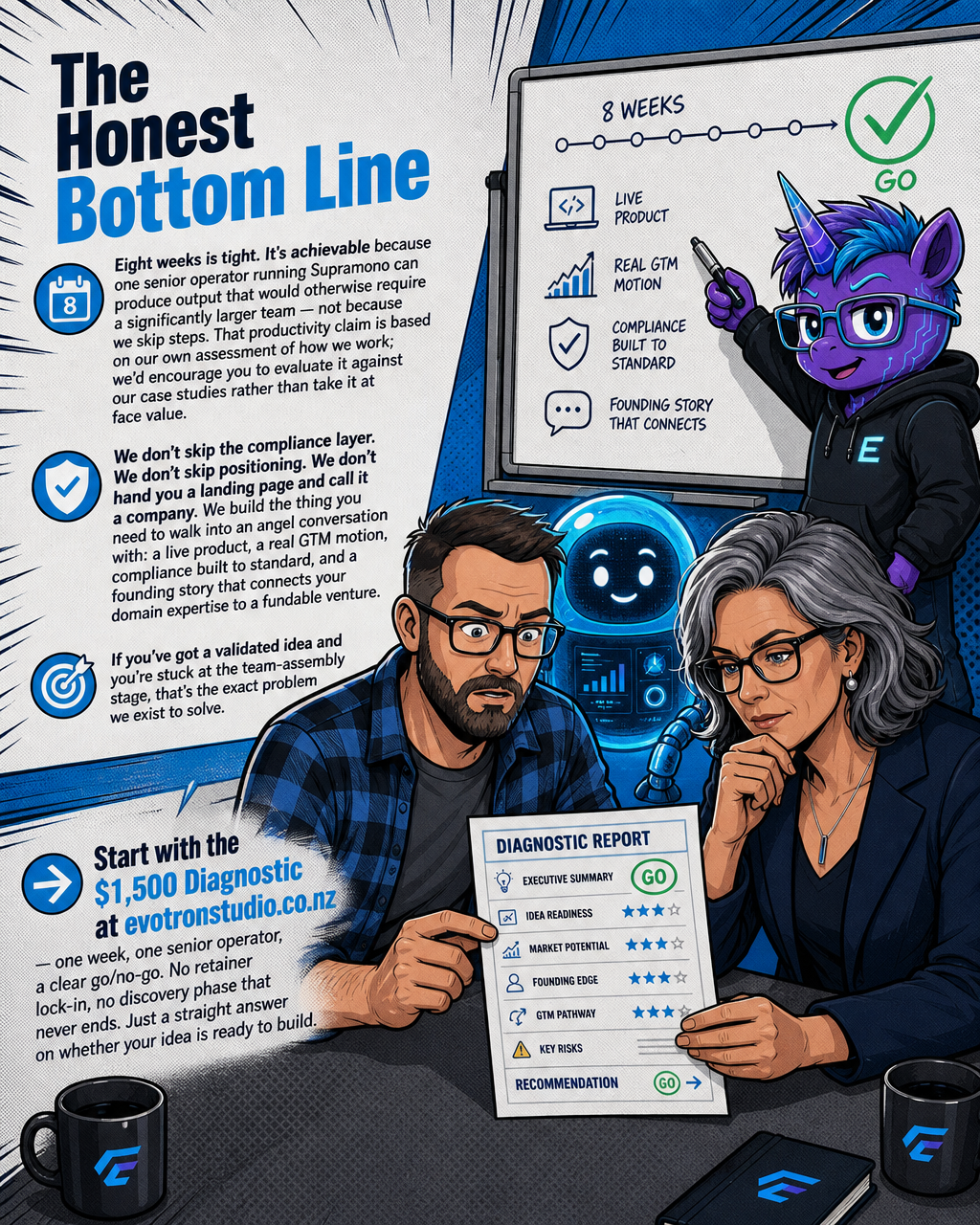
The Honest Bottom Line
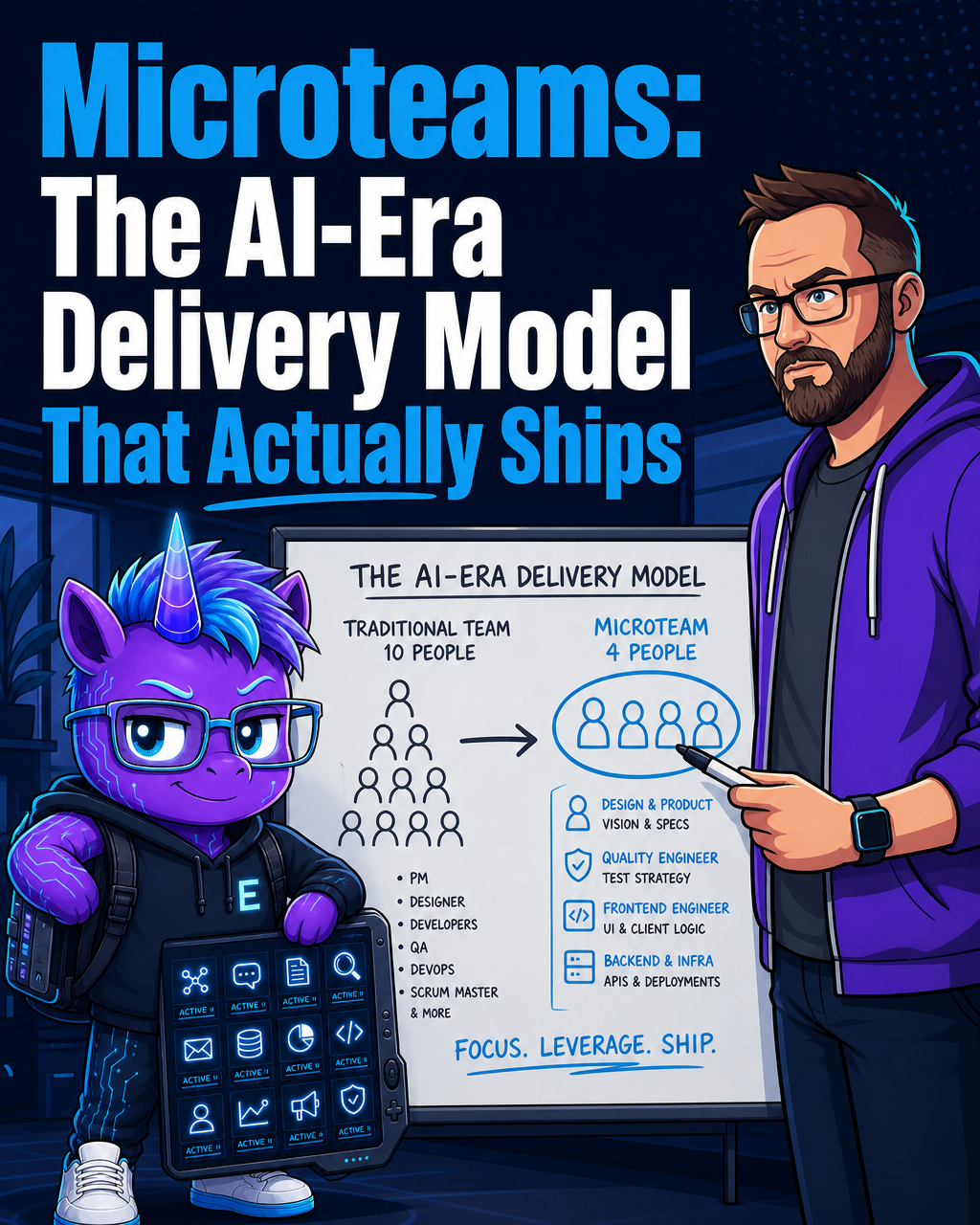
Eight weeks is tight. It's achievable because one senior operator running Supramono can produce output that would otherwise require a significantly larger team — not because we skip steps. That productivity claim is based on our own assessment of how we work; we'd encourage you to evaluate it against our case studies rather than take it at face value.
We don't skip the compliance layer. We don't skip positioning. We don't hand you a landing page and call it a company. We build the thing you need to walk into an angel conversation with: a live product, a real GTM motion, compliance built to standard, and a founding story that connects your domain expertise to a fundable venture.
If you've got a validated idea and you're stuck at the team-assembly stage, that's the exact problem we exist to solve.
Start with the $1,500 Diagnostic at evotronstudio.co.nz — one week, one senior operator, a clear go/no-go. No retainer lock-in, no discovery phase that never ends. Just a straight answer on whether your idea is ready to build.
Related reading
Evotron Studio
We build and run our own AI-amplified ventures — and bring the same capability into yours.
We build and run our own AI-amplified ventures — and bring the same capability into yours.
Learn more about Evotron Studio and get started today.
Visit Evotron Studio