Why Pre-2020 Vertical SaaS Is Losing the Retention War
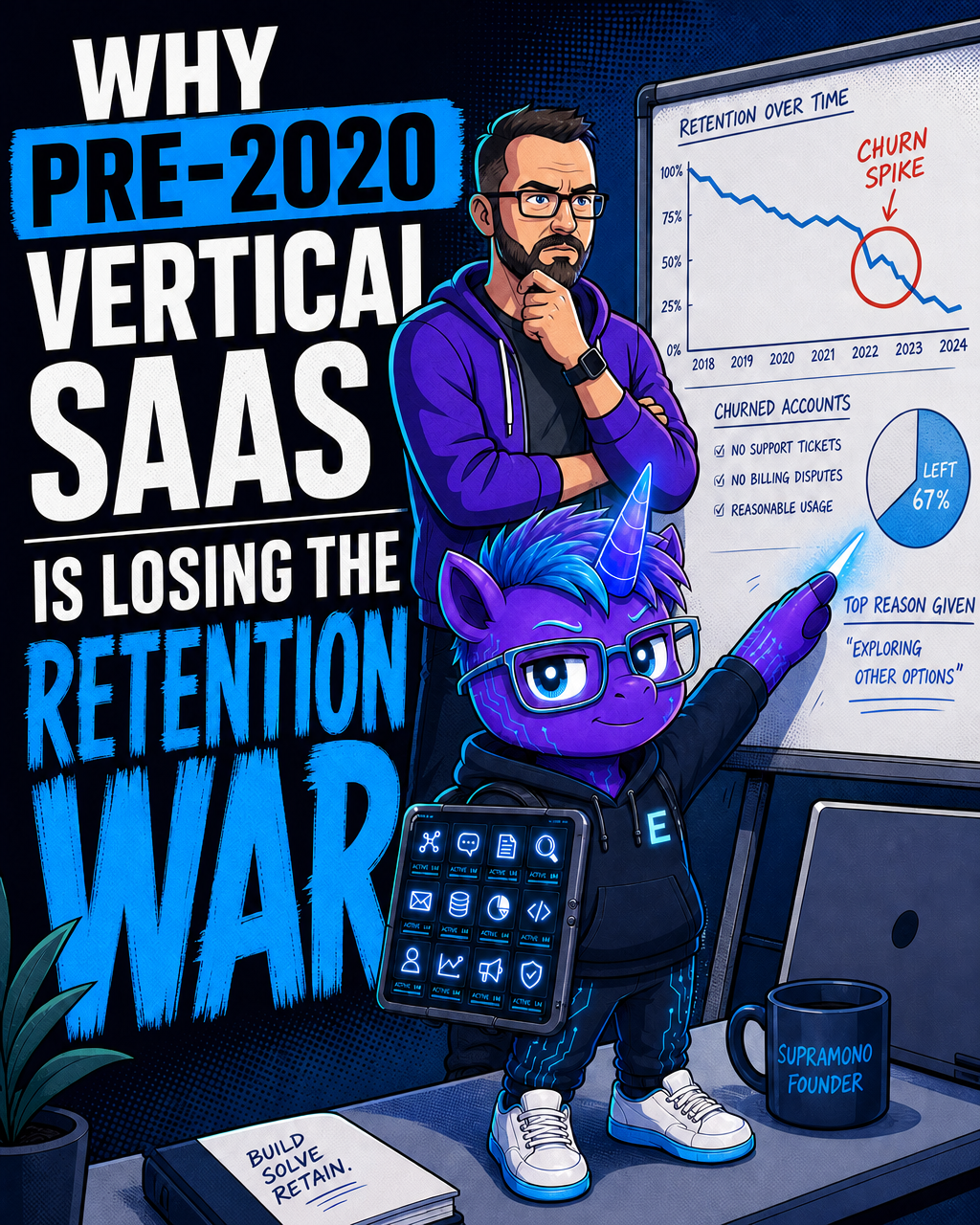

If you built a vertical SaaS product before 2020, there's a reasonable chance your retention numbers are telling you something your product roadmap hasn't caught up to yet. Churn is ticking up. The churned accounts look fine on paper — no support tickets, no billing disputes, reasonable usage right up until they didn't renew. And when you ask them why they left, you get something vague about "exploring other options."
Here's the honest read: they found something that felt more capable. Not necessarily more feature-complete. Just more capable in the way that matters to them right now.
This isn't a marketing problem. It's not a pricing problem. It's an architecture problem, and the sooner product leaders name it clearly, the faster they can make useful decisions about it.
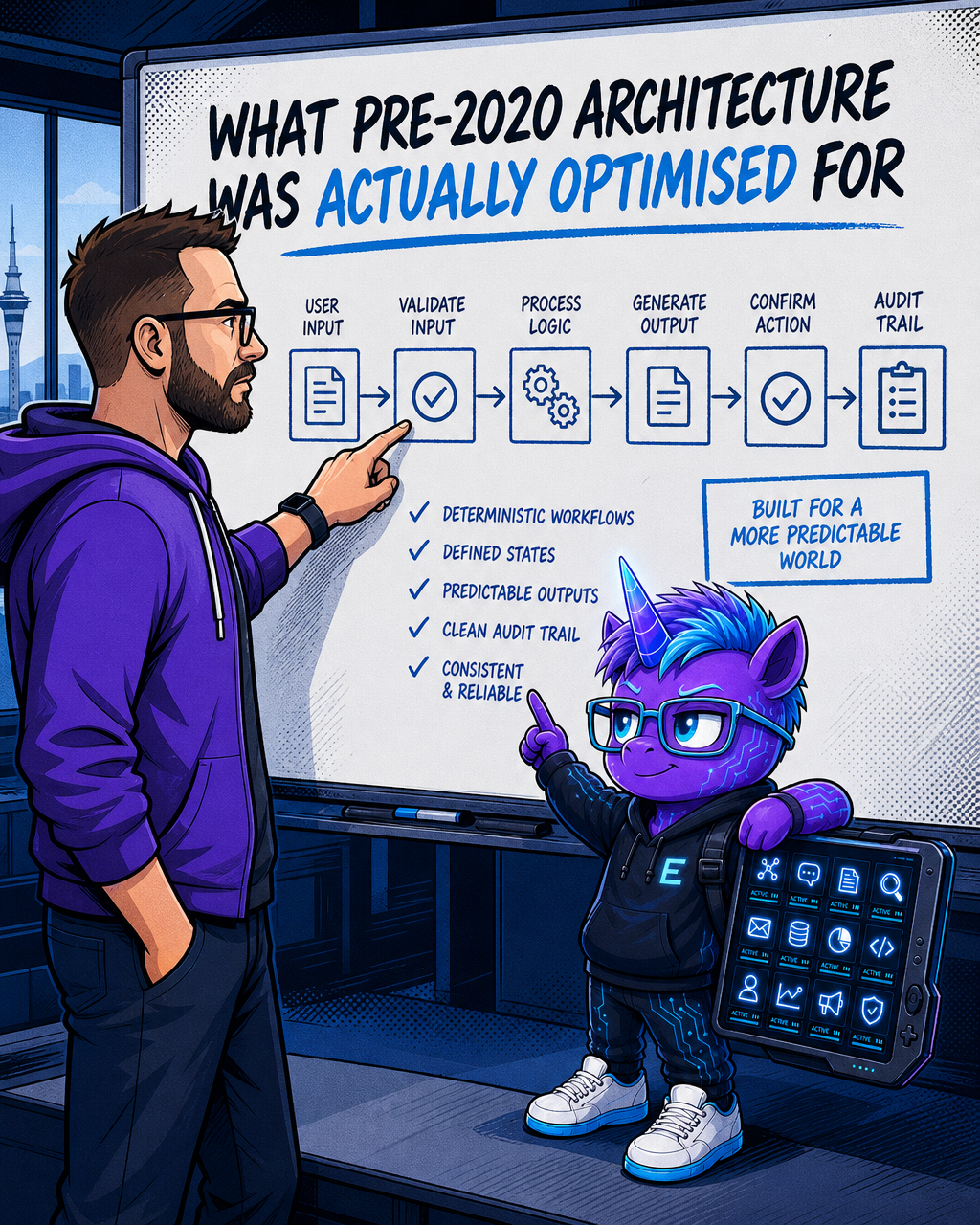
What Pre-2020 Architecture Was Actually Optimised For
Vertical SaaS built before 2020 was, almost without exception, designed around deterministic workflows. The product encoded a sequence of steps, validated inputs at defined points, produced predictable outputs, and kept a clean audit trail. That was the job. It was good software engineering for the problem that existed.
The underlying data model reflected this. Tables were structured to represent states, not conversations. The UX logic assumed that a user would move through a defined path: form, review, submit, confirm. Branching was handled by conditional logic written at build time. The system knew what it was allowed to do, and it did exactly that.
That architecture made sense because the users of 2016 or 2018 expected exactly that behaviour from software. Predictable. Auditable. Consistent.
The problem is that user expectations have shifted underneath these products without the products changing shape.
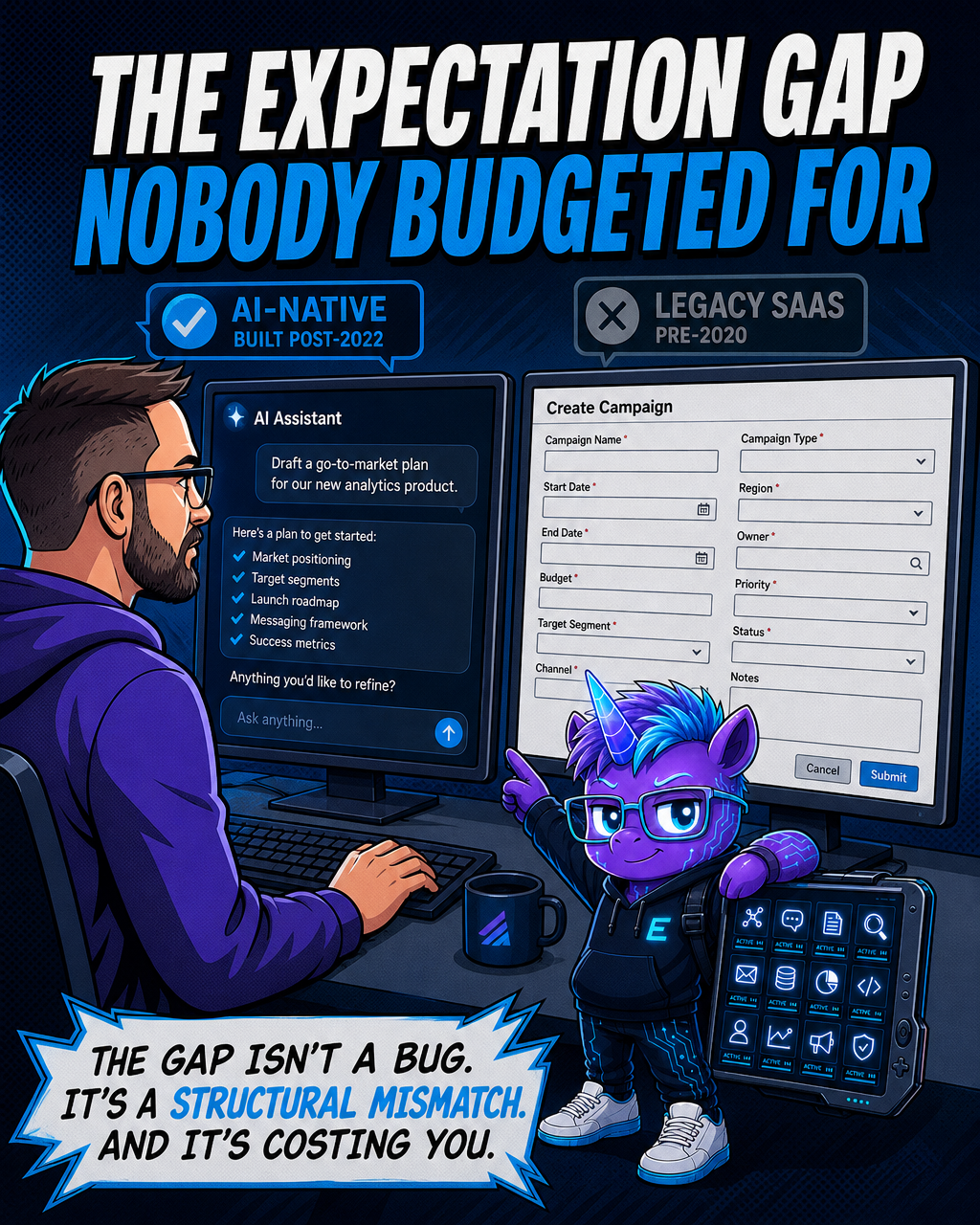
The Expectation Gap Nobody Budgeted For
AI-native tools — the ones built post-2022 with LLMs as a first-class architectural primitive — produce probabilistic, context-aware outputs. They accept ambiguous inputs. They surface suggestions the user didn't ask for but finds useful. They learn, or appear to learn, from the conversation. They let a user start in the middle of a workflow, provide partial information, and get something useful back.
This is structurally different from what a pre-2020 vertical SaaS product does. Not incrementally different. Structurally different.
When a user who is now accustomed to conversational AI tools comes back to your legacy product and has to fill out a twelve-field form to do something your competitor handles with a two-sentence prompt, they don't file a support ticket. They just quietly start evaluating alternatives.
The expectation gap is real, and it compounds. Every time your users interact with AI-native tools in other parts of their stack — and they will, because enterprise AI adoption and spending on AI-native applications grew sharply year-over-year through 2025 across multiple analyst measures — the contrast with your product becomes sharper.
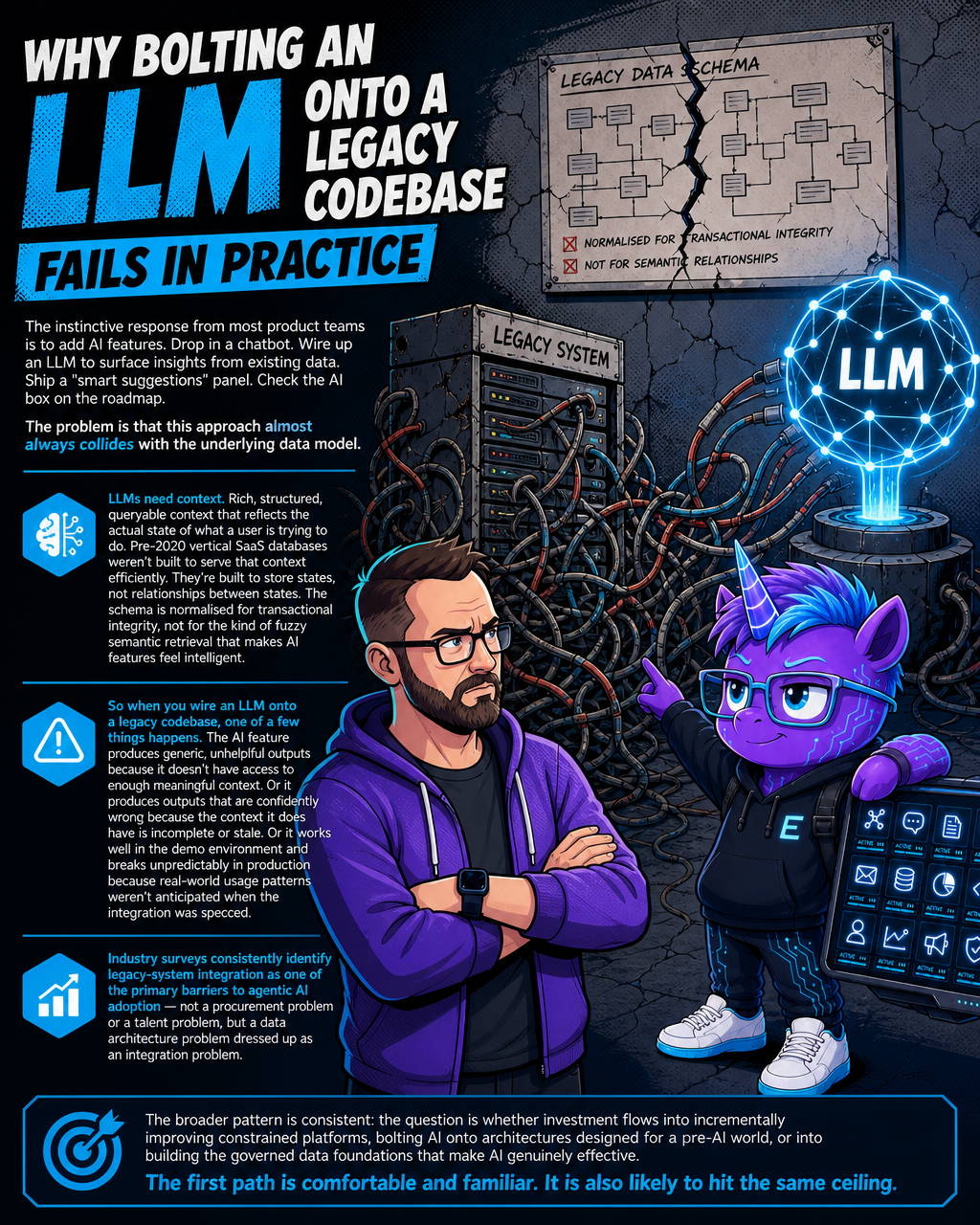
Why Bolting an LLM Onto a Legacy Codebase Fails in Practice
The instinctive response from most product teams is to add AI features. Drop in a chatbot. Wire up an LLM to surface insights from existing data. Ship a "smart suggestions" panel. Check the AI box on the roadmap.
The problem is that this approach almost always collides with the underlying data model.
LLMs need context. Rich, structured, queryable context that reflects the actual state of what a user is trying to do. Pre-2020 vertical SaaS databases weren't built to serve that context efficiently. They're built to store states, not relationships between states. The schema is normalised for transactional integrity, not for the kind of fuzzy semantic retrieval that makes AI features feel intelligent.
So when you wire an LLM onto a legacy codebase, one of a few things happens. The AI feature produces generic, unhelpful outputs because it doesn't have access to enough meaningful context. Or it produces outputs that are confidently wrong because the context it does have is incomplete or stale. Or it works well in the demo environment and breaks unpredictably in production because real-world usage patterns weren't anticipated when the integration was specced.
Industry surveys consistently identify legacy-system integration as one of the primary barriers to agentic AI adoption — not a procurement problem or a talent problem, but a data architecture problem dressed up as an integration problem.
The broader pattern is consistent: the question is whether investment flows into incrementally improving constrained platforms, bolting AI onto architectures designed for a pre-AI world, or into building the governed data foundations that make AI genuinely effective. The first path is comfortable and familiar. It is also likely to hit the same ceiling.
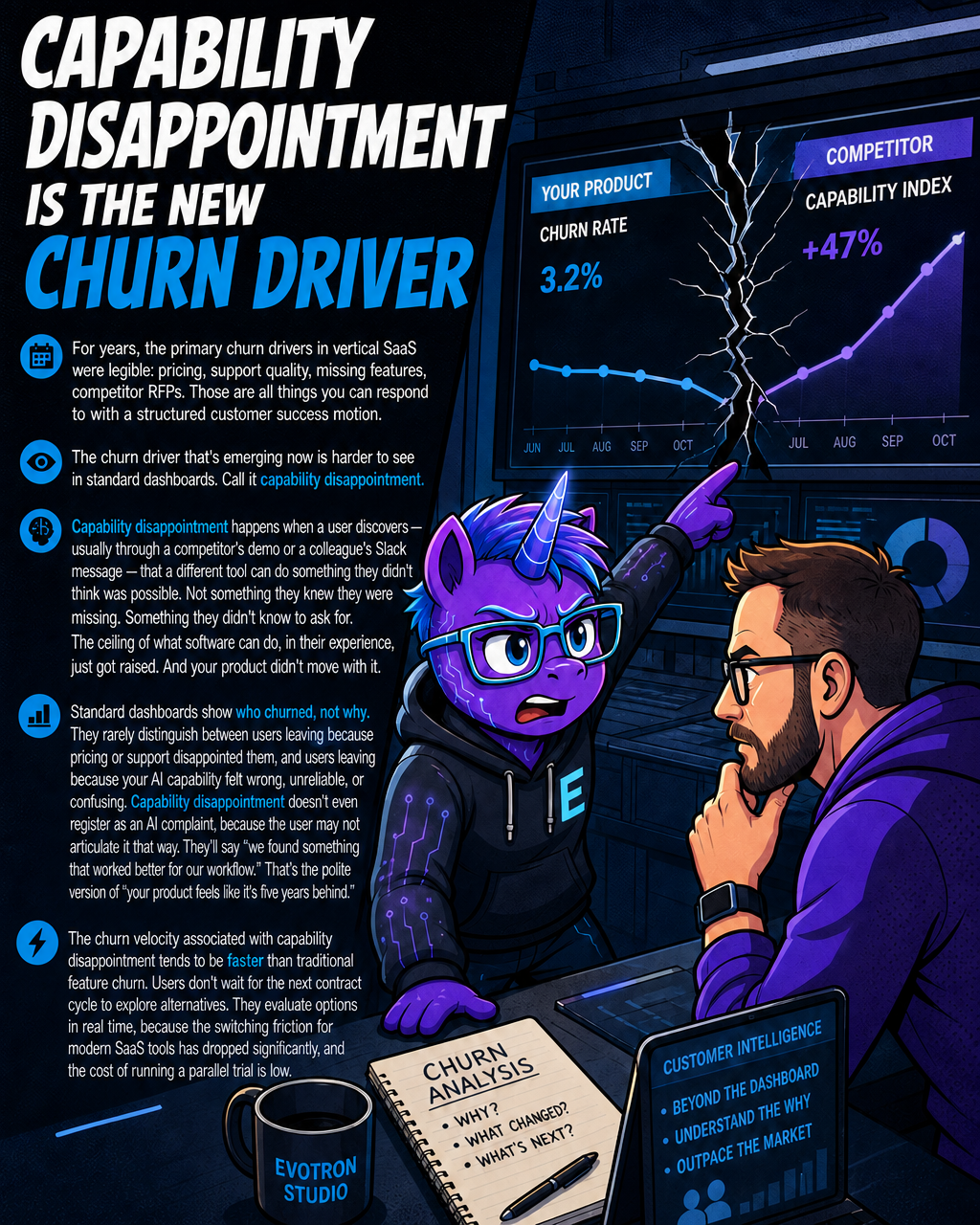
Capability Disappointment Is the New Churn Driver
For years, the primary churn drivers in vertical SaaS were legible: pricing, support quality, missing features, competitor RFPs. Those are all things you can respond to with a structured customer success motion.
The churn driver that's emerging now is harder to see in standard dashboards. Call it capability disappointment.
Capability disappointment happens when a user discovers — usually through a competitor's demo or a colleague's Slack message — that a different tool can do something they didn't think was possible. Not something they knew they were missing. Something they didn't know to ask for. The ceiling of what software can do, in their experience, just got raised. And your product didn't move with it.
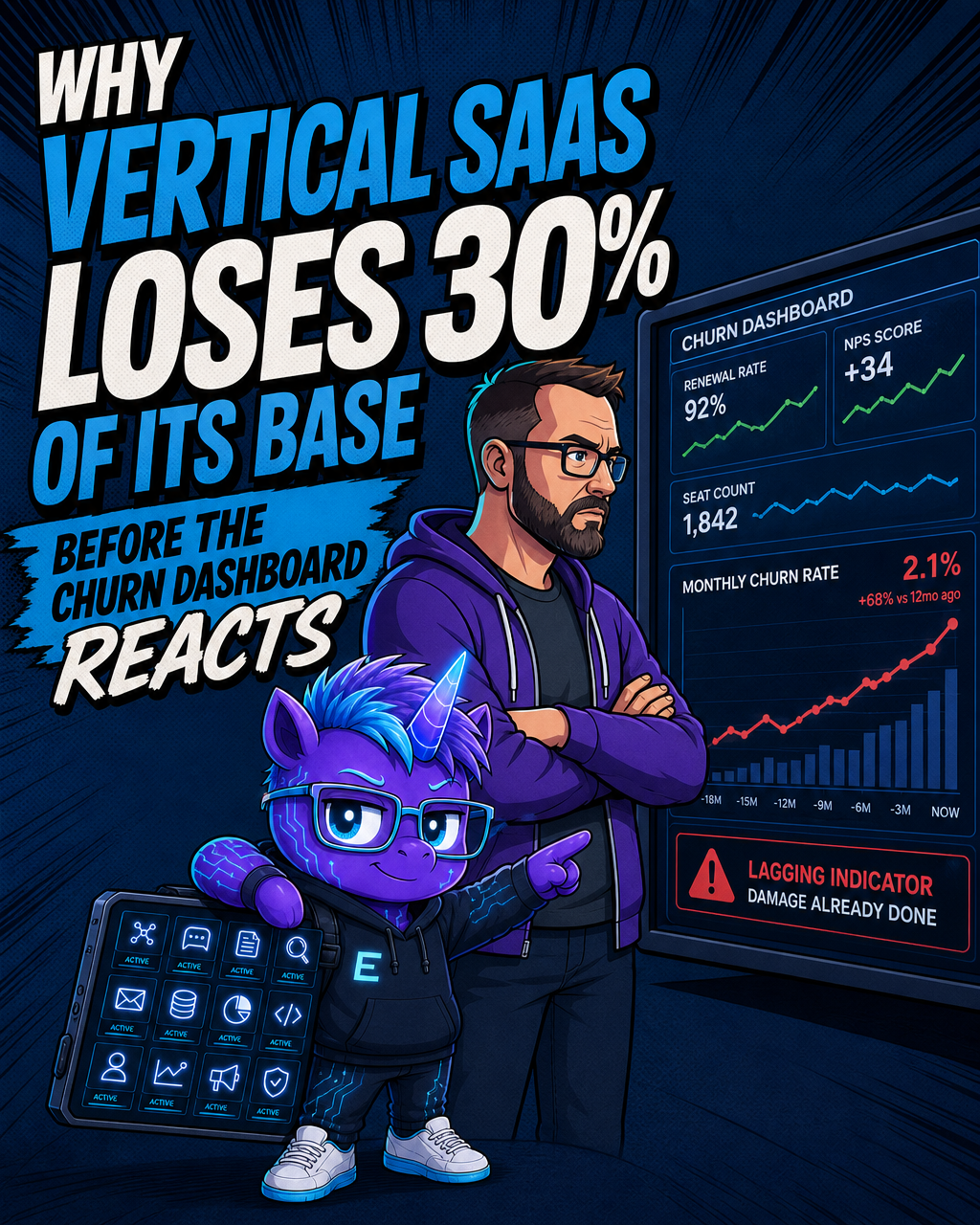
Standard dashboards show who churned, not why. They rarely distinguish between users leaving because pricing or support disappointed them, and users leaving because your AI capability felt wrong, unreliable, or confusing. Capability disappointment doesn't even register as an AI complaint, because the user may not articulate it that way. They'll say "we found something that worked better for our workflow." That's the polite version of "your product feels like it's five years behind."
The churn velocity associated with capability disappointment tends to be faster than traditional feature churn. Users don't wait for the next contract cycle to explore alternatives. They evaluate options in real time, because the switching friction for modern SaaS tools has dropped significantly, and the cost of running a parallel trial is low.
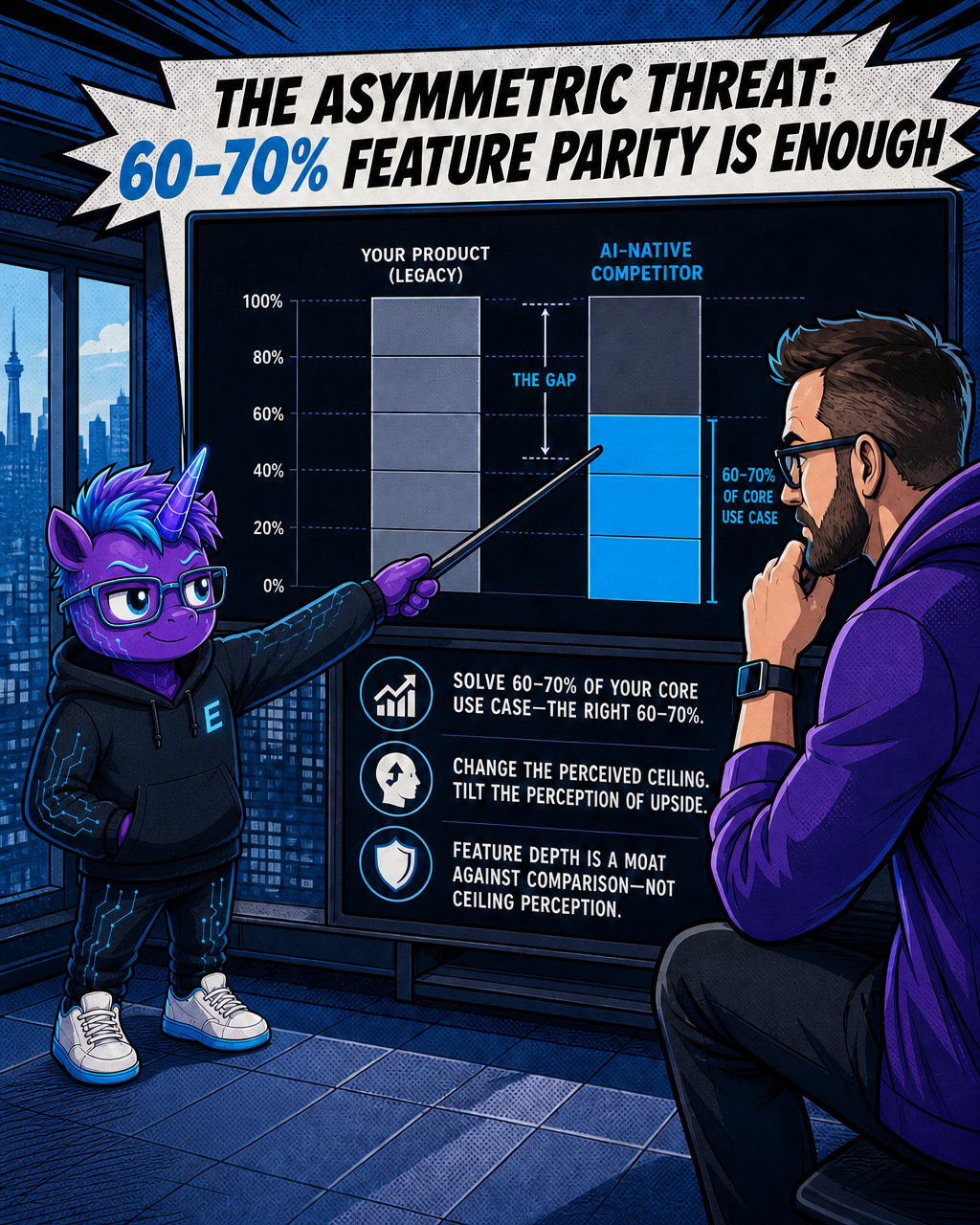
The Asymmetric Threat: 60–70% Feature Parity Is Enough
Here's the part that most legacy vertical SaaS founders find genuinely uncomfortable.
An AI-native competitor doesn't need to match your feature set. They don't need to solve the same 100% of use cases you solve. They need to solve 60–70% of your core use case — specifically the 60–70% that your churnable segments use most — and do it in a way that makes the ceiling feel higher.
Your customers have a mental model of what your product can do. That ceiling is set by five or ten years of using your software. When an AI-native competitor shows them something that feels qualitatively different, they start mentally recalibrating what the ceiling could be for the whole category. Even if the new tool is missing features your product has, the perception of upside tilts toward the newer tool.
This is asymmetric because your moat — the depth of your feature set, the compliance certifications, the workflow depth, the integrations — protects you against feature-for-feature comparison. It doesn't protect you against ceiling-perception comparison.
AI-native competitors don't have years of commitments, exceptions, and existing revenue models to protect. A pricing model change that looks straightforward on paper touches billing logic, revenue recognition rules, contract templates, and customer communications simultaneously. They can move differently because they don't carry the weight of an installed base. And the window to hold a feature lead is narrowing: AI-assisted development has materially compressed the time it takes to reach meaningful feature parity in many categories, though the degree varies significantly depending on product complexity and team composition.
The segment of your customer base most at risk isn't your most engaged, deeply-embedded power users. It's the accounts that use a subset of your functionality, have lower switching costs, and are most likely to be impressed by a cleaner experience that does the 60–70% they actually need.
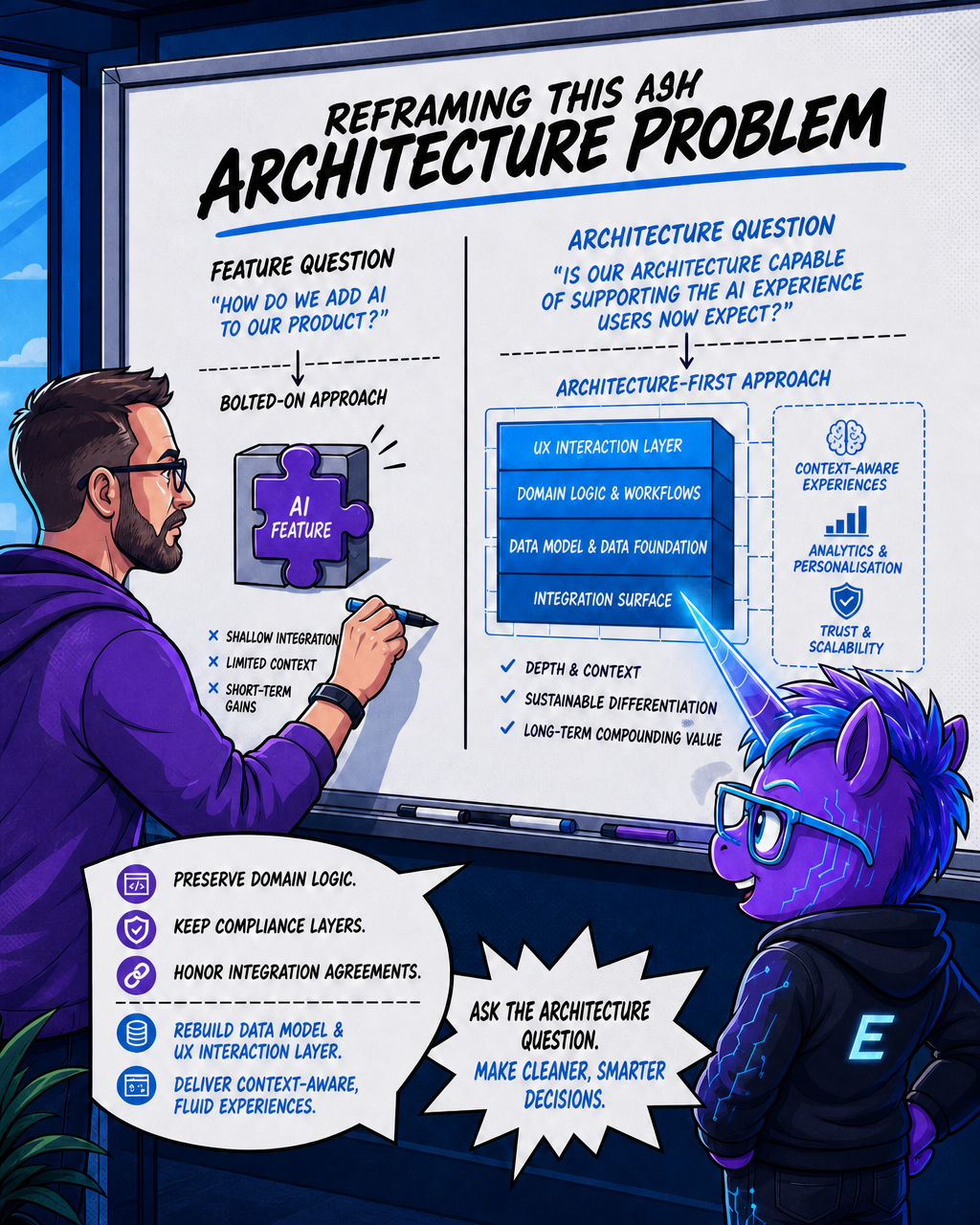
Reframing This as an Architecture Problem
The founders and product leaders who make the best decisions in this environment are the ones who stop asking "how do we add AI to our product?" and start asking "is our architecture capable of supporting the kind of AI experience users now expect?"
Those are different questions with different answers and very different implications.
The first question leads you to bolt things on. The second question leads you to an honest assessment of your data model, your UX logic, and your integration surface. And from that honest assessment, you can make a much cleaner decision about what to rebuild versus what to preserve.
Not everything needs to be rebuilt. Pre-2020 vertical SaaS products often have real competitive assets baked into them: domain-specific workflow logic that took years to encode, compliance architecture that took expensive certifications to build, deep integrations with industry-specific data sources that new entrants can't replicate quickly. Legacy SaaS providers who can genuinely augment their domain knowledge with AI, rather than just bolting on a chatbot, still hold meaningful cards.
But those assets only compound if they're built on a data and integration foundation that can support the context-aware, probabilistic behaviour that AI-native features require. Clean, versioned, and compliant data enables AI-driven features, supports analytics and personalisation, and establishes trust and scalability across the platform. If your data model can't serve that, your domain IP sits behind a wall that AI features can't reach.
The rebuild-versus-preserve decision becomes much cleaner once you're asking the architecture question rather than the feature question. You can preserve the domain logic, the compliance layers, the integration agreements. You rebuild the data model and the UX interaction layer so they can support the kind of fluid, context-aware experience that users now compare you against.
What This Means for Retention, Practically
Retention in vertical SaaS used to be driven by switching costs. Deep integrations, training investment, workflow habituation — these things kept customers even when the product wasn't winning on merit.
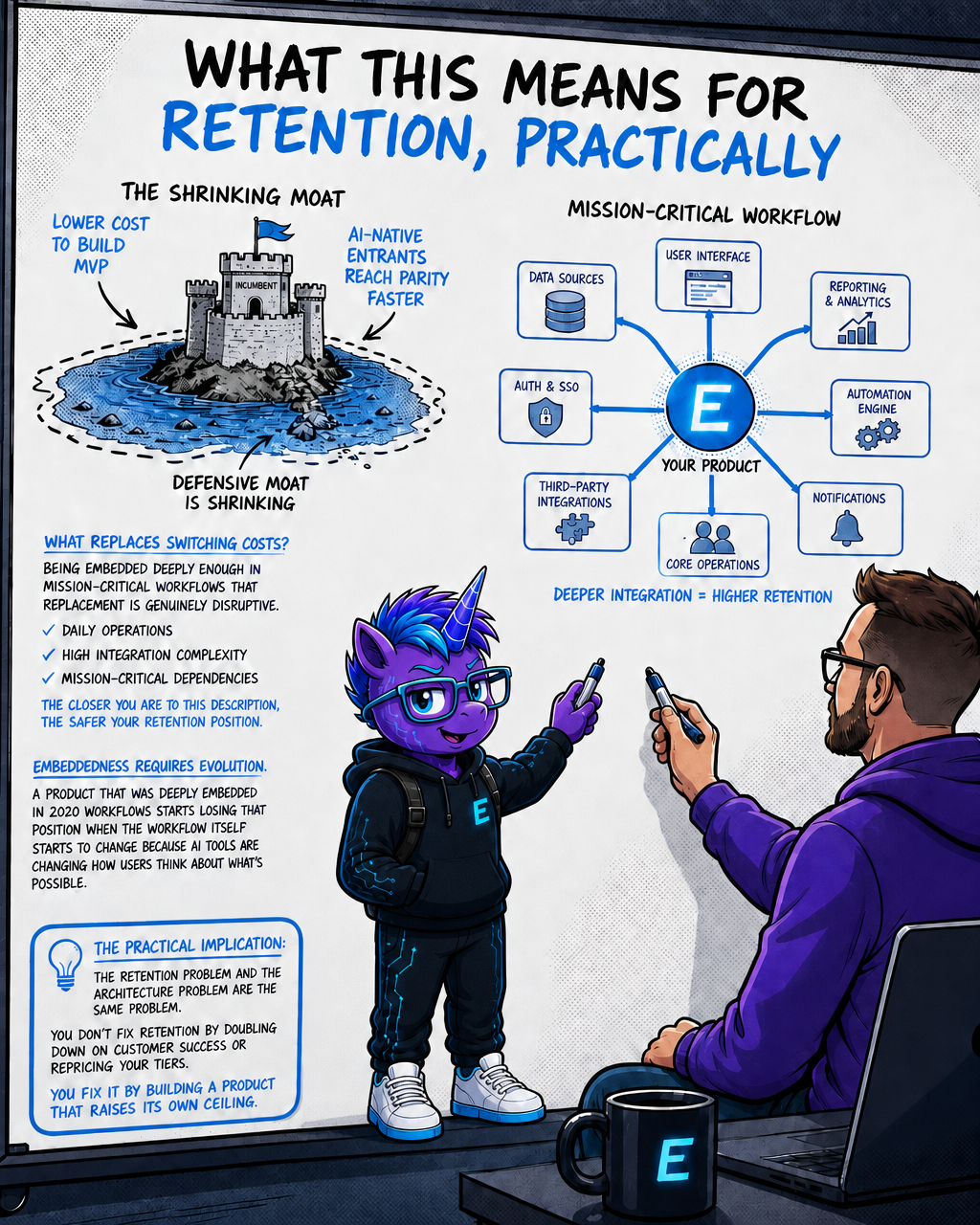
Those switching costs still exist. But they're being eroded from two directions. The cost of building a competing SaaS MVP has fallen materially, and AI-native entrants are reaching meaningful feature parity faster than incumbents have historically been able to move. The defensive moat is shrinking.
What replaces switching costs as a retention driver? Being embedded deeply enough in mission-critical workflows that replacement is genuinely disruptive. Products that sit closest to that description — genuinely embedded in daily operations, with high technical integration complexity and mission-critical dependencies — tend to demonstrate the most resilient retention. The closer your product sits to that description, the safer your retention position.
But genuine embeddedness requires the product to keep being useful as user expectations evolve. A product that was deeply embedded in 2020 workflows starts losing that position when the workflow itself starts to change because AI tools are changing how users think about what's possible.
The practical implication: the retention problem and the architecture problem are the same problem. You don't fix retention by doubling down on customer success or repricing your tiers. You fix it by building a product that raises its own ceiling.
The Decision in Front of You
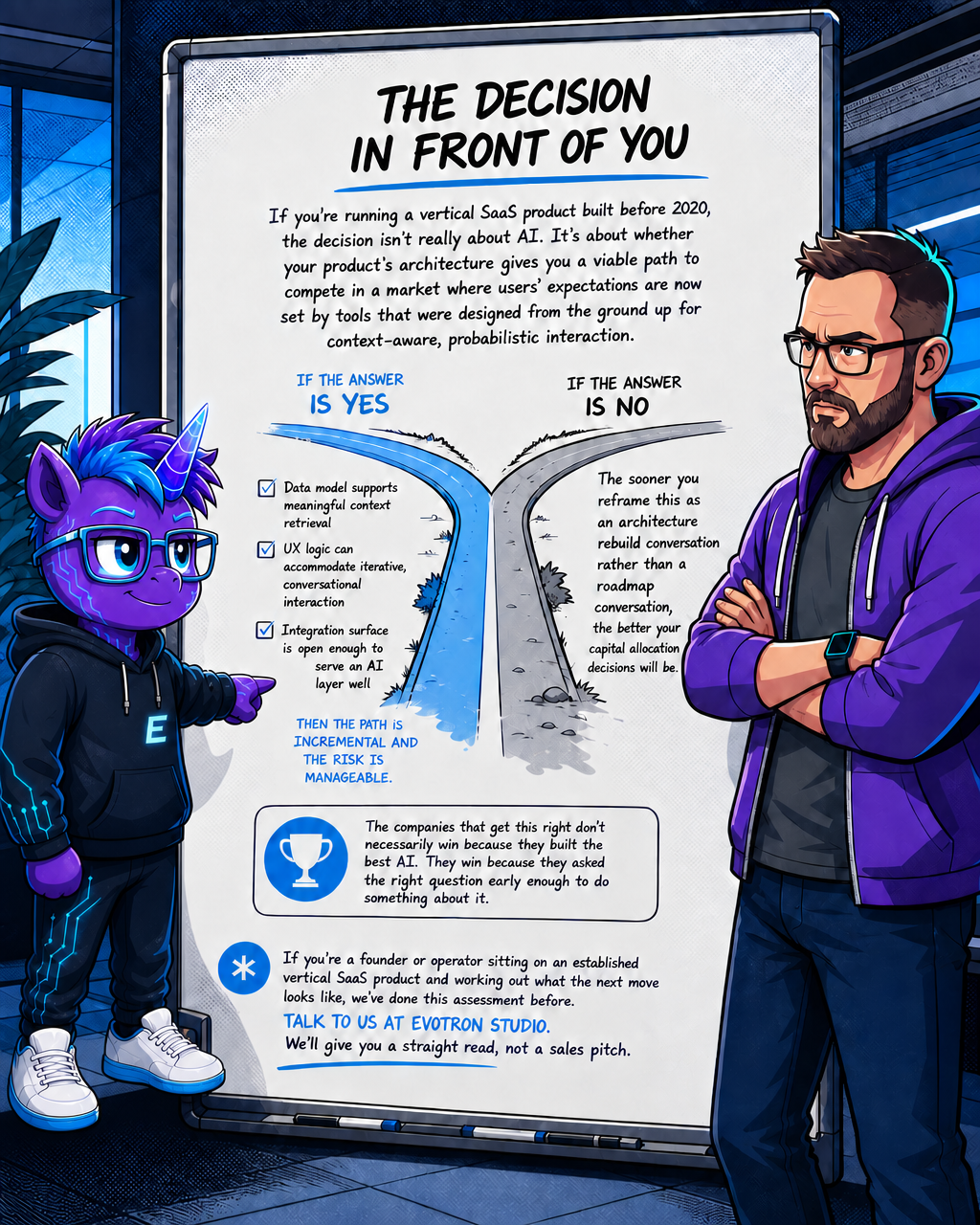
If you're running a vertical SaaS product built before 2020, the decision isn't really about AI. It's about whether your product's architecture gives you a viable path to compete in a market where users' expectations are now set by tools that were designed from the ground up for context-aware, probabilistic interaction.
If the answer is yes — if your data model can support meaningful context retrieval, if your UX logic can accommodate iterative, conversational interaction, if your integration surface is open enough to serve an AI layer well — then the path is incremental and the risk is manageable.
If the answer is no, the sooner you reframe this as an architecture rebuild conversation rather than a roadmap conversation, the better your capital allocation decisions will be.
The companies that get this right don't necessarily win because they built the best AI. They win because they asked the right question early enough to do something about it.
If you're a founder or operator sitting on an established vertical SaaS product and working out what the next move looks like, we've done this assessment before. Talk to us at Evotron Studio. We'll give you a straight read, not a sales pitch.
Related reading

Evotron Studio
We build and run our own AI-amplified ventures — and bring the same capability into yours.
We build and run our own AI-amplified ventures — and bring the same capability into yours.
Learn more about Evotron Studio and get started today.
Visit Evotron Studio