Why Vertical SaaS Loses 30% of Its Base Before the Churn Dashboard Reacts
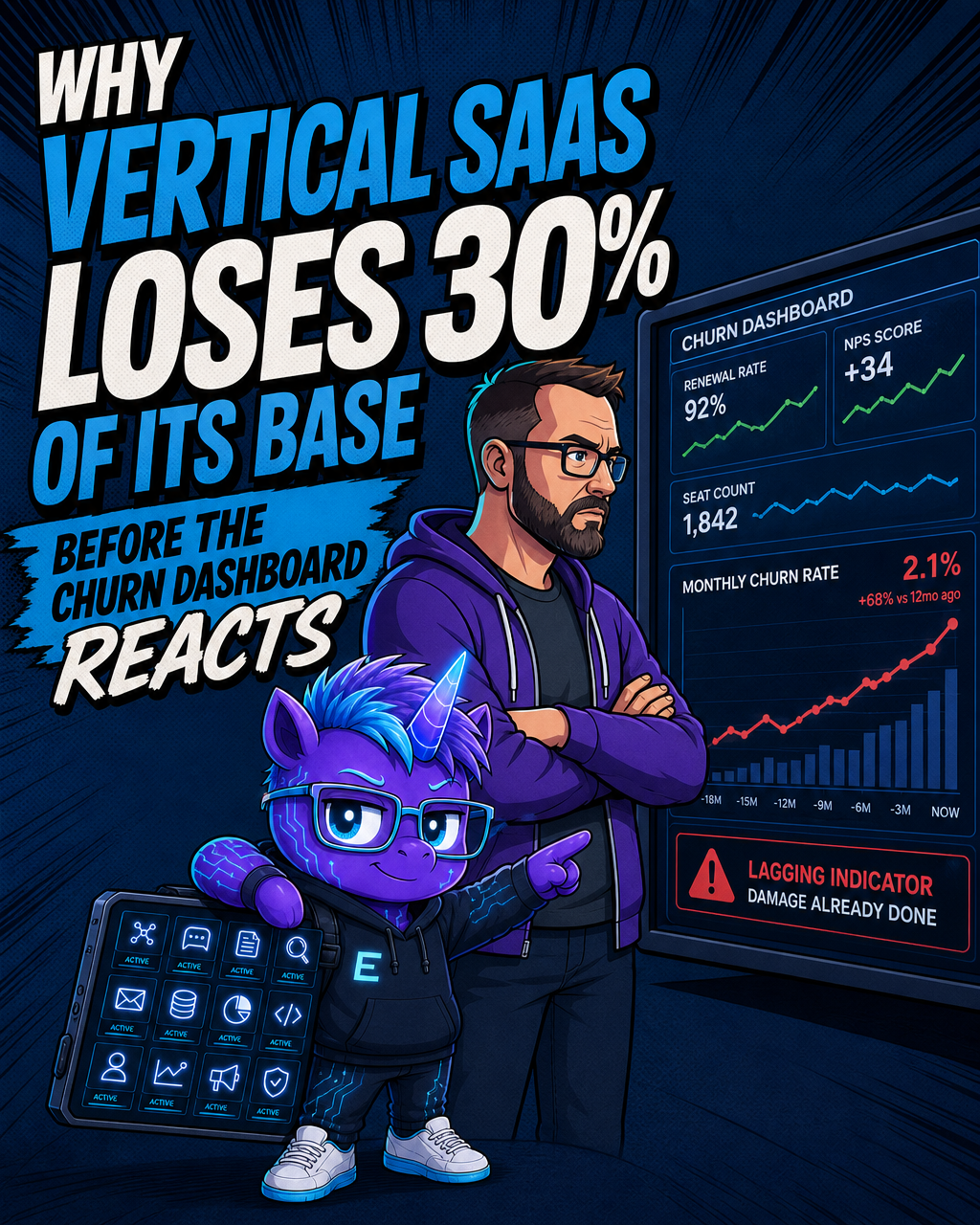
Your renewal rate looks fine. NPS is holding. Seat count is flat. And somewhere in your market, an AI-native competitor is quietly winning your next six renewals.
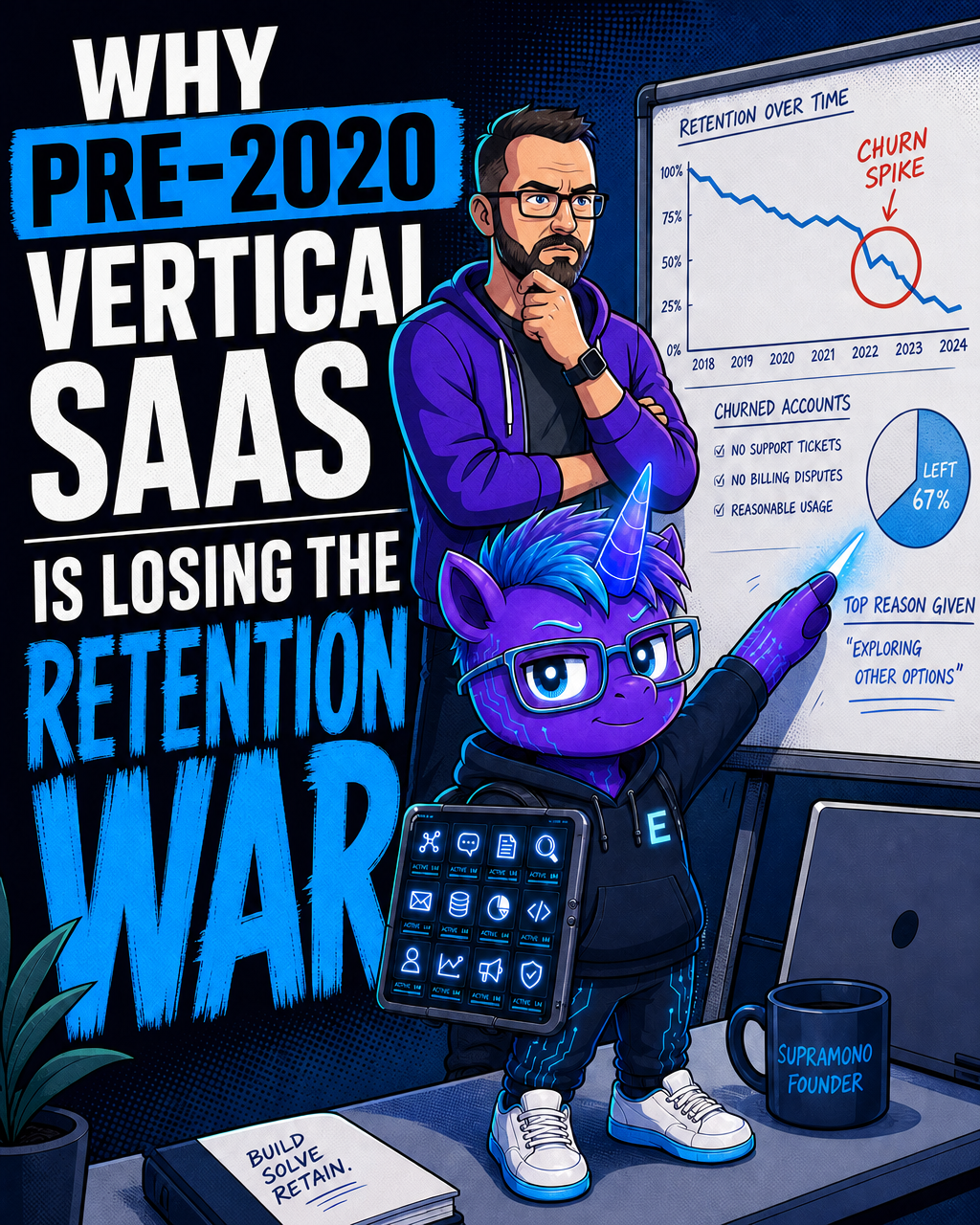
This is the part nobody talks about clearly: vertical SaaS churn is a lagging indicator. By the time it shows up in your dashboard, the real damage happened twelve to eighteen months ago. The question isn't whether AI-native entrants are coming for your customer base. At mid-2026, that question is settled. The question is whether you'll see them arriving.
How AI-native competitors actually enter your accounts
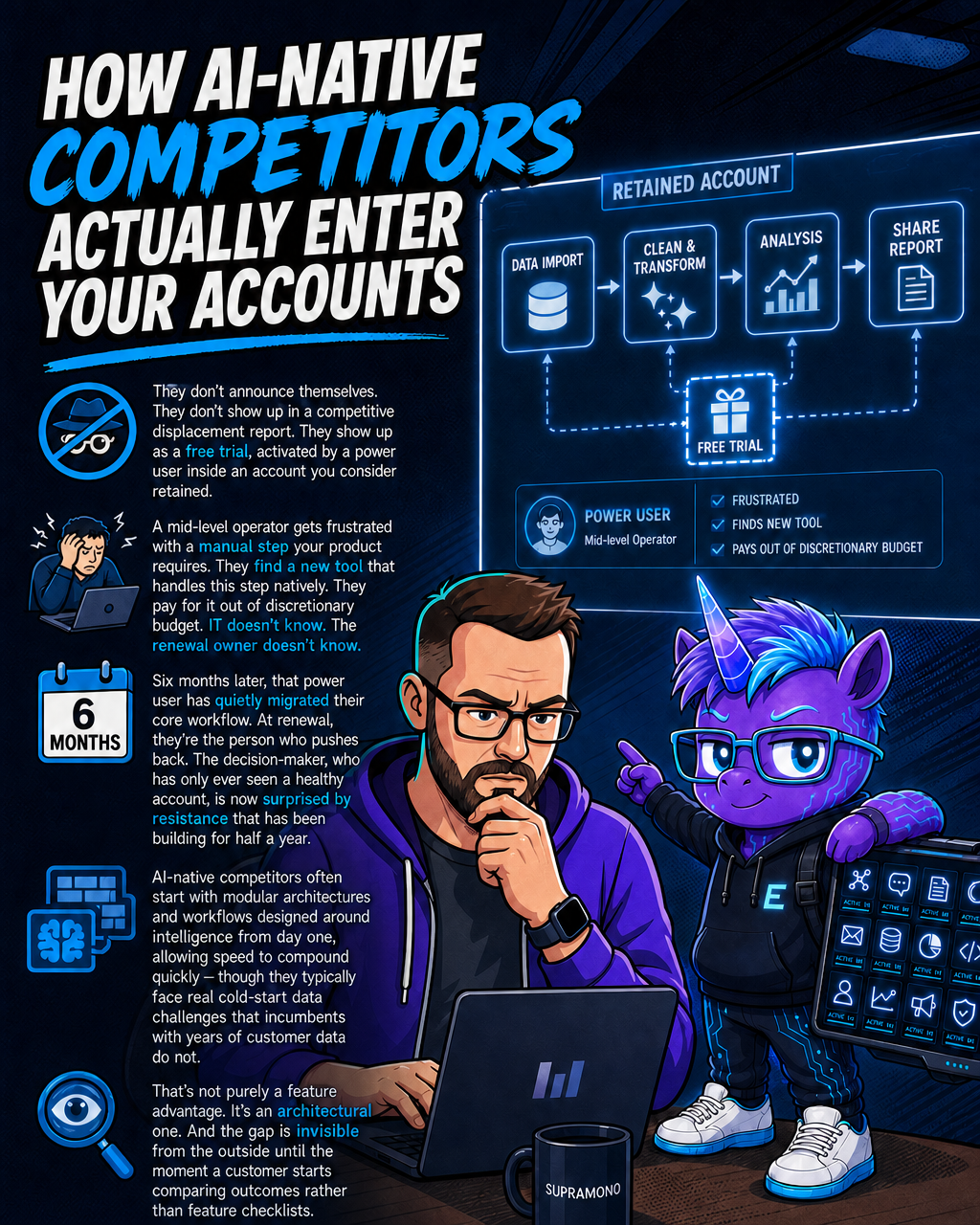
They don't announce themselves. They don't show up in a competitive displacement report. They show up as a free trial, activated by a power user inside an account you consider retained.
The pattern is consistent. A mid-level operator at one of your customers gets frustrated with a manual step your product requires. Maybe it's exporting a report to clean it up in Excel before sharing it. Maybe it's copying data between two modules that should talk to each other but don't. They find a new tool that handles this step natively, using inference rather than configuration. They pay for it out of discretionary budget. IT doesn't know. The renewal owner doesn't know.
Six months later, that power user has quietly migrated their core workflow. At renewal, they're the person who pushes back. The decision-maker, who has only ever seen a healthy account, is now surprised by resistance that has been building for half a year.
AI-native competitors often start with modular architectures and workflows designed around intelligence from day one, allowing speed to compound quickly — though they typically face real cold-start data challenges that incumbents with years of customer data do not. That's not purely a feature advantage. It's an architectural one. And the gap is invisible from the outside until the moment a customer starts comparing outcomes rather than feature lists.
The churn lag is longer than founders expect
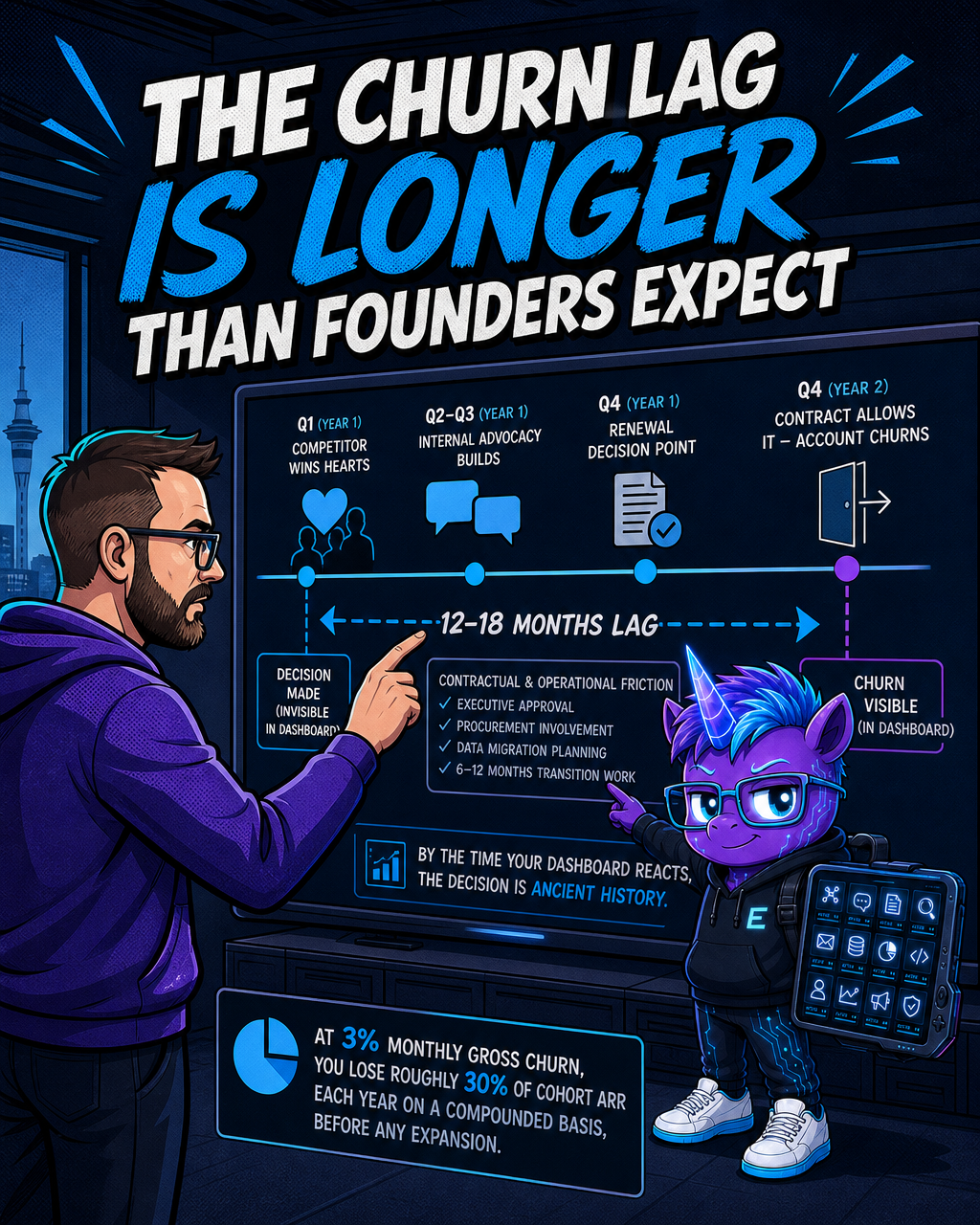
At 3% monthly gross churn — a figure more typical of SMB SaaS than enterprise — you lose roughly 30% of cohort ARR each year on a compounded basis, before any expansion. That math is widely understood. What's less understood is the timing gap between competitive displacement and visible churn.
In vertical SaaS, contracts provide structural friction. Enterprise customers especially don't cancel mid-term. Enterprise customers churn at dramatically lower rates not because enterprise products are better, but because cancelling an enterprise contract requires executive approval, procurement involvement, data migration planning, and often 6–12 months of transition work. The structural friction suppresses churn independently of product quality.
So here's what actually happens. A competitor wins the hearts of your power users in Q1. Those users start advocating internally for a switch. The renewal is in Q4. The account doesn't churn until Q4 of the following year, when the contract allows it. You've watched two full years of stable dashboards while the competitive loss was decided in the first quarter.
This is why a lag of often 12–18 months is plausible in practice — though the actual window varies significantly by contract length, deal size, and vertical. The cancellation happens when the contract allows it, not when the decision is made. By the time your dashboard reacts, the decision is ancient history.
The feature parity instinct is a trap
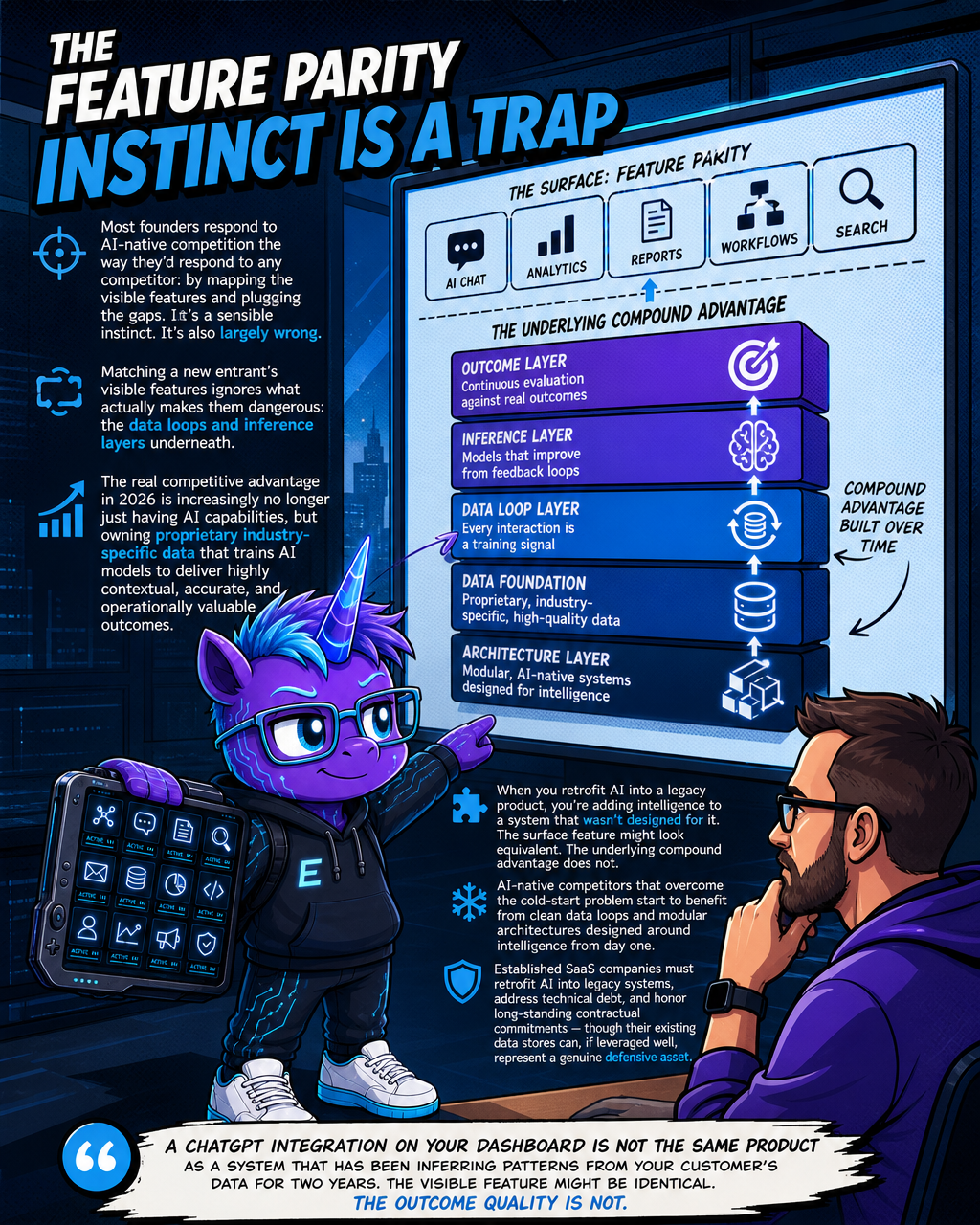
Most founders respond to AI-native competition the way they'd respond to any competitor: by mapping the visible features and plugging the gaps. It's a sensible instinct. It's also largely wrong.
Matching a new entrant's visible features ignores what actually makes them dangerous: the data loops and inference layers underneath.
Consider what an AI-native competitor builds from day one. Every interaction is a training signal. Every output is evaluated against an outcome. Their model gets better every week because it's wired to improve, not patched to compete. The real competitive advantage in 2026 is increasingly no longer just having AI capabilities, but owning proprietary industry-specific data that trains AI models to deliver highly contextual, accurate, and operationally valuable outcomes.
When you retrofit AI into a legacy product, you're adding intelligence to a system that wasn't designed for it. The surface feature might look equivalent. The underlying compound advantage does not. AI-native competitors that overcome the cold-start problem start to benefit from clean data loops and modular architectures designed around intelligence from day one. Established SaaS companies must retrofit AI into legacy systems, address technical debt, and honor long-standing contractual commitments — though their existing data stores can, if leveraged well, represent a genuine defensive asset.
A ChatGPT integration on your dashboard is not the same product as a system that has been inferring patterns from your customer's data for two years. The visible feature might be identical. The outcome quality is not.
Power users are your highest switching risk, not your lowest
There's a common assumption in retention thinking: power users are sticky. They've invested the most in learning the product. They've built the most workflows around it. That switching cost should protect them.
It does protect them, until a competitor removes the need for the workaround.
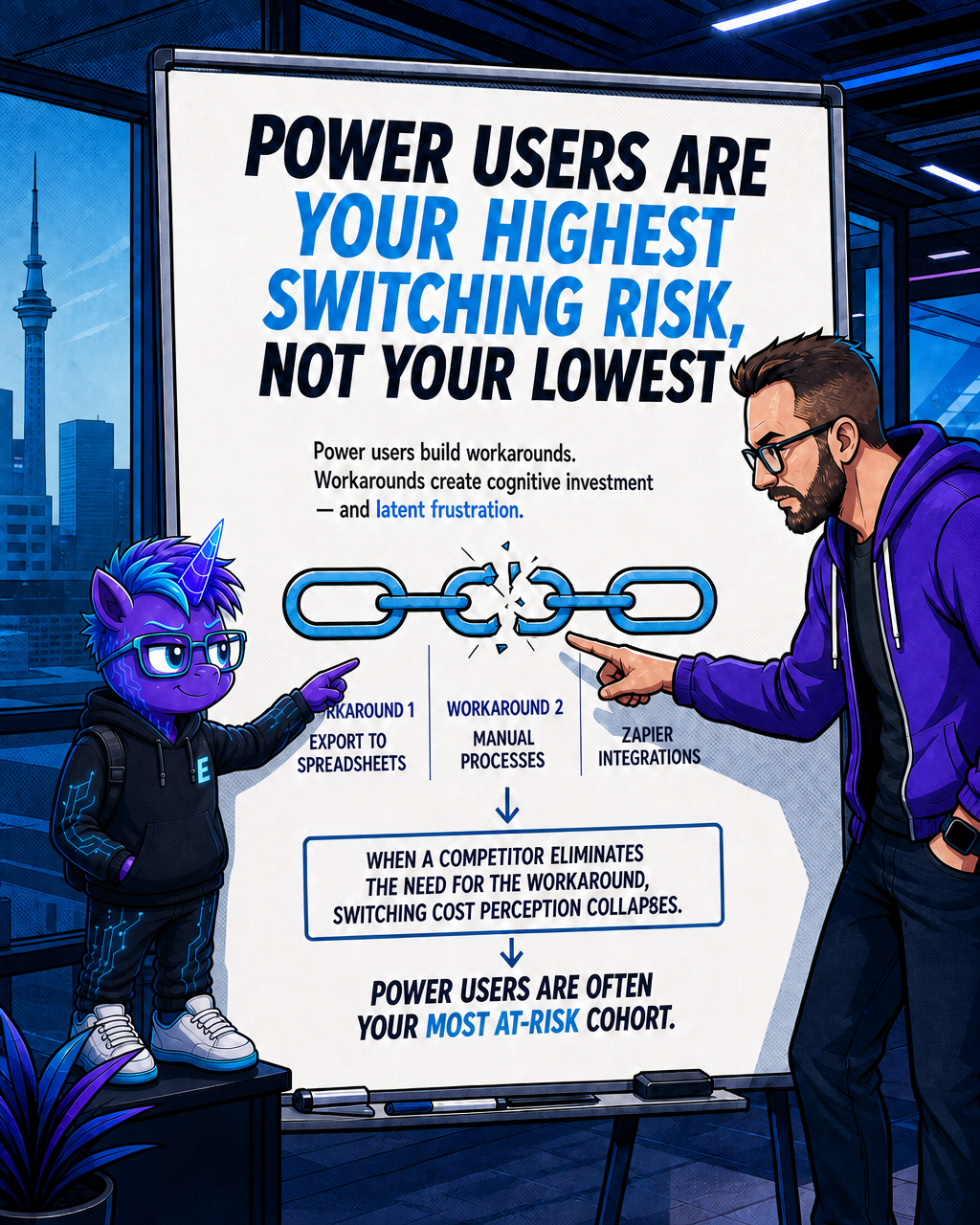
Here's the mechanism. Power users, by definition, push products harder than anyone else. They find the edges. They build workarounds for the gaps. They export to spreadsheets, build Zapier chains, maintain manual processes alongside the software. These workarounds represent cognitive investment. But they also represent latent frustration.
When an AI-native competitor shows up and natively handles what used to require three workarounds, the power user's switching cost perception collapses. They don't need to migrate their data model. They need to stop maintaining three hacks they've been quietly resenting for eighteen months.
In traditional SaaS, switching was brutal. Migrating your CRM meant months of data migration, retraining hundreds of reps, rebuilding integrations, reconfiguring workflows. With AI-native tools, the workflow often moves before the formal switch does — though it's worth noting that AI agents with deep workflow integration and embedded process automation can, in some cases, create higher switching costs than traditional SaaS. Both dynamics are present in the market and which applies depends heavily on how deeply the AI layer is embedded.
This is why power users aren't necessarily your most protected cohort under AI-native competition. They're often your most at-risk. They know exactly what they hate about your product. They're the first to find something that doesn't require them to hate it anymore.
What the real early warning signal looks like
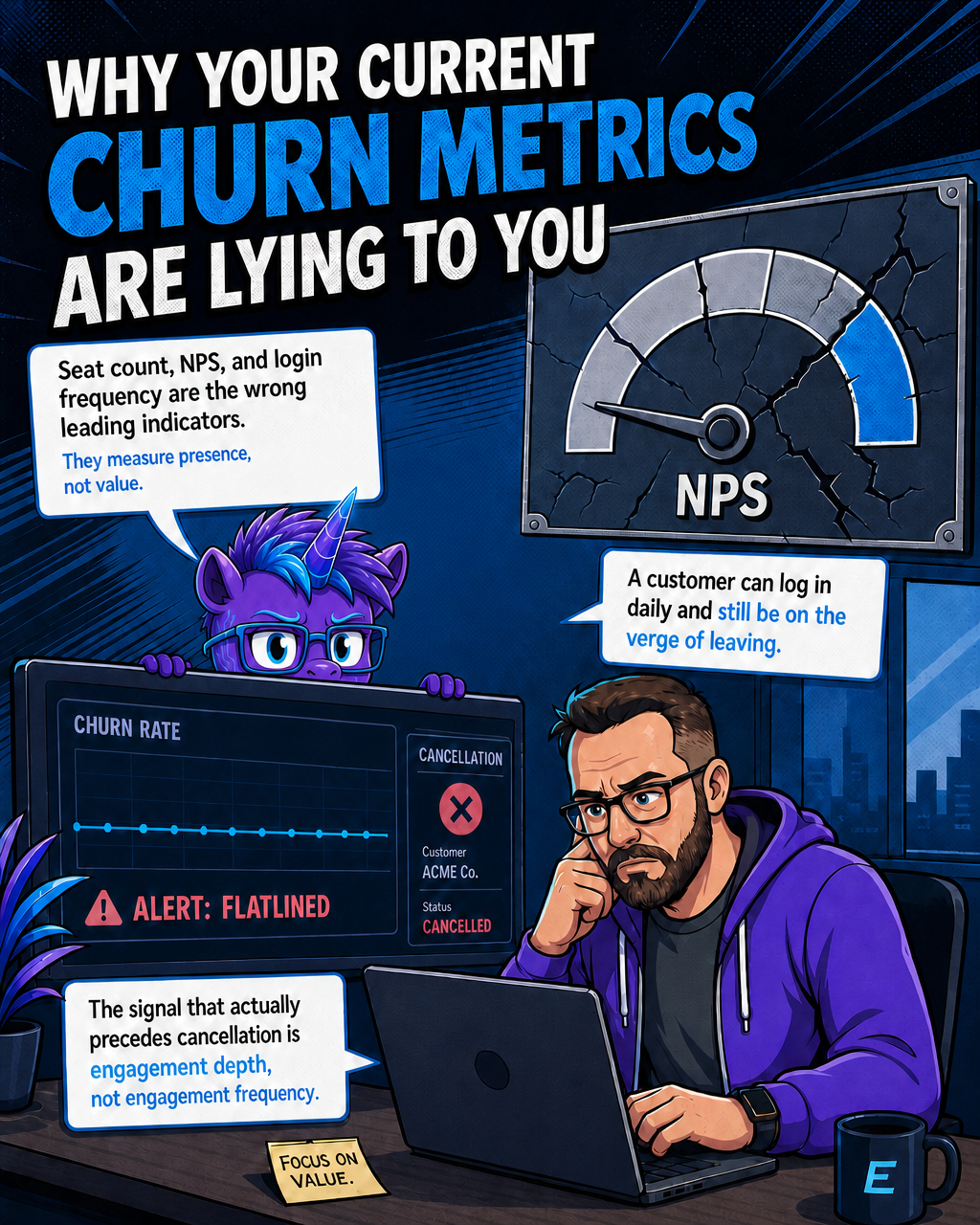
Most vertical SaaS companies track the wrong leading indicators. Seat count tells you how many contracts you have, not how much people value the product. NPS is a snapshot, not a trend. Login frequency is a shallow proxy for genuine engagement.
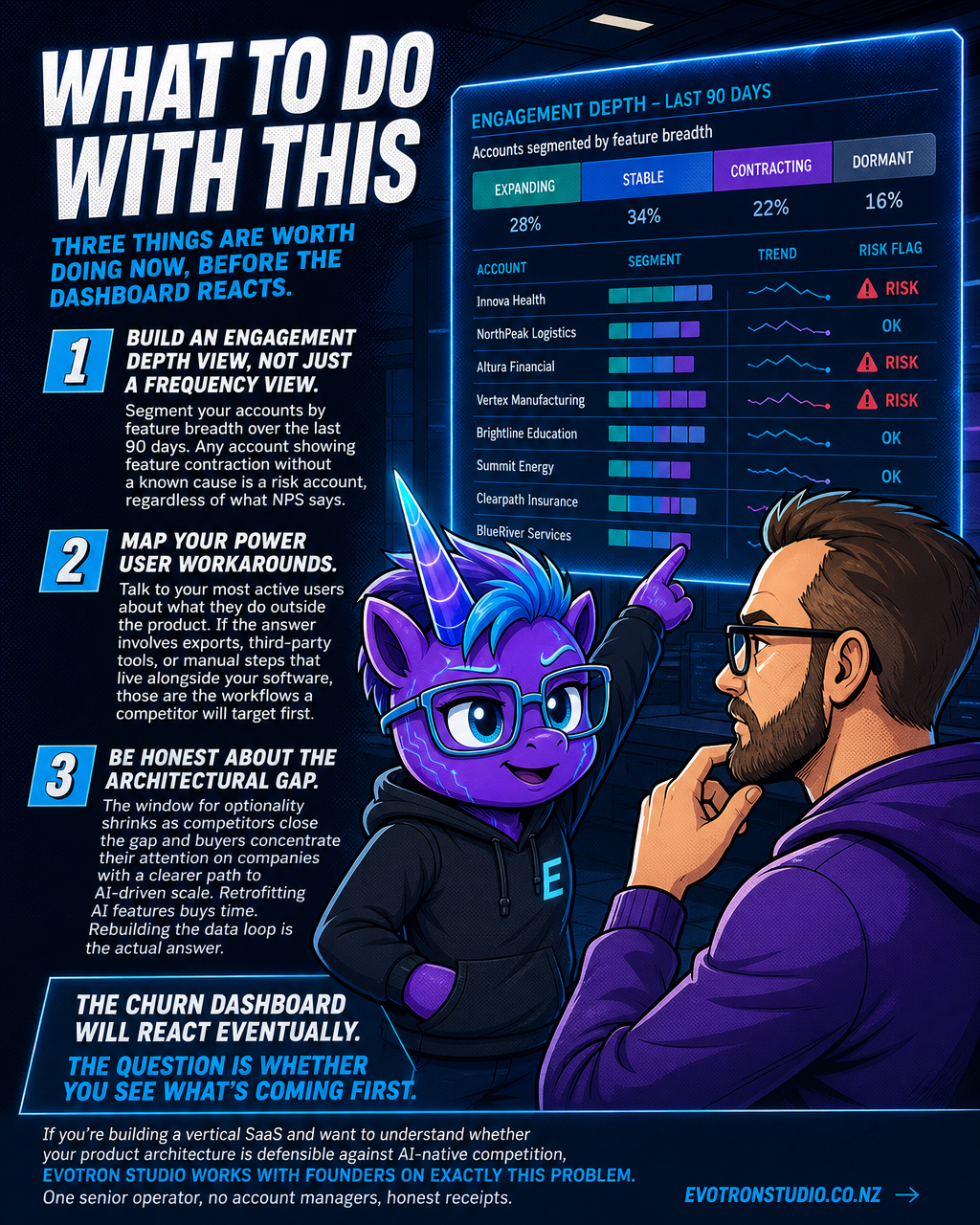
The signal that actually precedes cancellation is engagement depth, not engagement frequency.
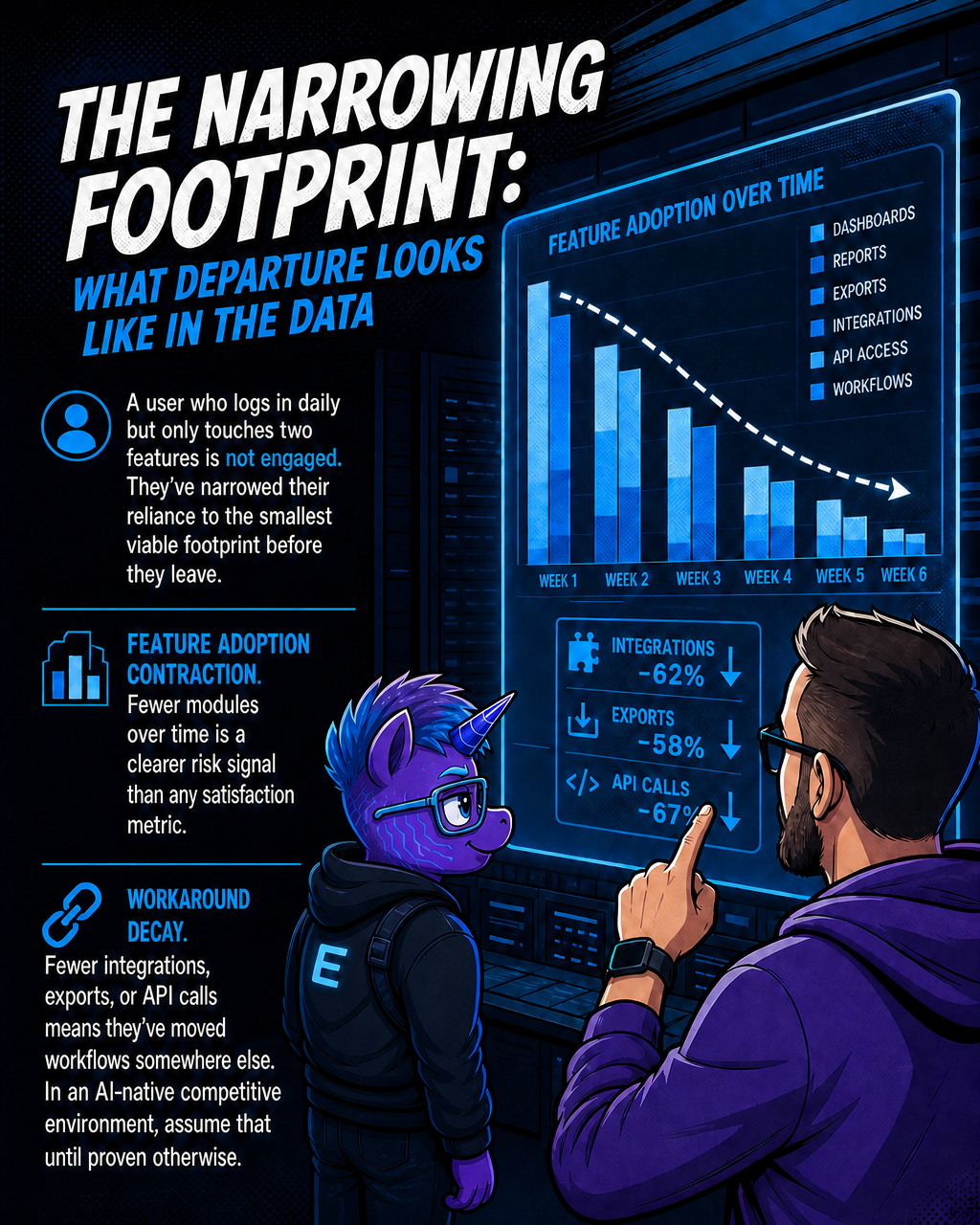
A customer might maintain regular login frequency but show declining engagement depth, which traditional metrics would miss. A user who logs in daily but only touches two features and skips the advanced modules is not an engaged user. They're a user who has narrowed their reliance to the smallest viable footprint before they leave.
Ongoing churn analysis can reveal signals such as declining logins, reduced feature usage, or spikes in support tickets that show up before customers leave. But you need to look at depth, not just count. The specific signals worth tracking:
Feature adoption contraction. Are users using fewer modules over time, not more? Contraction in feature breadth is a clearer risk signal than any satisfaction metric.
Workaround decay. If users are using fewer integrations, fewer exports, fewer API calls, it can mean one of two things: the product got better, or they moved those workflows somewhere else. In a period of active AI-native competition, assume the latter until proven otherwise.
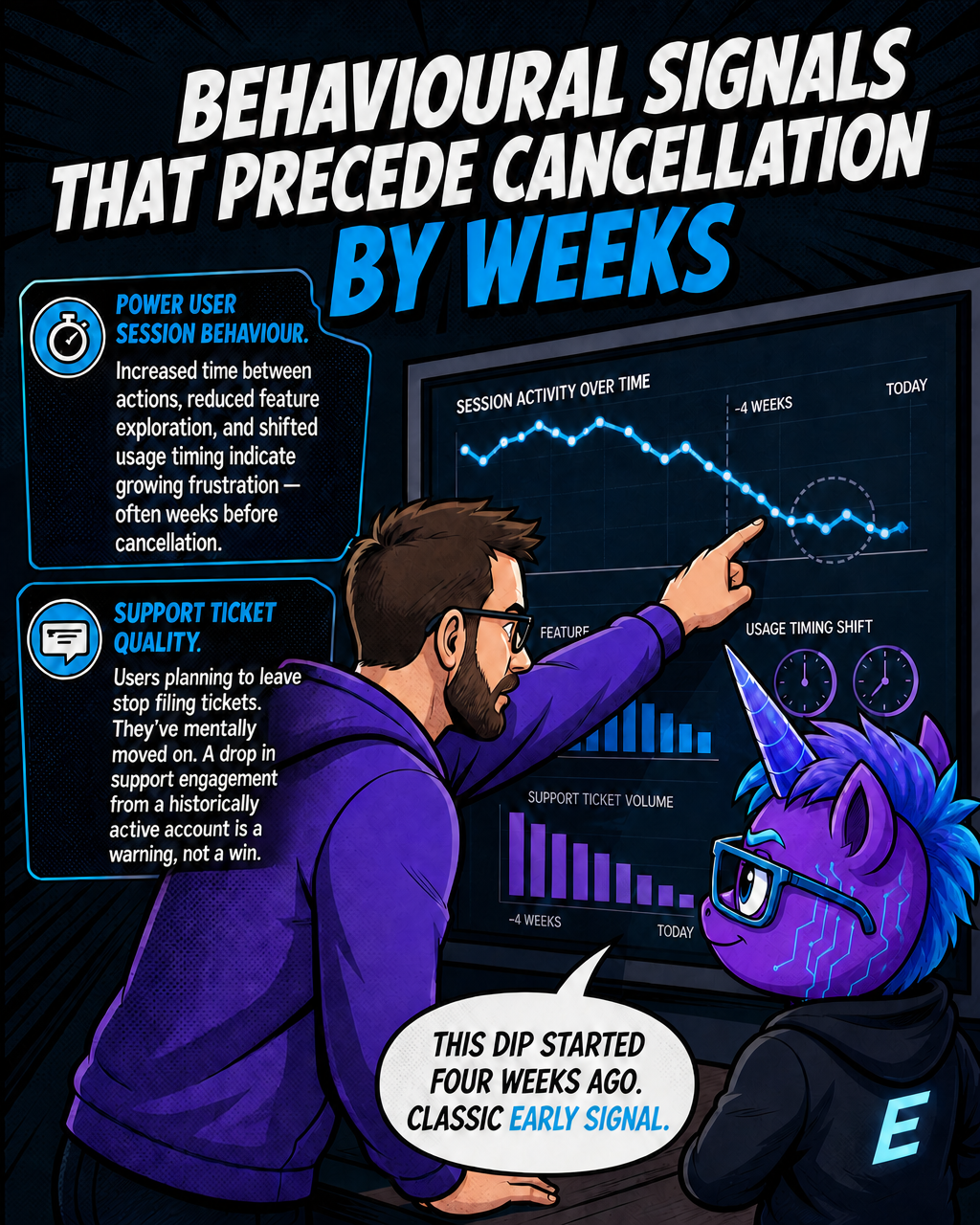
Power user session behaviour. Subtle changes like increased time between actions, reduced feature exploration, or changes in usage timing can indicate growing user frustration. These changes can precede cancellation by weeks or months, though the lead time varies considerably by product type, contract structure, and user role.
Support ticket quality. Users who are planning to leave often stop filing support tickets. They've mentally moved on. A drop in support engagement from a historically active account isn't a retention win. It's a warning.
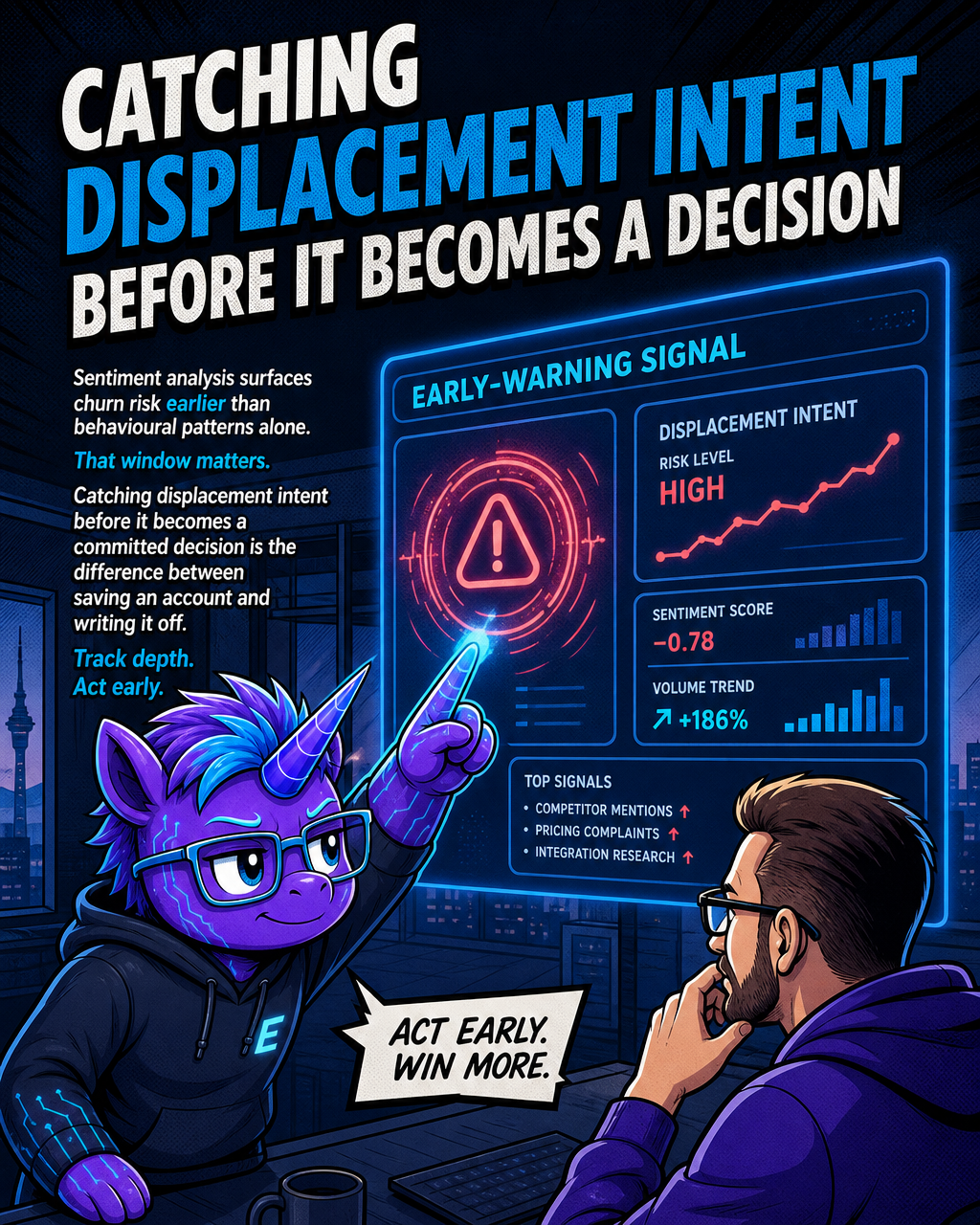
Sentiment analysis can provide earlier warning of churning customers compared to waiting for behavioural patterns to mature. That earlier window matters — catching displacement intent before it becomes a committed decision is the difference between saving an account and writing it off.
Why this pattern is accelerating in 2026
There is a growing consensus among analysts and practitioners that the era of "AI as a feature" is drawing to a close, and that 2026 is marking a meaningful shift toward AI-native apps and agentic AI becoming the standard of comparison. Reasonable observers disagree on pace and extent, but the directional shift is widely observed across the industry.
This represents a structural shift in what customers compare your product against. The vertical SaaS products most exposed are the ones that built their moat on workflow depth and switching cost alone, without building the data loop that makes AI inference compound.
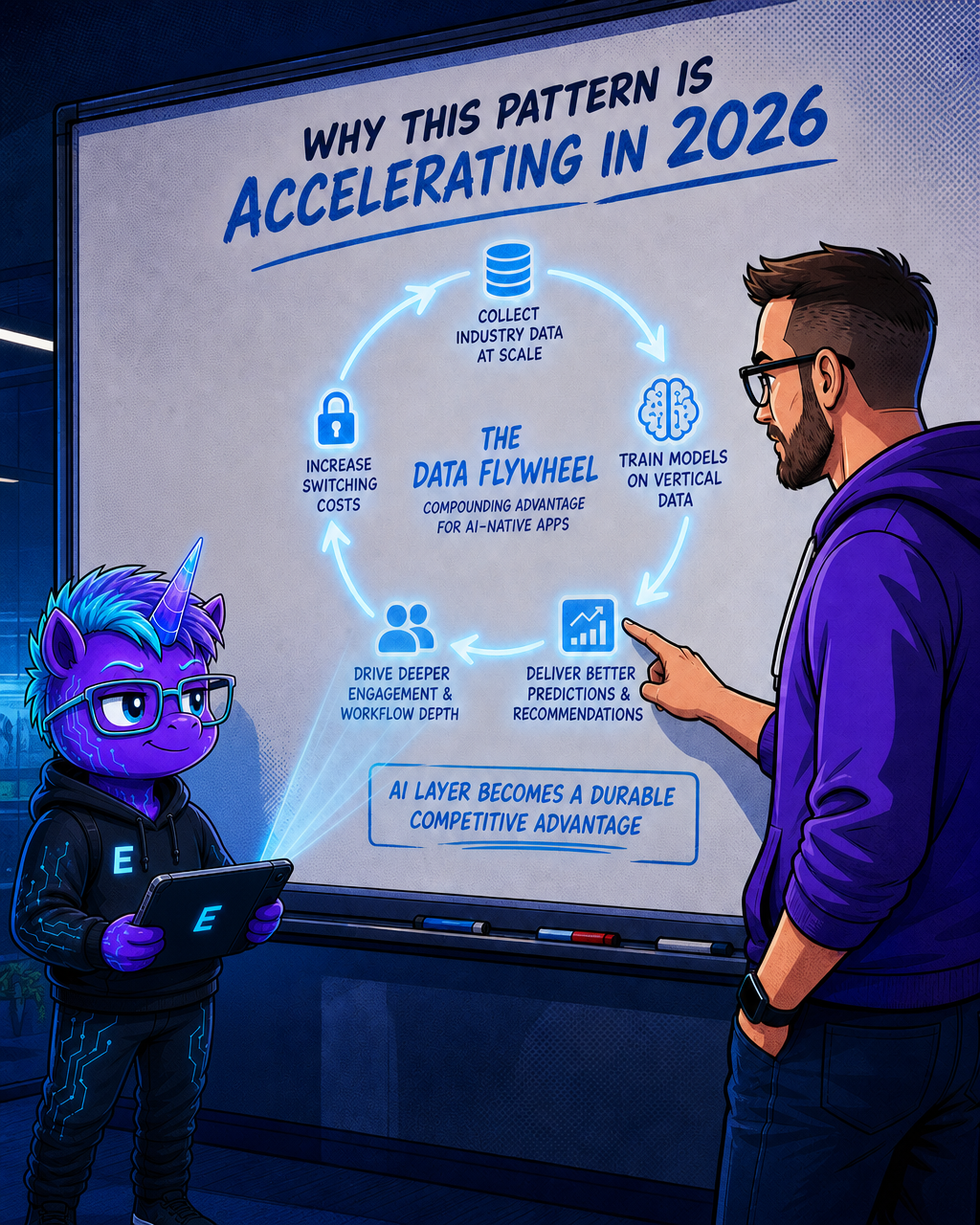
AI gives vertical SaaS platforms a potentially defensible data moat. Because they accumulate industry-specific operational data at scale, they can train models that produce predictions and recommendations most horizontal tools struggle to match without vertical-specific training data. A vertical SaaS for dental practices can predict appointment cancellations with greater precision than a generic scheduling tool — but only if that data advantage is actively leveraged. As this data flywheel compounds, the switching costs increase, making the AI layer a durable competitive advantage rather than a feature checkbox.
The vertical SaaS businesses best positioned to survive this shift aren't the ones that bolt AI onto an existing product and rewrite their homepage. They're the ones that use engagement depth signals to catch competitive displacement early, then rebuild the workflow from the inside out. That said, some incumbents — particularly those operating in heavily regulated verticals with deep EHR, ERP, or compliance dependencies — have successfully defended market position through more selective AI integration rather than full architectural rebuilds. The right response depends heavily on the switching cost structure of your specific vertical.
That's a different exercise from roadmap planning. It requires looking at your accounts honestly and asking: which of our power users is maintaining a workaround that a better-architected product would eliminate? That's your displacement map. That's where the floor is already shifting.
What to do with this
Three things are worth doing now, before the dashboard reacts.
First, build an engagement depth view, not just a frequency view. Segment your accounts by feature breadth over the last 90 days. Any account showing feature contraction without a known cause is a risk account, regardless of what NPS says.
Second, map your power user workarounds. Talk to your most active users about what they do outside the product. If the answer involves exports, third-party tools, or manual steps that live alongside your software, those are the workflows a competitor will target first.
Third, be honest about the architectural gap. The window for optionality shrinks as competitors close the gap and buyers concentrate their attention on companies with a clearer path to AI-driven scale. Retrofitting AI features buys time. Rebuilding the data loop is the actual answer.
The churn dashboard will react eventually. The question is whether you see what's coming first.
If you're building a vertical SaaS and want to understand whether your product architecture is defensible against AI-native competition, Evotron Studio works with founders on exactly this problem. One senior operator, no account managers, honest receipts.
Related reading

Evotron Studio
We build and run our own AI-amplified ventures — and bring the same capability into yours.
We build and run our own AI-amplified ventures — and bring the same capability into yours.
Learn more about Evotron Studio and get started today.
Visit Evotron Studio