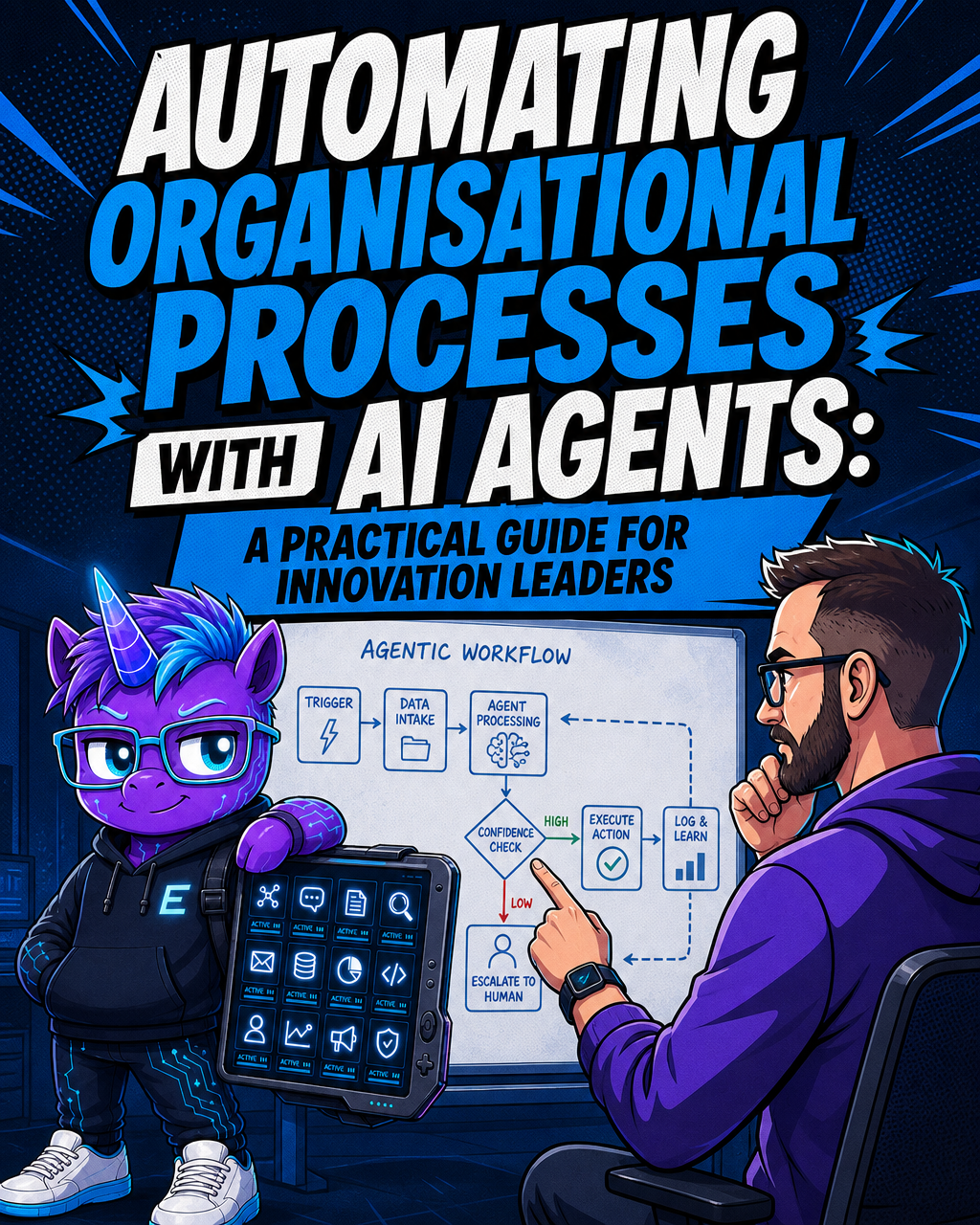
Automating Organisational Processes with AI Agents: A Practical Guide for Innovation Leaders
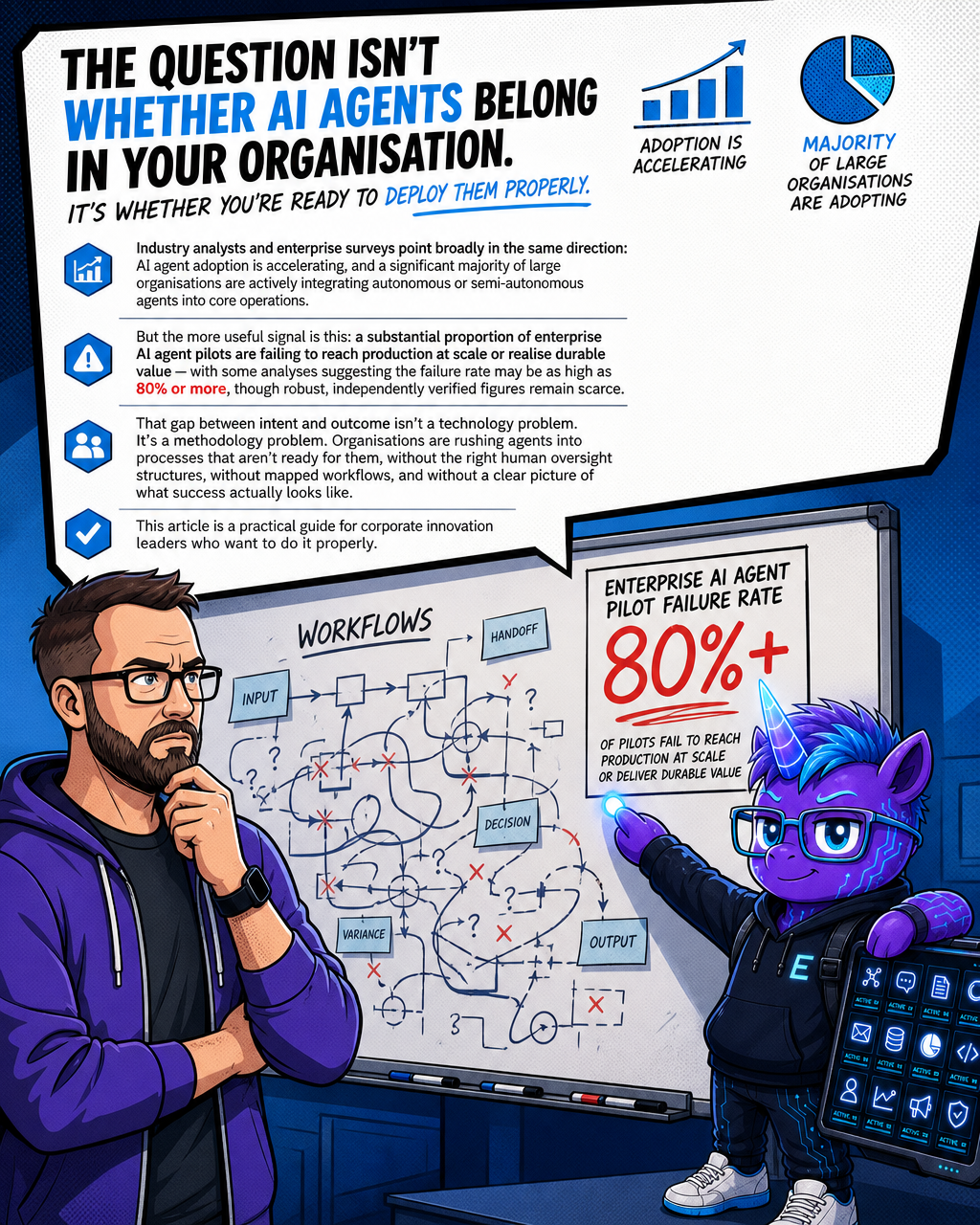

The question isn't whether AI agents belong in your organisation. It's whether you're ready to deploy them properly.
Industry analysts and enterprise surveys point broadly in the same direction: AI agent adoption is accelerating, and a significant majority of large organisations are actively integrating autonomous or semi-autonomous agents into core operations. But the more useful signal is this: a substantial proportion of enterprise AI agent pilots are failing to reach production at scale or realise durable value — with some analyses suggesting the failure rate may be as high as 80% or more, though robust, independently verified figures remain scarce.
That gap between intent and outcome isn't a technology problem. It's a methodology problem. Organisations are rushing agents into processes that aren't ready for them, without the right human oversight structures, without mapped workflows, and without a clear picture of what success actually looks like.
This article is a practical guide for corporate innovation leaders who want to do it properly.
What AI agents actually are (and aren't)
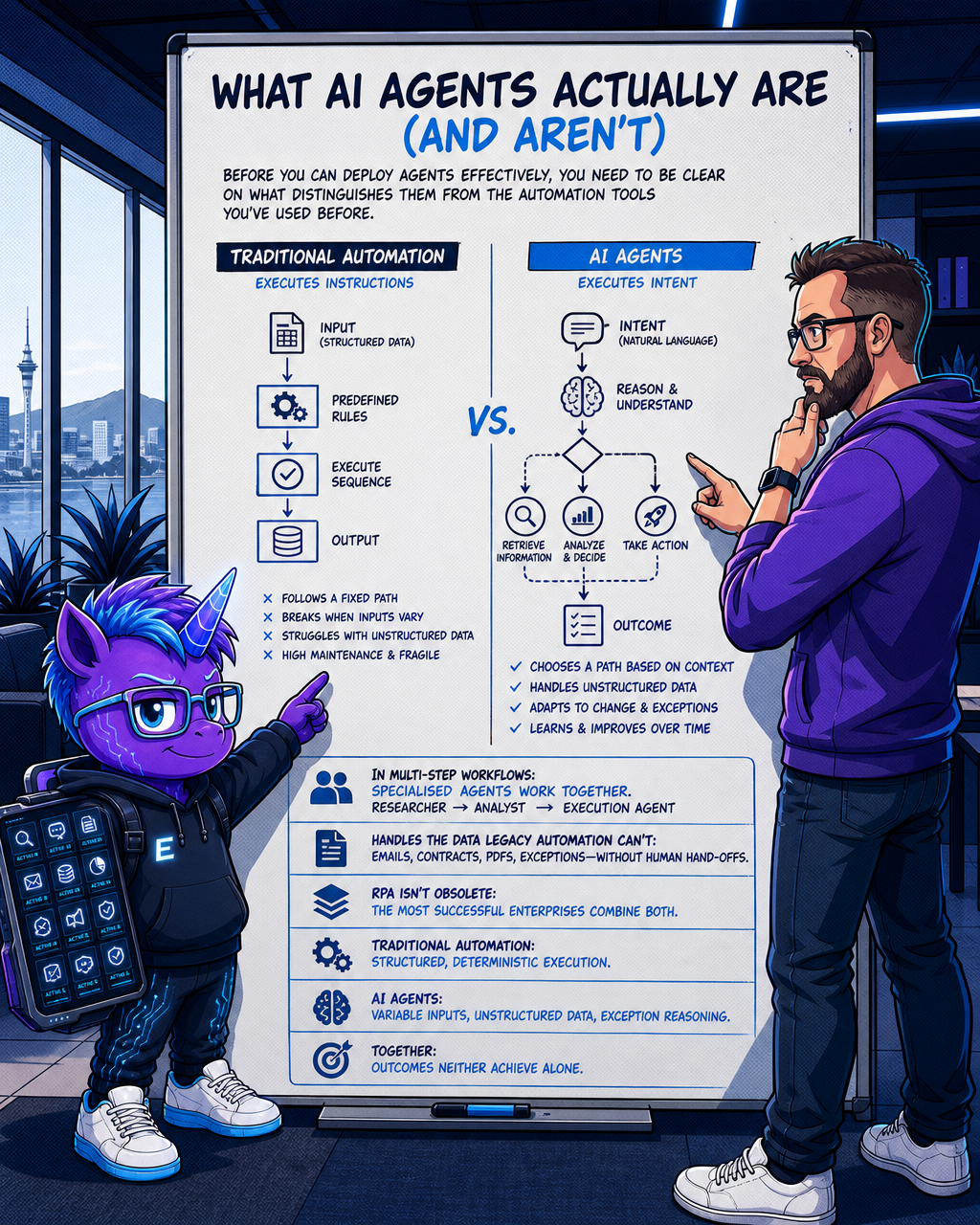
Before you can deploy agents effectively, you need to be clear on what distinguishes them from the automation tools you've used before.
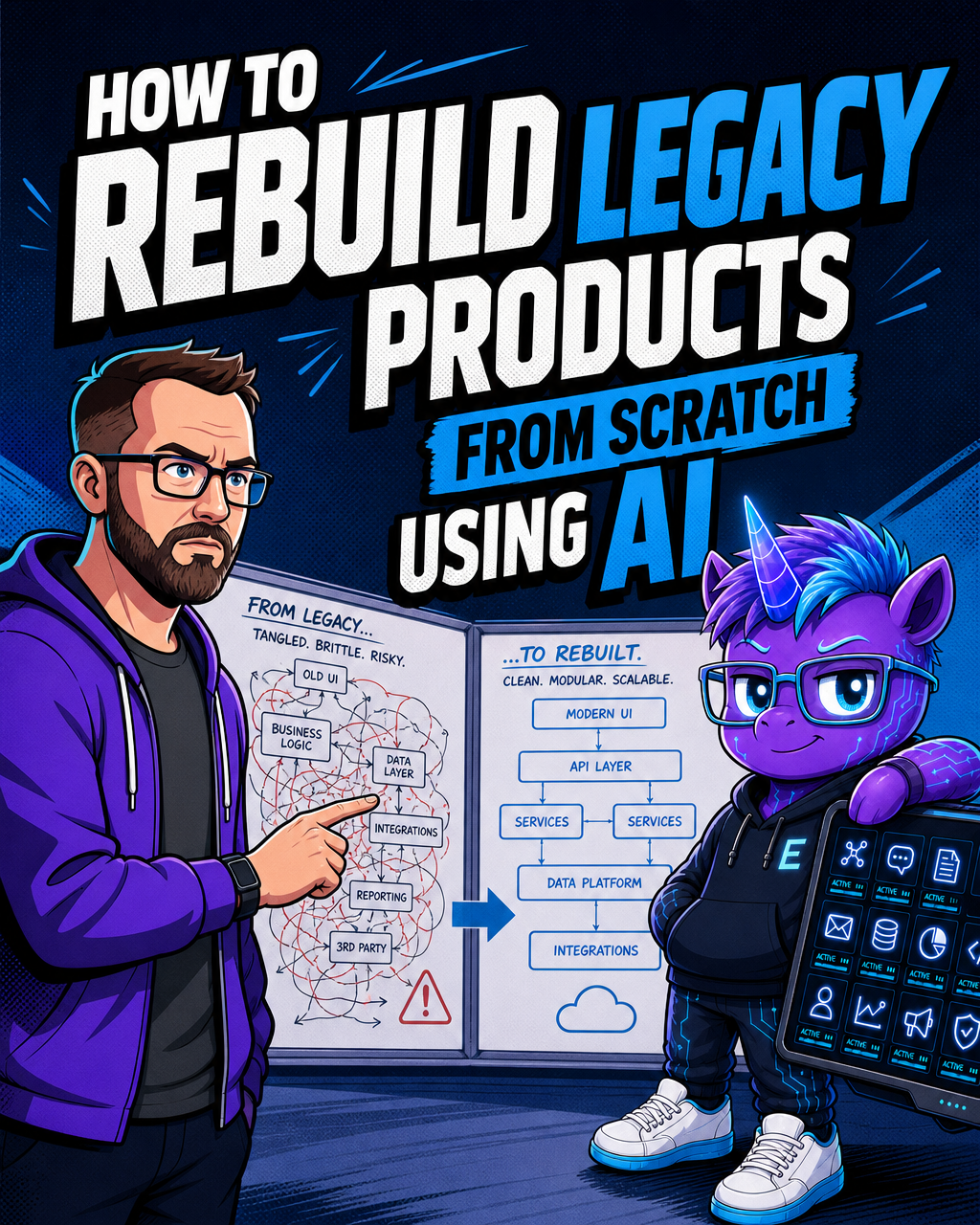
Traditional automation, including RPA, scripted workflows, and rule-based pipelines, executes predefined sequences on structured data. It fails when inputs vary, when unstructured data appears, or when the underlying application UI changes. That brittleness is expensive. Industry analysts have noted that maintenance can consume a significant portion of total RPA automation budgets — some estimates place this as high as 60–80% — though figures vary considerably by organisation and deployment maturity.
AI agents are architecturally different. Over the past several months, AI agents have moved from experimental technology to infrastructure that enterprises use in production. Unlike traditional software that waits for human input, agents reason through problems, make decisions, and take action autonomously, handling everything from multi-step coding workflows to cross-functional business processes.
The practical distinction is this: traditional automation executes instructions, while agentic automation executes intent. Traditional systems follow a fixed path; agents choose a path based on context.
In a multi-step workflow, that matters considerably. Enterprise architecture in 2026 relies heavily on multi-agent systems. Instead of one massive AI trying to run the whole company, businesses deploy specialised agents. A researcher agent gathers data, passes it to an analyst agent for review, who then hands the decision to an execution agent.
Agents can also handle the data your legacy automation can't touch. The majority of enterprise data is estimated to be unstructured — a figure widely cited in industry literature, including by IDC, though the precise percentage varies by source and methodology. Agents read emails, parse contracts, extract meaning from PDFs, and respond to exceptions without a human having to step in for every edge case.
This doesn't make RPA obsolete. The most successful enterprise automation programmes in 2026 deploy traditional automation and AI agents as complementary layers in a single process architecture. Traditional automation handles structured, deterministic execution. AI agents handle variable inputs, unstructured data, and exception reasoning. The combination delivers outcomes that neither technology achieves alone.
Start with the process, not the agent
The single biggest mistake innovation leaders make is trying to drop an agent into a process that hasn't been properly mapped. You end up with an AI making decisions that nobody can audit, in a workflow that nobody fully understands.
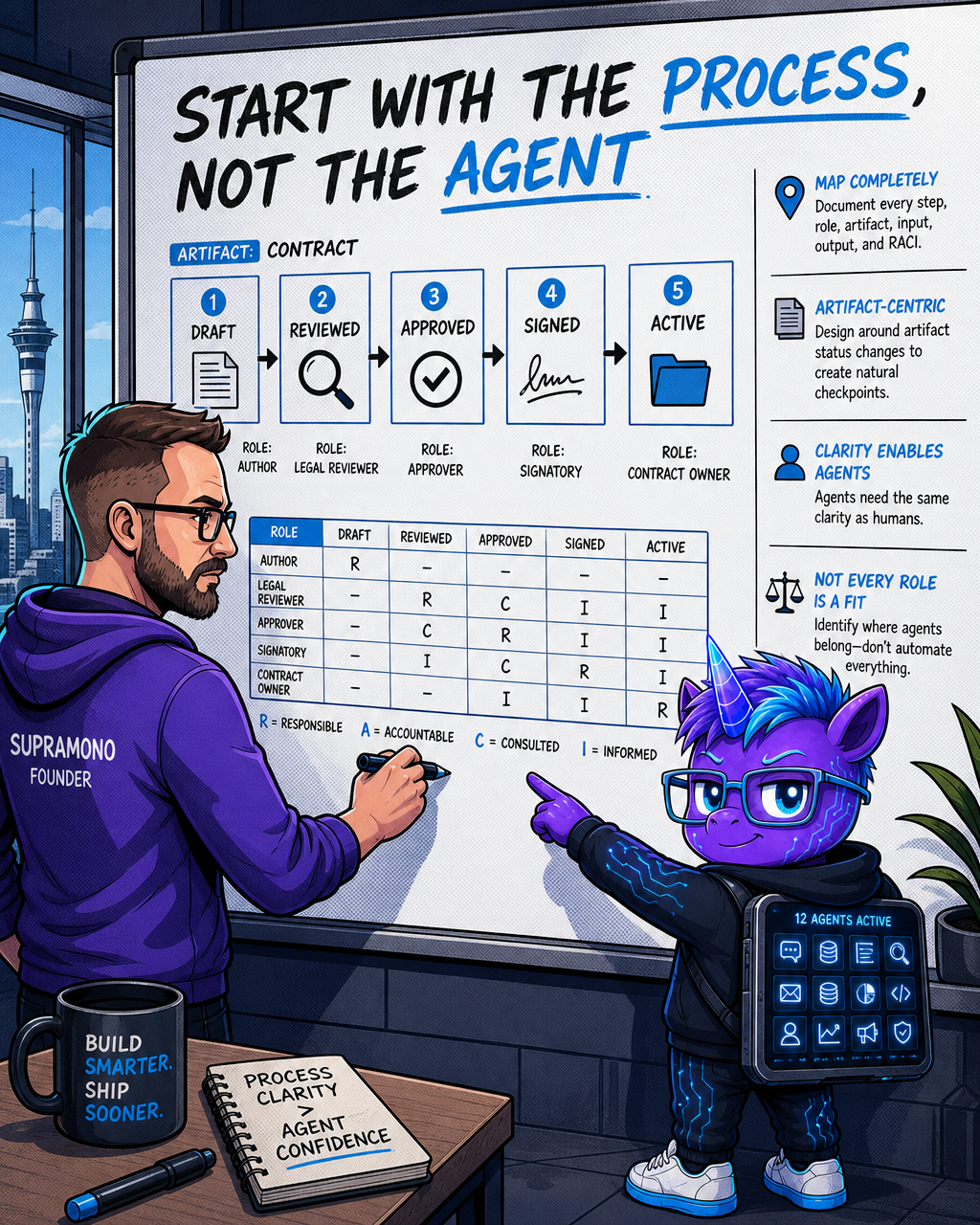
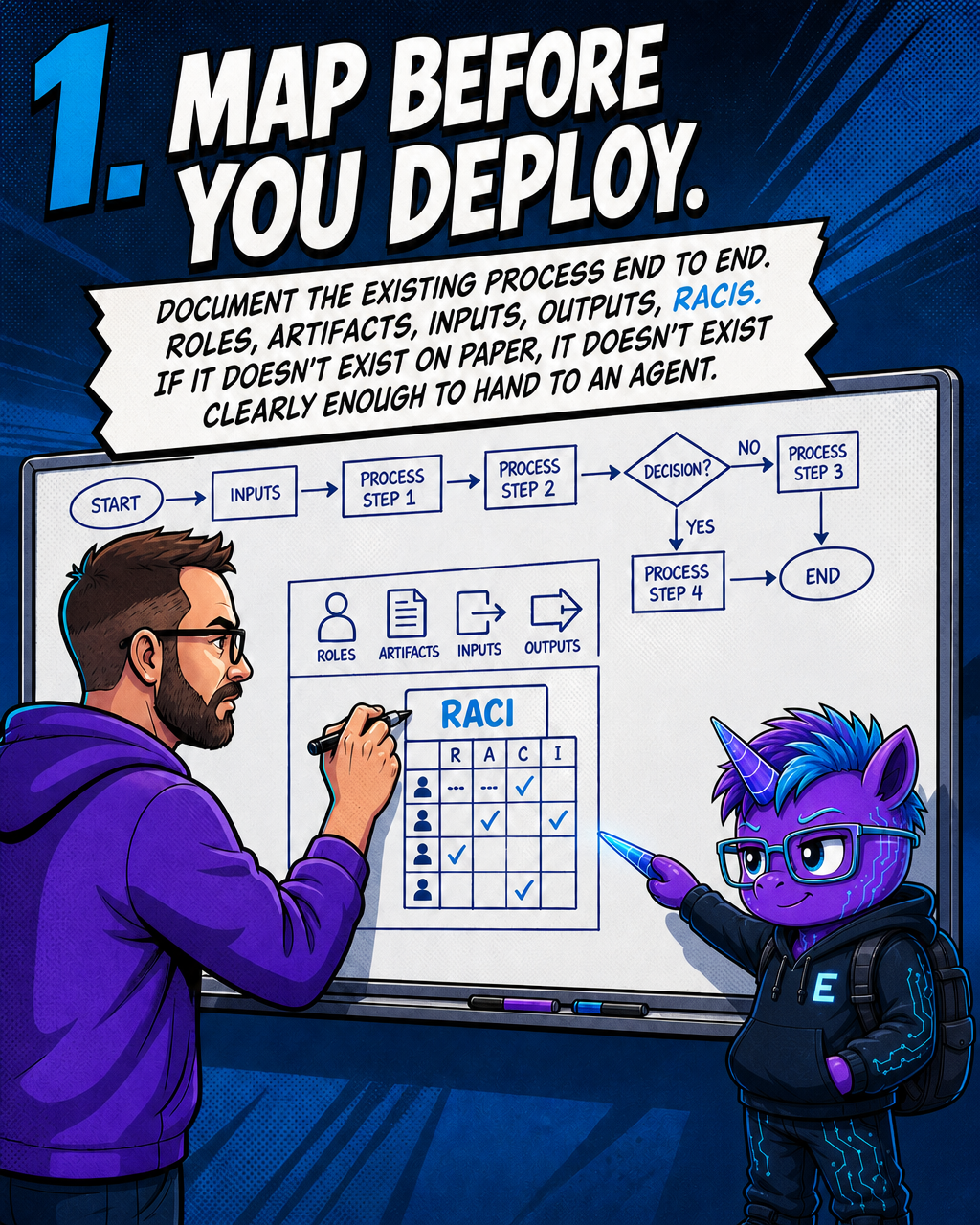
Before any agent touches a workflow, you need to do the unglamorous work: map the process completely.
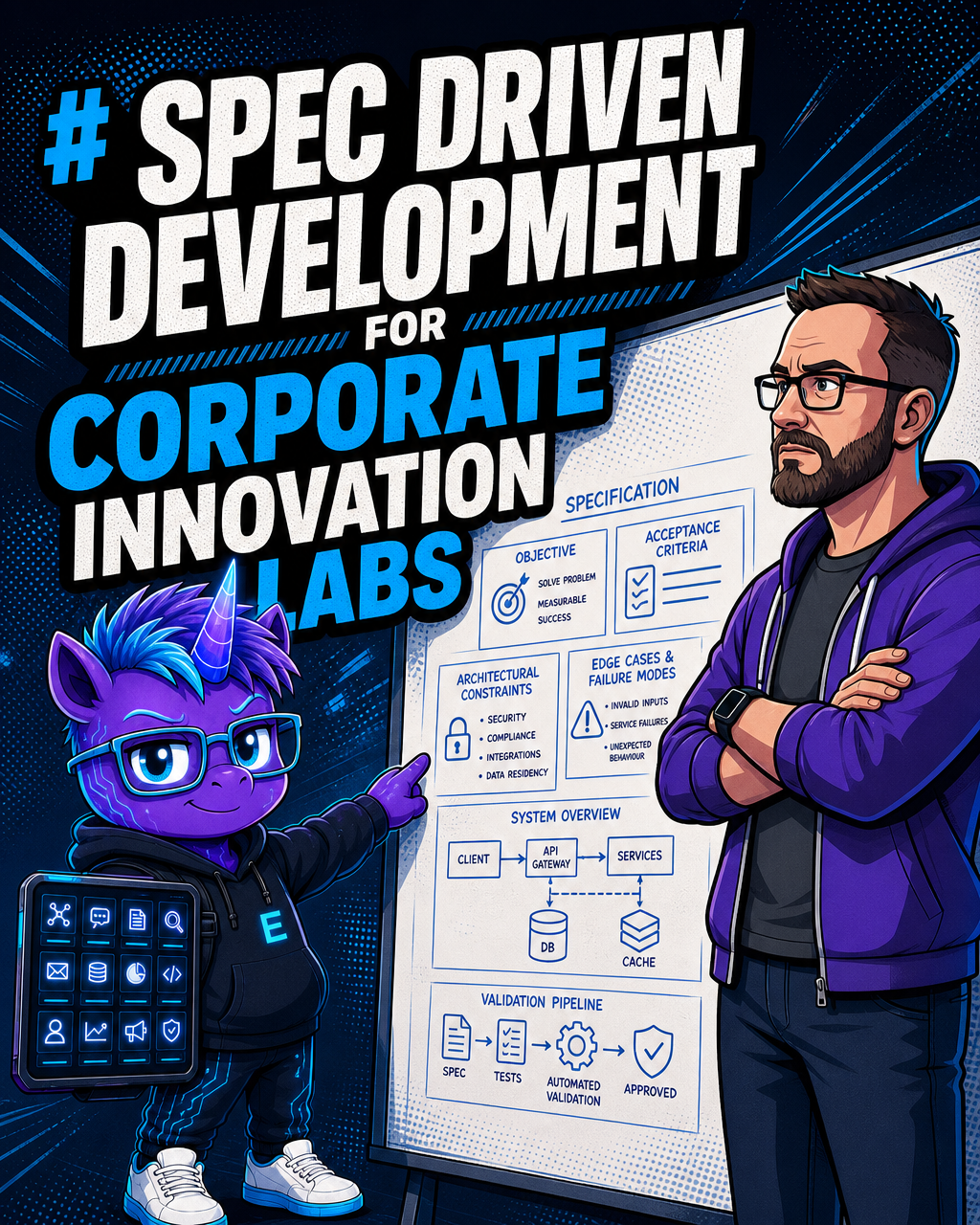
That means documenting every step, every role, every artifact the process produces or consumes, every input and required output, and who is responsible, accountable, consulted, and informed at each stage. If your RACI doesn't exist yet, build it now. Not because it's good project hygiene, but because agents need the same clarity humans do. They need to know what they're receiving, what they're expected to produce, what the definition of done looks like, and under what conditions they should stop and escalate.
Artifact-centric thinking is particularly useful here. Structure your process around the documents, records, or outputs that change state as work moves through the workflow. A contract moves from draft to reviewed to approved. A procurement request moves from submitted to validated to authorised. When you design your process around artifact status changes with clearly defined role responsibilities at each transition, you create natural checkpoints where agents can hand off, humans can review, and oversight can be maintained without constant interruption.
This mapping work also reveals something important: not every role in the process is a candidate for an agent. Some require human judgment, accountability, or relationship. The goal of the mapping exercise is to identify where agents genuinely belong, not to automate everything by default.
The use cases already delivering results
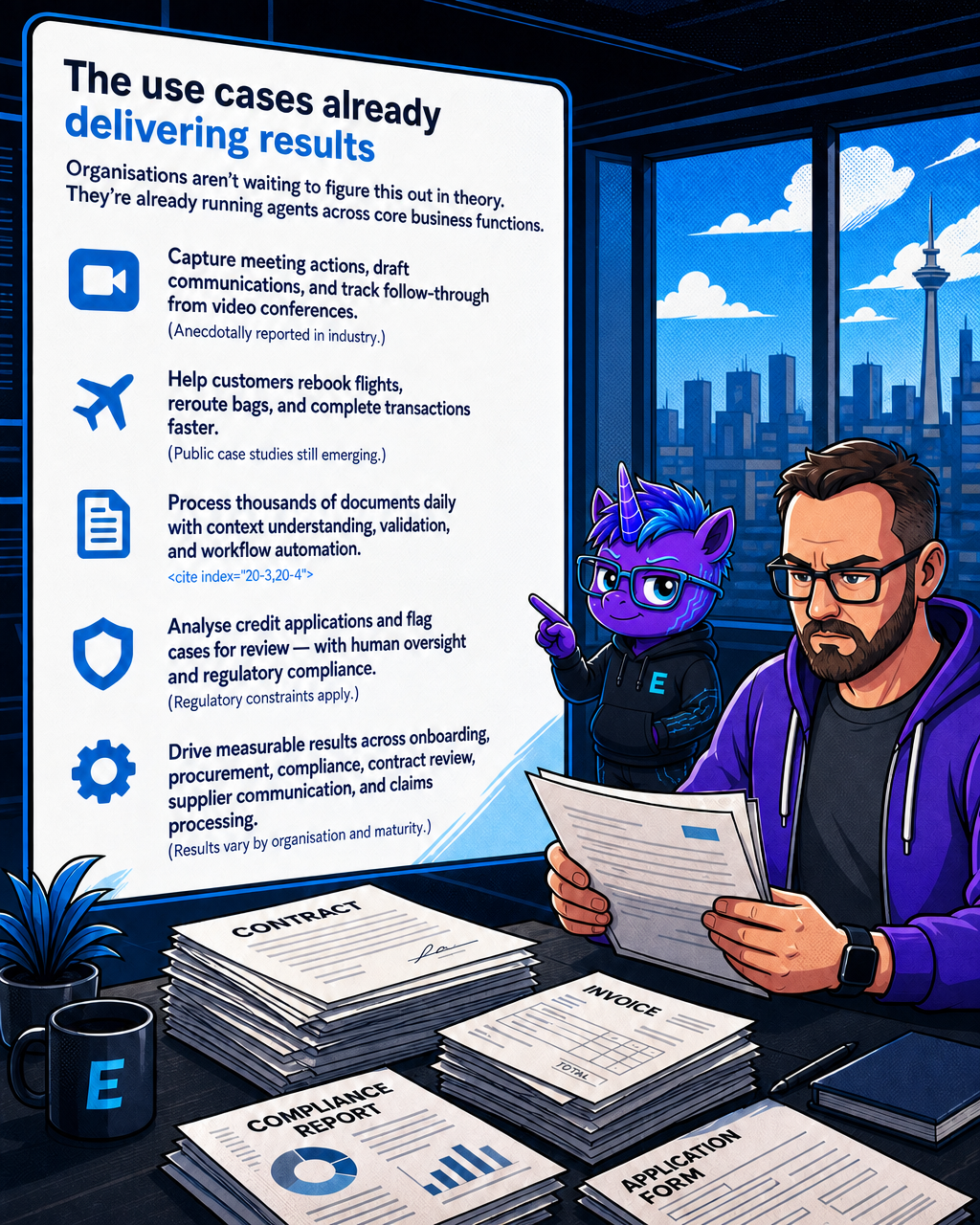
Organisations aren't waiting to figure this out in theory. They're already running agents across core business functions.
Some financial services organisations are building agentic workflows to automatically capture meeting actions from video conferences, draft communications to remind participants of their next steps, and track follow-through. (Specific companies running such deployments have been reported anecdotally in industry coverage, though named, independently verified case studies remain limited.)
Some carriers are using AI agents to help customers complete common transactions, such as rebooking a flight or rerouting bags, freeing up human agents to address more complex matters. (Again, named public case studies with verified outcomes are still emerging.)
Every enterprise processes thousands of documents daily: contracts, invoices, compliance reports, and application forms. AI agents are transforming this by not only extracting data but also understanding context, validating information against business rules, and triggering appropriate workflows without human intervention.
Some financial services enterprises have reported using AI agents to help analyse credit applications and flag cases for human review and escalation. It is worth noting that in most jurisdictions — including under ECOA in the United States and Consumer Duty in the United Kingdom — fully autonomous credit approval decisions face significant regulatory constraints around explainability and human oversight, and any such deployment would need to be designed accordingly.
Employee onboarding, procurement approvals, compliance monitoring, contract review, and supplier communication are all producing measurable results in production deployments. Some early adopters have reported meaningful reductions in workflow cycle times in back-office operations such as claims processing, though results vary significantly by organisation, integration complexity, and process maturity — and independently verified, peer-reviewed data on typical improvement ranges remains limited.
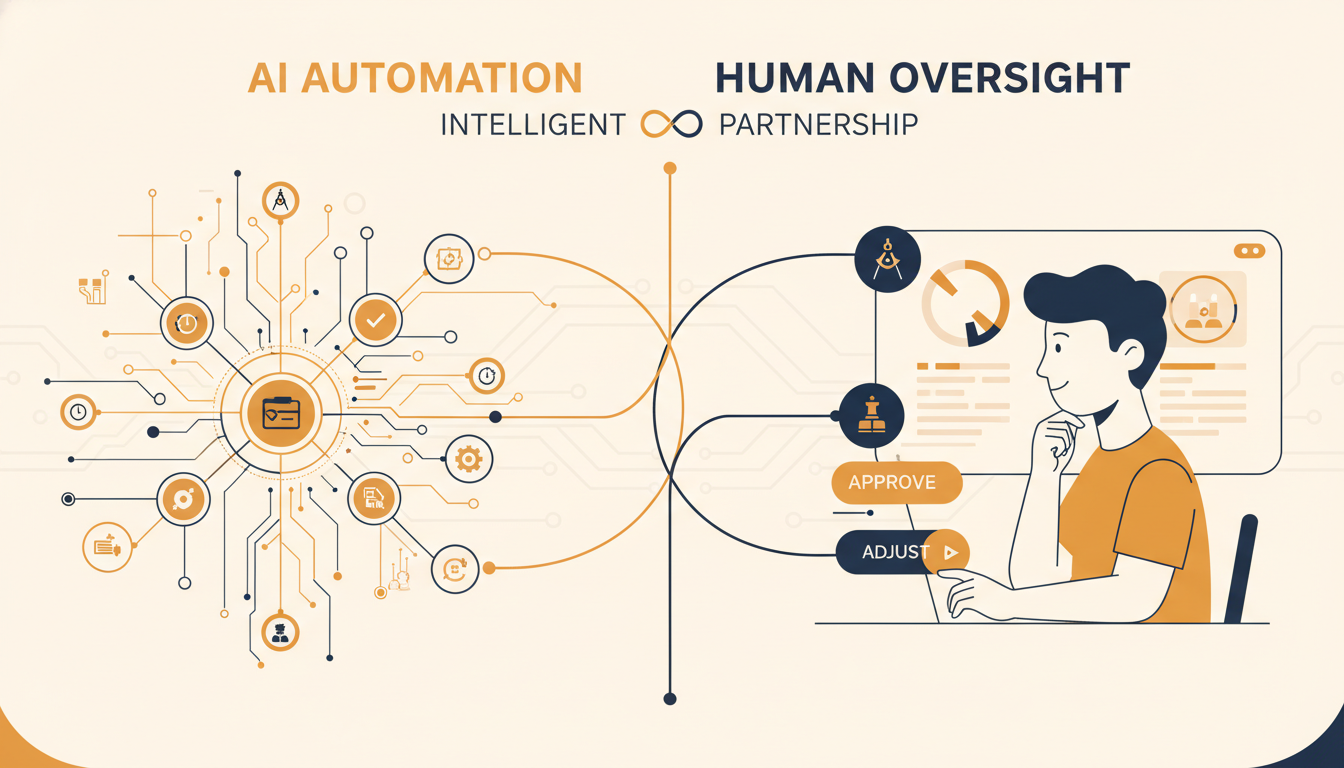
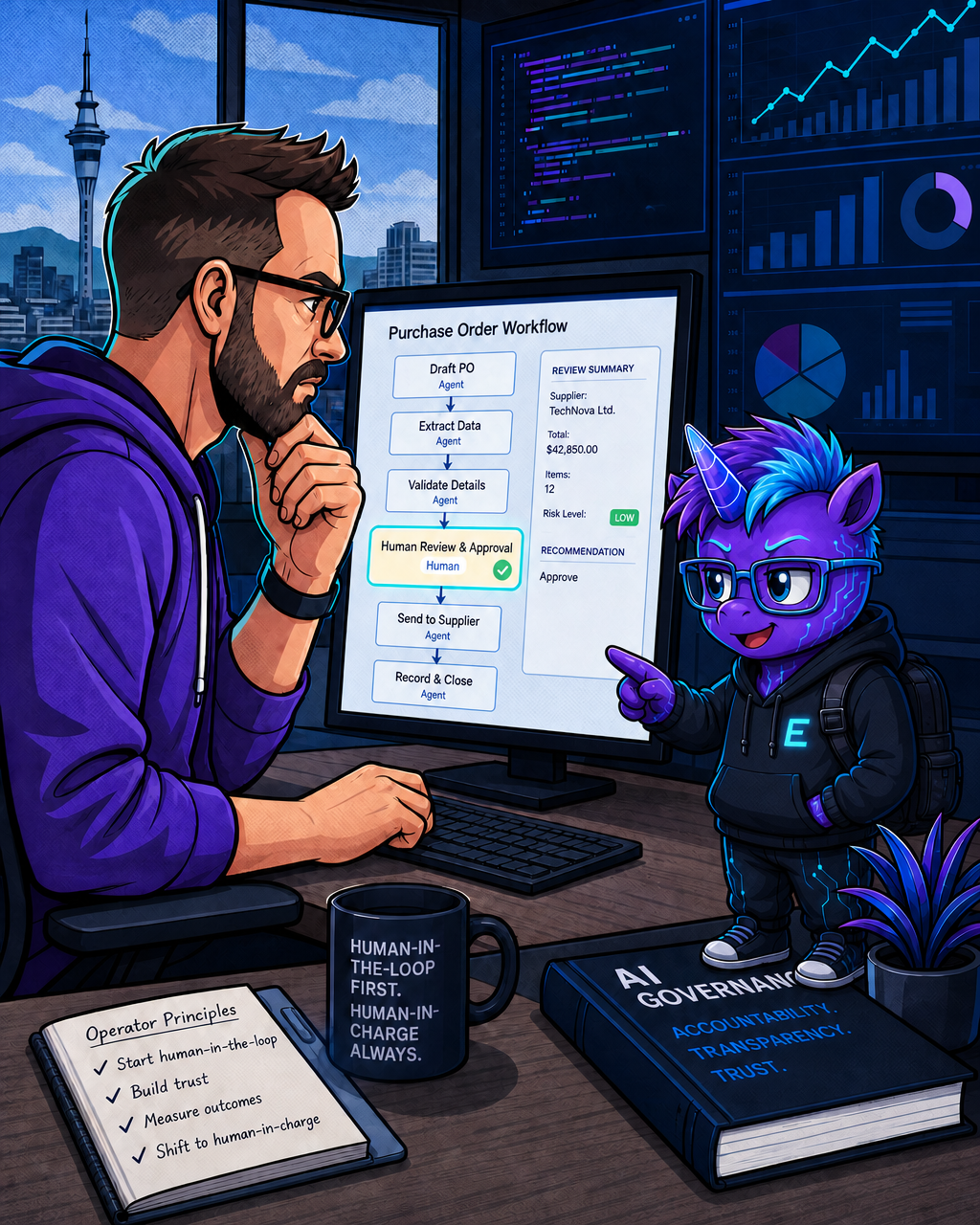
Human-in-the-loop first. Human-in-charge always.
Here's the principle that separates organisations getting durable value from those burning through pilot budgets: agents amplify human capability. They don't replace human accountability.
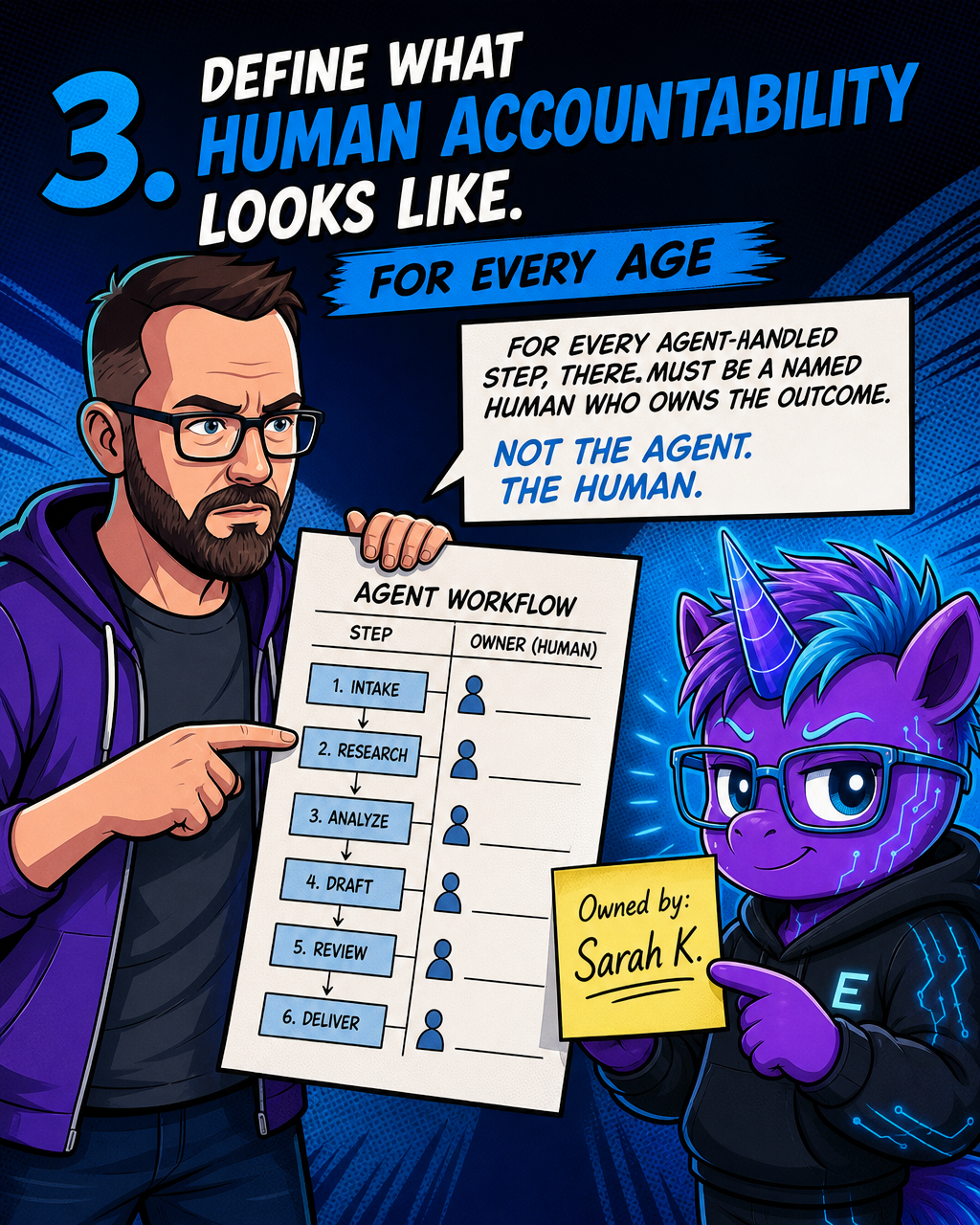
Your innovation leaders, your compliance officers, your procurement managers — they remain accountable for the outcomes of every process an agent touches. The agent accelerates and improves the work. The human owns the result.
Instead of dozens of pilots, successful organisations focus on two or three high-value, production-shaped use cases with clear business owners, defined KPIs, and explicit guardrails. Pick a process where the stakes are real but bounded, where the outputs are measurable, and where the humans who currently run the process can actively evaluate what the agent is doing.
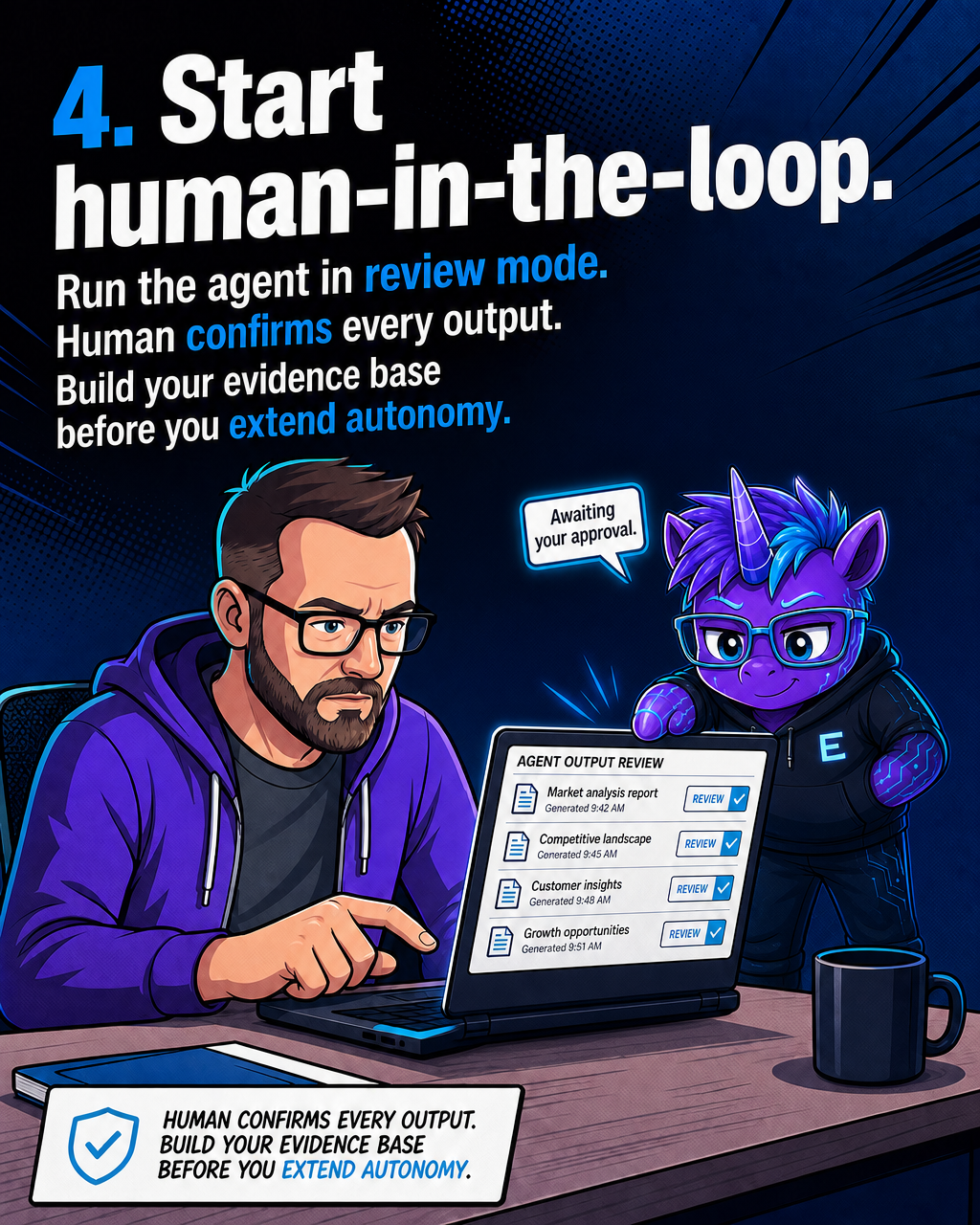
Start in human-in-the-loop state. In this model, the agent does the work and a human reviews and approves before any output takes effect. The agent handles the drafting, the data extraction, the routing decision — the human confirms before it moves forward. This is where you build trust in the system, identify failure modes, and tune the agent's behaviour against real-world conditions.
Once you've run enough volume through the process to understand where the agent is reliable and where it isn't, you can shift progressively toward human-in-charge. In this model, the agent acts autonomously on routine cases and surfaces only the exceptions, the ambiguous decisions, and the high-stakes calls to a human. The human is still firmly in charge — they're just not reviewing every output manually. They're setting policy, reviewing performance, and intervening when the agent flags uncertainty.
This progression matters because trust in AI systems is built through accumulated evidence, not assumed capability.
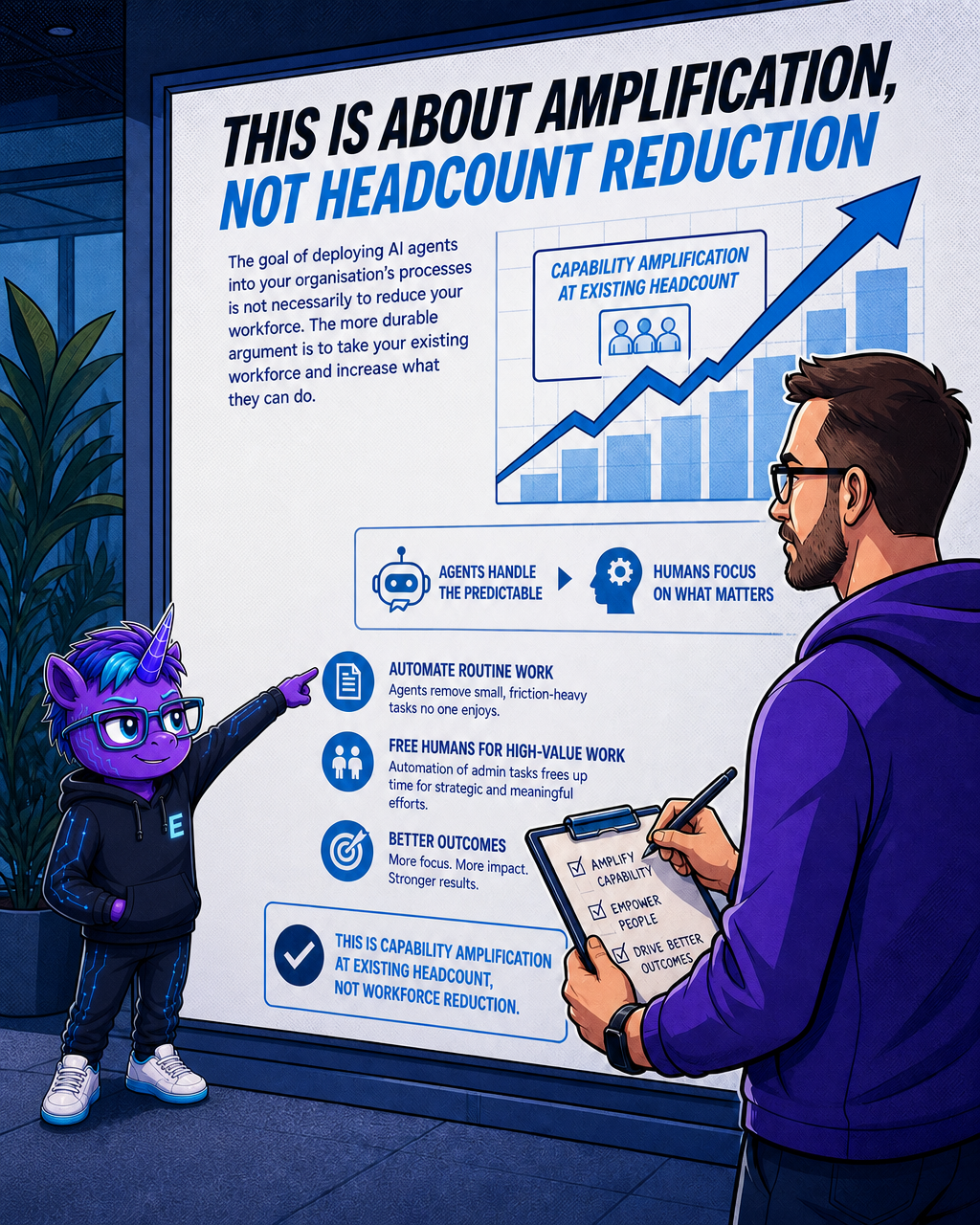
This is about amplification, not headcount reduction
Let's be direct about something that often gets muddled in these conversations.
The goal of deploying AI agents into your organisation's processes is not necessarily to reduce your workforce. That said, different organisations will have different objectives, and some will pursue efficiency gains that do involve workforce restructuring. The more durable argument — and the one that tends to produce better outcomes — is to take your existing workforce and increase what they can do. Organisations that frame agentic automation primarily as a cost-reduction exercise through headcount cuts often find themselves facing employee resistance, a culture that treats agents as a threat, and a governance vacuum where nobody owns the quality of what the agents produce.
Successful implementations of AI agents don't replace human agents; they automate predictable interactions, allowing humans to focus on critical tasks that require creativity, empathy, and complex problem-solving.
Your compliance analyst who currently spends four hours a day reviewing routine documentation can spend those same four hours on the complex cases that actually require their expertise. Your procurement officer who manually chases approvals via email gets to focus on supplier strategy and contract negotiation instead. The work that's menial, repetitive, and error-prone moves to the agent. The work that's genuinely difficult, relationship-dependent, or judgment-heavy stays with the person.
Agents remove small, friction-heavy tasks such as updating CRMs or writing routine requirement documents — the tasks no one enjoys. This automation of administrative tasks frees up humans to focus on high-value interactions or strategic initiatives.
The framing to take into your board conversation: this is capability amplification at existing headcount, not workforce reduction. For many organisations, that's a more sustainable and more credible proposition — and one that will get you further with your teams.
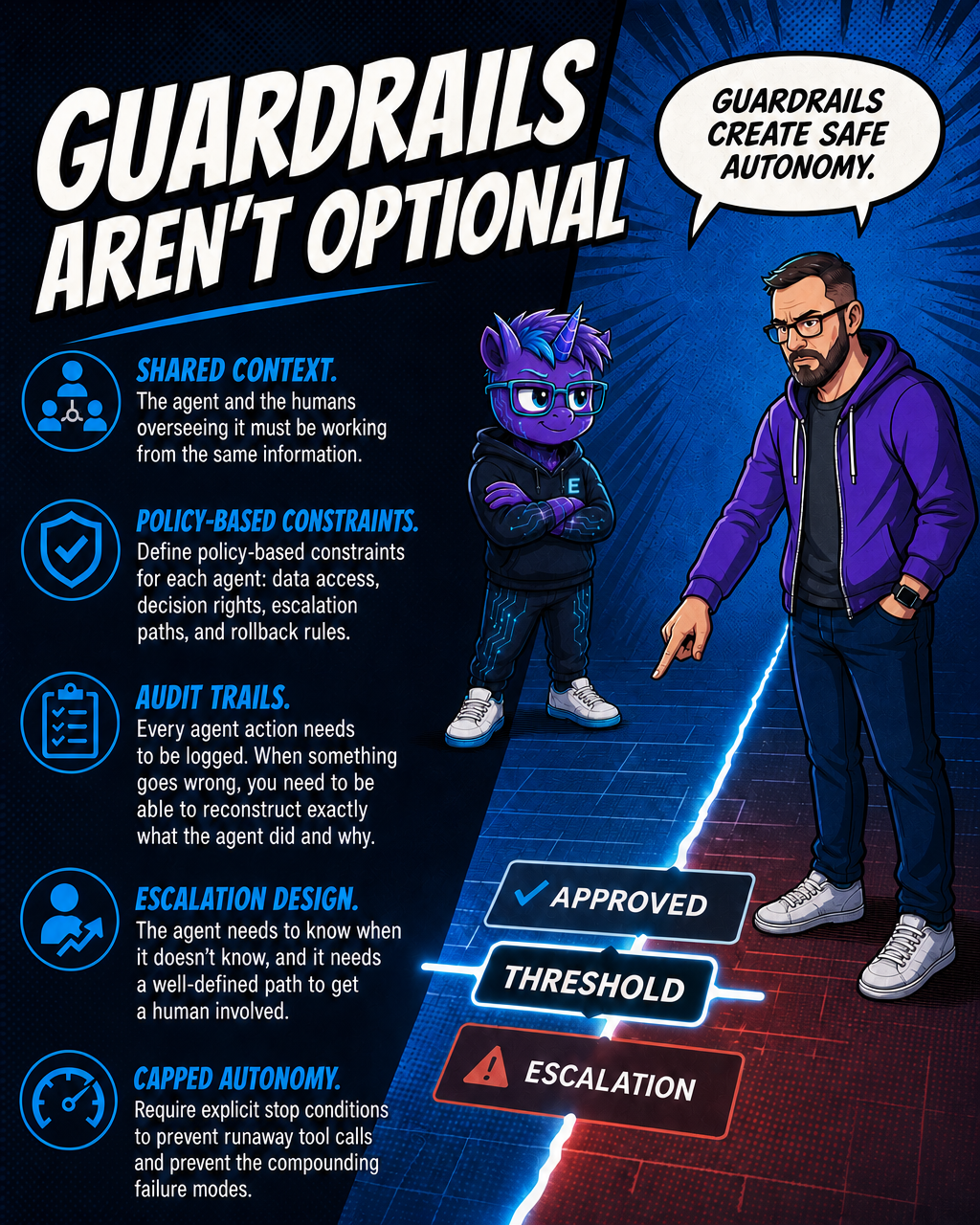
Guardrails aren't optional
Agents operating autonomously in enterprise processes can create real problems if they're not properly constrained. Implementing effective guardrails involves establishing a multi-layered control system spanning data and context guardrails, design-time governance, runtime enforcement, identity management, and human oversight.
The practical requirements for production-ready agent deployments include several non-negotiables.
Shared context. The agent and the humans overseeing it must be working from the same information. Building AI-ready context means investing in context graphs with machine-readable business definitions, lineage, policies, and quality metrics. Organisations succeeding at scale treat context as critical infrastructure, unifying data and AI governance into shared control planes and implementing multi-layer guardrails spanning design-time policies, runtime enforcement, and human oversight. If the agent is making decisions on stale or incomplete data, the guardrails don't matter — the foundation is wrong.
Policy-based constraints. Define policy-based constraints for each agent: data access, decision rights, escalation paths, and rollback rules. An agent authorised to approve procurement requests up to a certain value shouldn't be able to approve anything above that threshold without human sign-off. These boundaries need to be explicit and technically enforced, not assumed.
Audit trails. Every agent action needs to be logged. The priority is controlled autonomy: business rules, approval flows, audit trails, and human-in-the-loop checkpoints by design. When something goes wrong, you need to be able to reconstruct exactly what the agent did and why. This isn't just good governance practice — depending on your sector, it's increasingly a legal requirement.
Escalation design. Identity, least-privilege access, audit logs, explainability, and human-in-the-loop controls should be designed upfront, not bolted on later. Production agents should be engineered to handle retries, partial failures, validation against systems of record, and graceful degradation. The agent needs to know when it doesn't know, and it needs a well-defined path to get a human involved.
Capped autonomy. Require explicit stop conditions to prevent runaway tool calls. Many teams cap agent tool calls per task and require escalation if the agent can't resolve the issue within the budget. This prevents the compounding failure modes that occur when agents are left to iterate indefinitely on a task they're not equipped to resolve.
How to measure whether it's actually working
Time saved is a valid metric. It's also an incomplete one. If an agent halves the time taken to process a document but introduces a 5% error rate that wasn't there before, you haven't improved the process — you've traded one problem for another.
The question shifts from 'How smart is the agent?' to 'What process outcome did we improve, and by how much?'
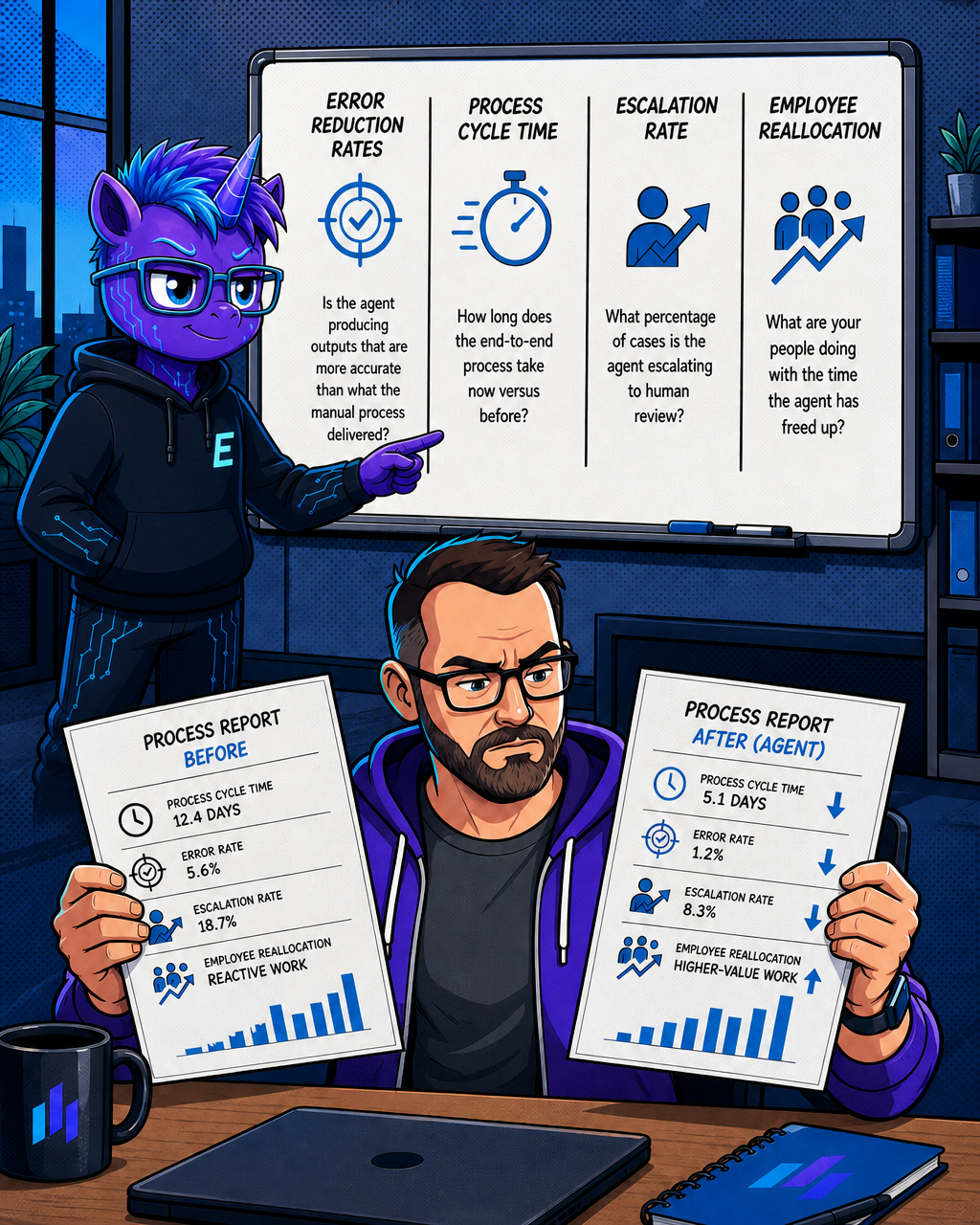
The metrics worth tracking in a well-governed agent deployment include:
Error reduction rates. Is the agent producing outputs that are more accurate than what the manual process delivered? Track error rates before and after, and hold that comparison honest.
Process cycle time. How long does the end-to-end process take now versus before? This captures the full workflow benefit, not just the time at the agent step.
Escalation rate. What percentage of cases is the agent escalating to human review? An escalation rate that's dropping over time is a signal the agent is learning the process well. An escalation rate that's too low might mean the agent is taking actions it shouldn't.
Employee reallocation. What are your people doing with the time the agent has freed up? This is the amplification metric. If the answer is "more of the same work but faster," you've optimised. If the answer is "higher-value work that wasn't getting done before," you've amplified.
One reasonable approach to evaluating financial value in agentic AI deployments is to discount gross benefit by reliability signals — such as hallucination rate, guardrail intervention rate, override rate in human-in-the-loop reviews, and model drift frequency — to produce a more accurate representation of true value delivered. This is a proposed methodology rather than an established industry-standard framework, and organisations should adapt it to their own measurement needs.
Payback timelines will vary significantly depending on organisation size, integration complexity, and change management maturity. Some analyses suggest faster payback for high-volume operational use cases such as document processing and customer service automation, and longer timelines for decision-support and analytics applications — but organisations should treat any published benchmarks as indicative rather than predictive, and build their own baseline projections from pilot data.
Be honest with your board about these timelines. The organisations that overstate early ROI claims and then can't sustain them are the ones that lose executive support before the programme matures.
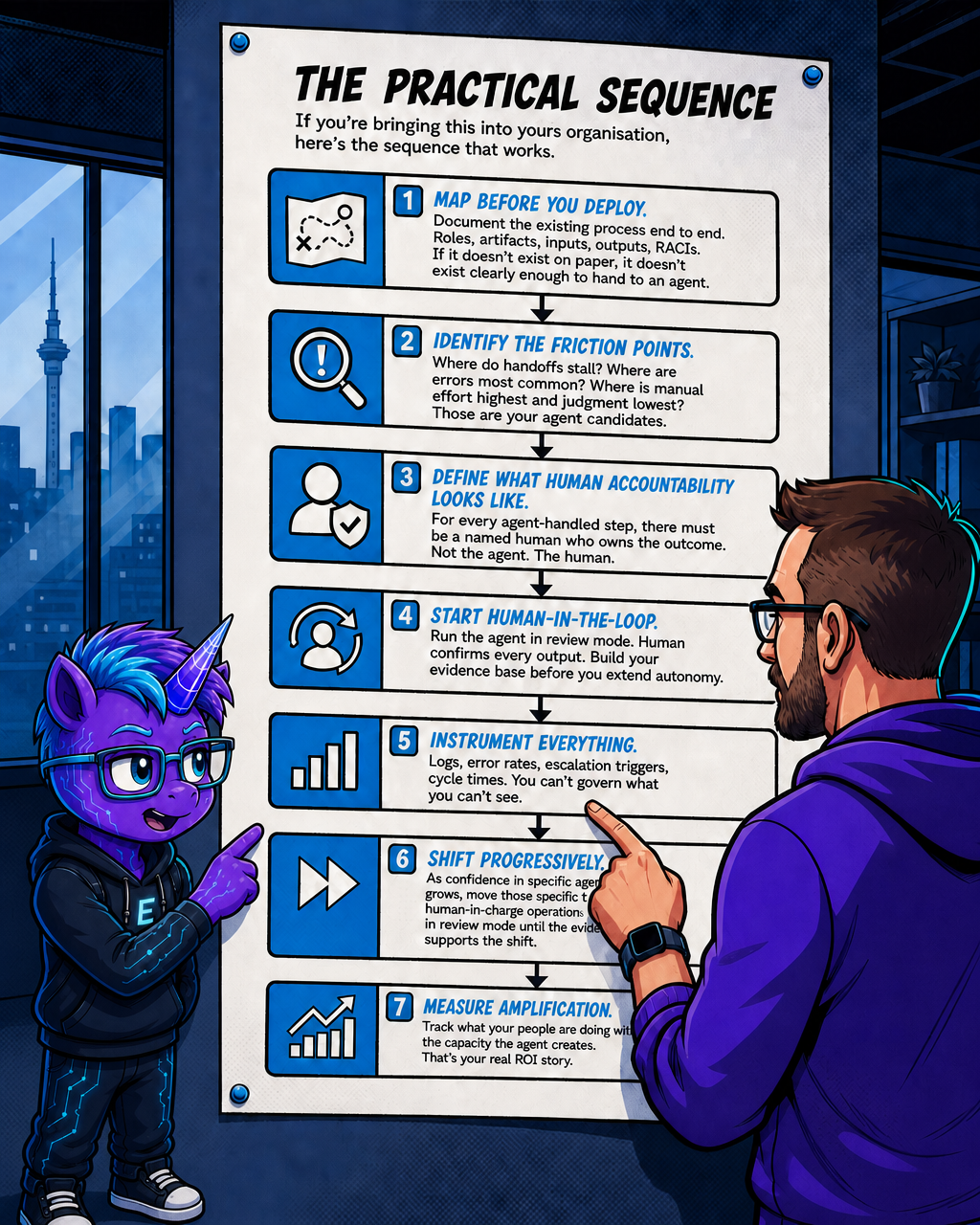
The practical sequence
If you're bringing this into your organisation, here's the sequence that works.
1. Map before you deploy. Document the existing process end to end. Roles, artifacts, inputs, outputs, RACIs. If it doesn't exist on paper, it doesn't exist clearly enough to hand to an agent.
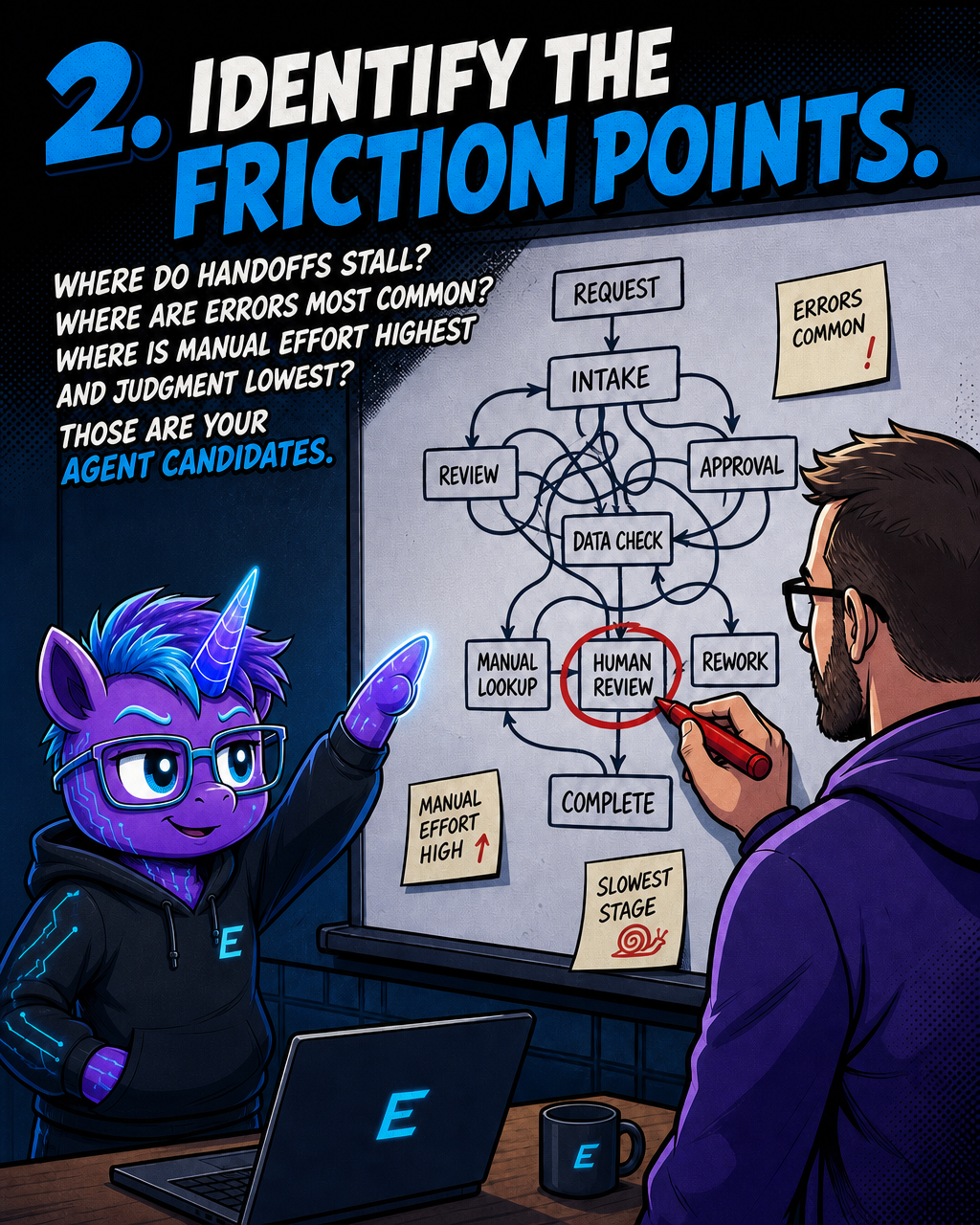
2. Identify the friction points. Where do handoffs stall? Where are errors most common? Where is manual effort highest and judgment lowest? Those are your agent candidates.
3. Define what human accountability looks like. For every agent-handled step, there must be a named human who owns the outcome. Not the agent. The human.
4. Start human-in-the-loop. Run the agent in review mode. Human confirms every output. Build your evidence base before you extend autonomy.
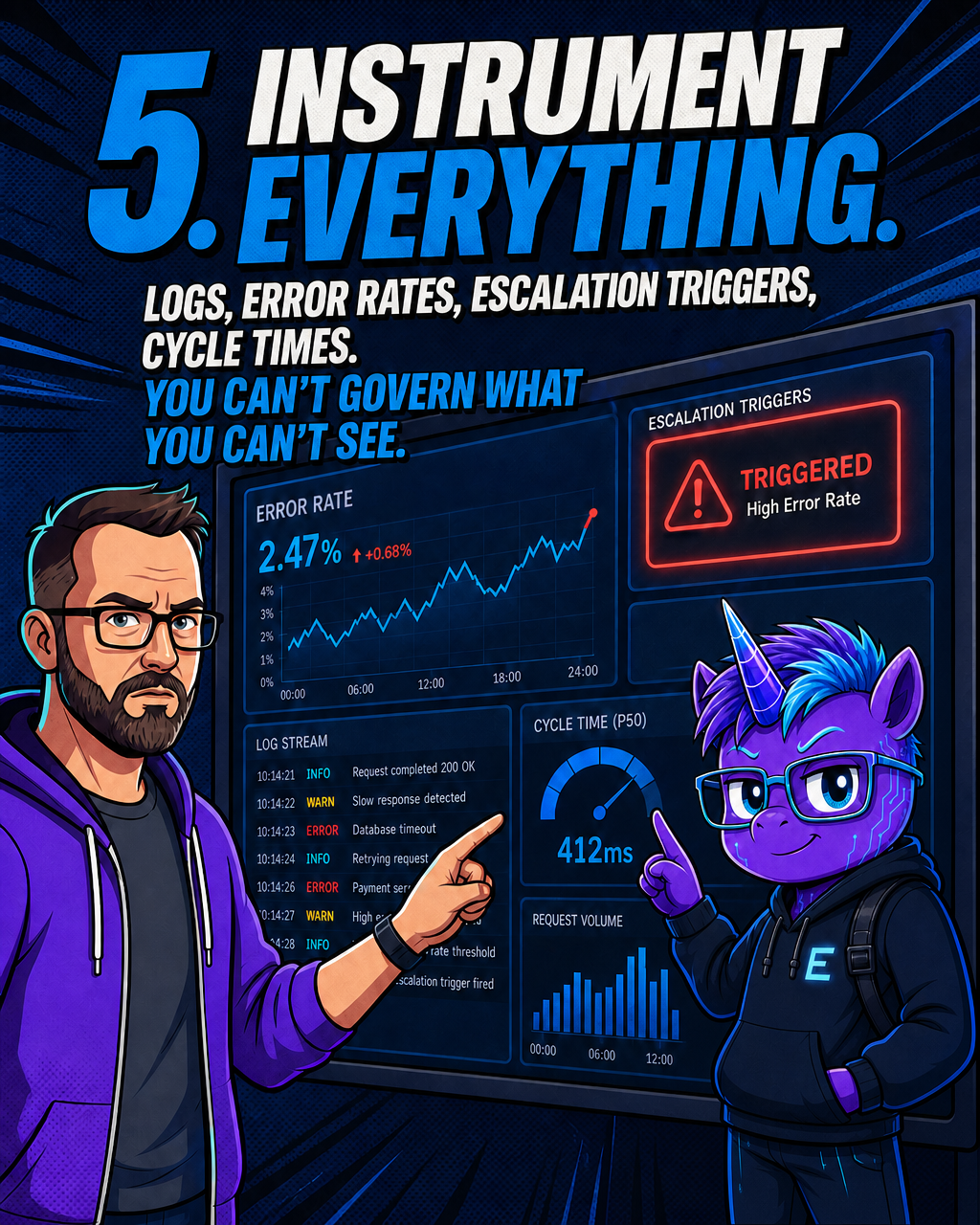
5. Instrument everything. Logs, error rates, escalation triggers, cycle times. You can't govern what you can't see.
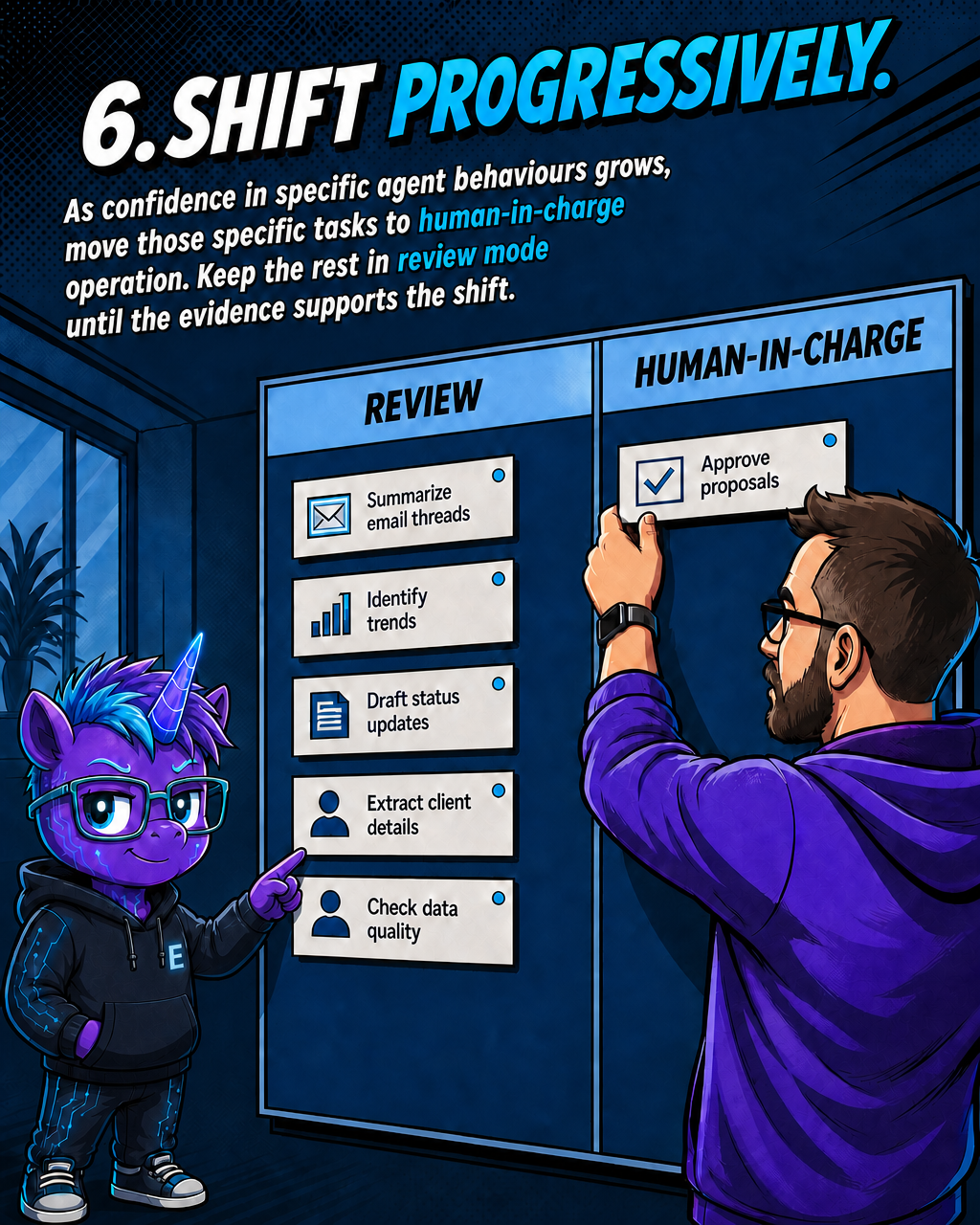
6. Shift progressively. As confidence in specific agent behaviours grows, move those specific tasks to human-in-charge operation. Keep the rest in review mode until the evidence supports the shift.
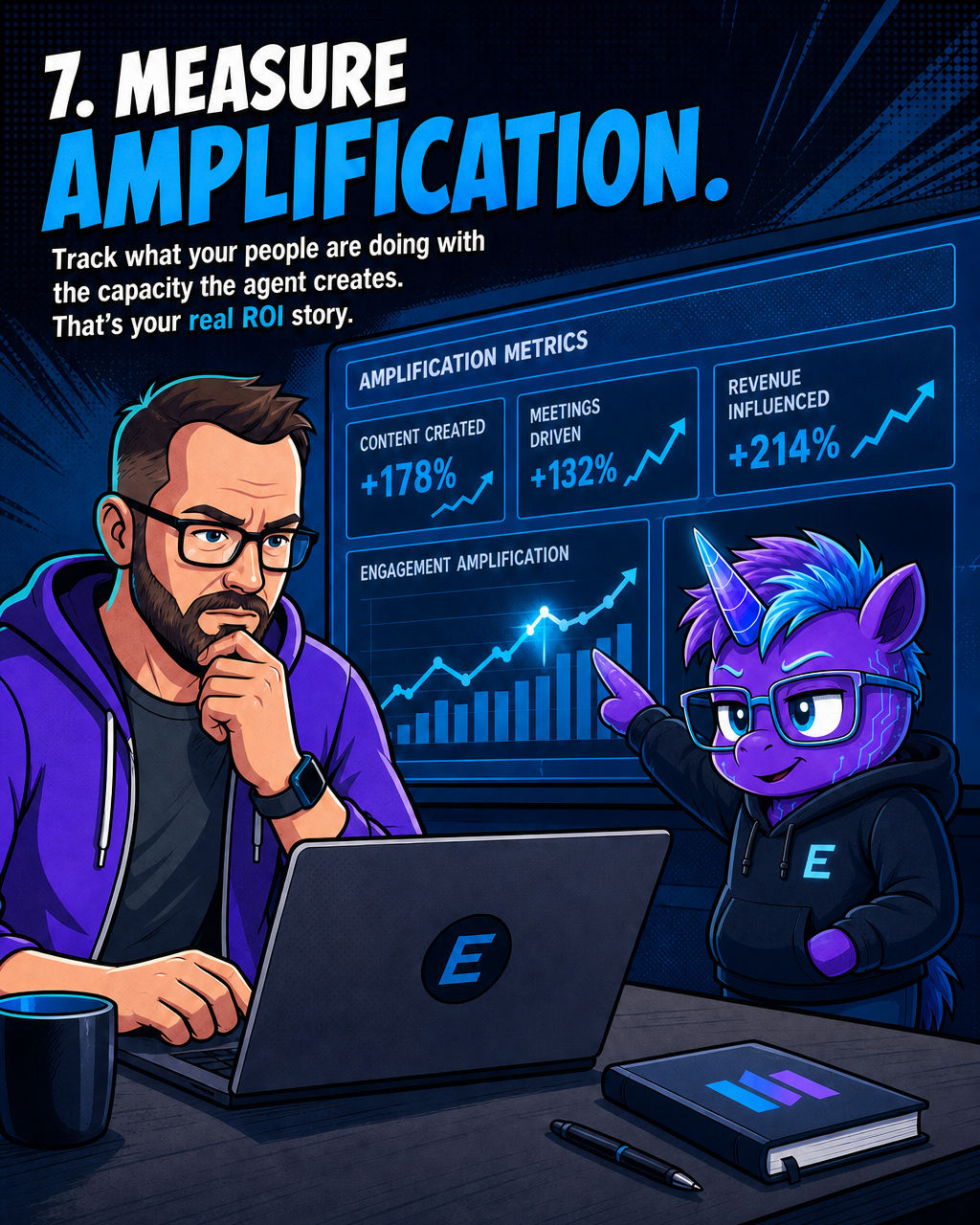
7. Measure amplification. Track what your people are doing with the capacity the agent creates. That's your real ROI story.
The board conversation
If you're building the business case for agent deployment inside a corporate environment, the framing that tends to land is straightforward: we're not reducing headcount, we're increasing throughput from our existing team, and we're building the governance to do it responsibly.
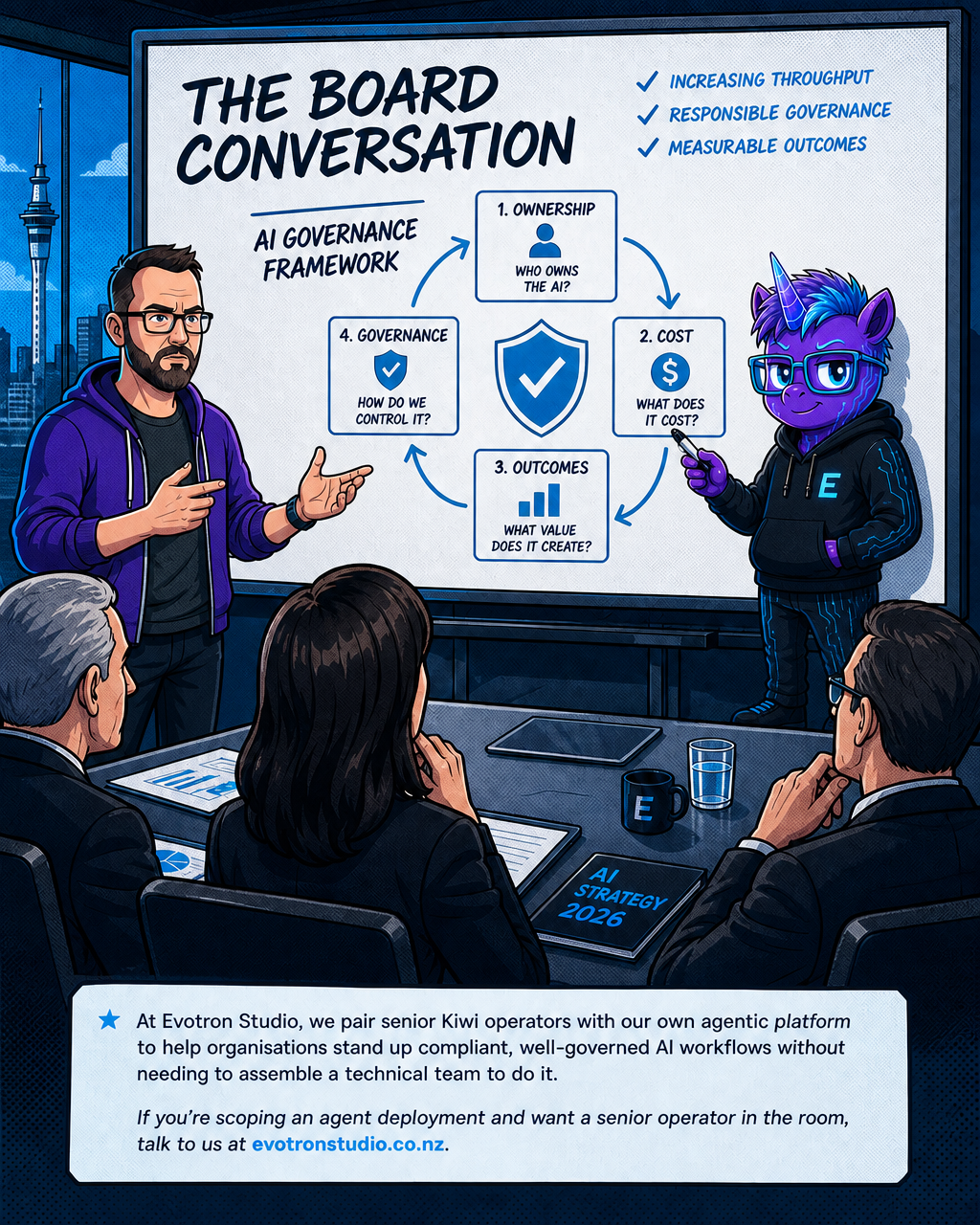
A theme emerging consistently across enterprise AI commentary in 2026 is that the differentiating factor will not be how much AI an organisation deploys, but how well it controls, governs, and realises value from it — understanding who owns the AI, what it costs, and how it creates measurable outcomes.
That's the framing your board can hold you to. And it's the framing you should want, because it's the one that makes the programme sustainable.
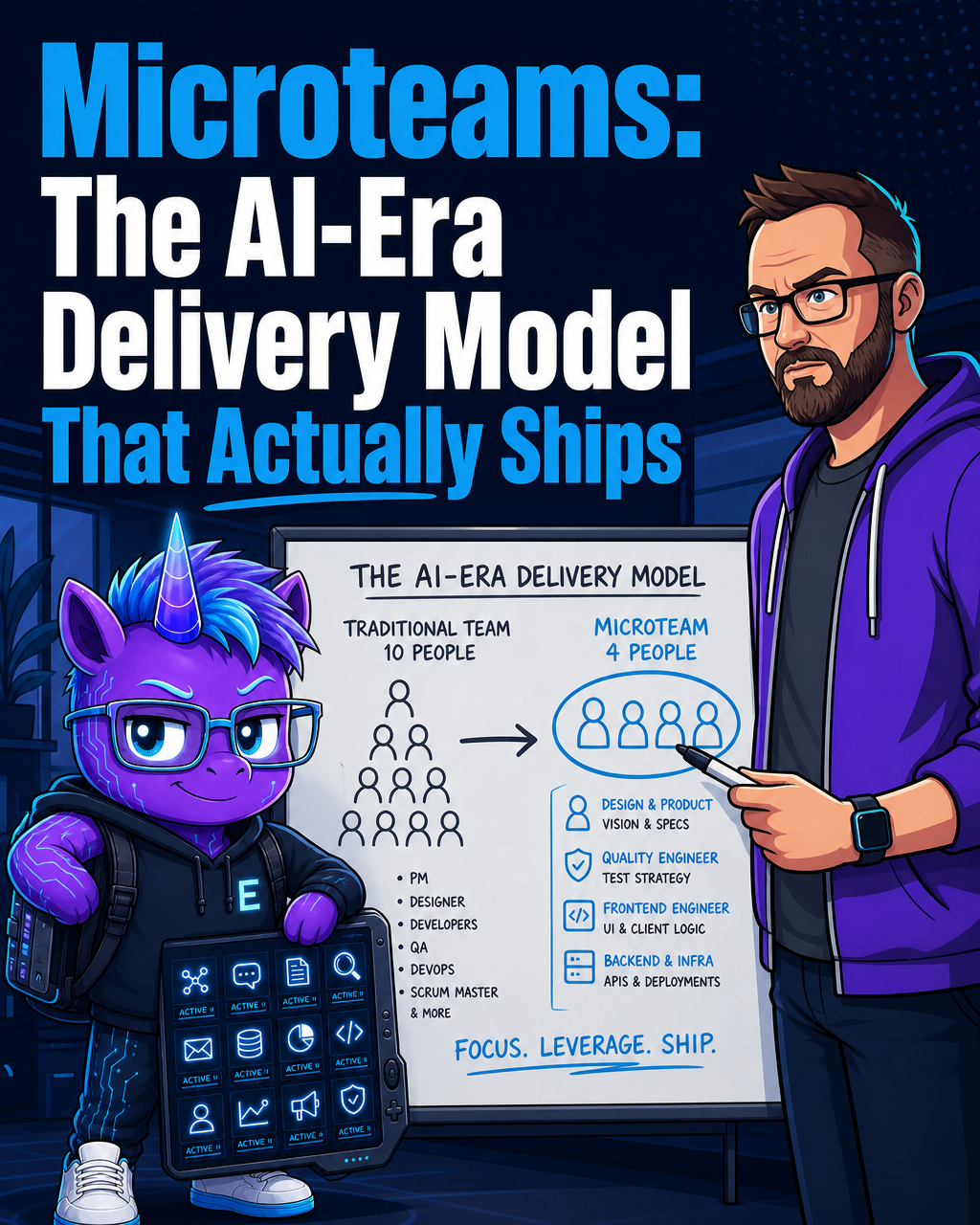
At Evotron Studio, we pair senior Kiwi operators with our own agentic platform to help organisations stand up compliant, well-governed AI workflows without needing to assemble a technical team to do it. If you're scoping an agent deployment and want a senior operator in the room, talk to us at evotronstudio.co.nz.

Evotron Studio
We build and run our own AI-amplified ventures — and bring the same capability into yours.
We build and run our own AI-amplified ventures — and bring the same capability into yours.
Learn more about Evotron Studio and get started today.
Visit Evotron Studio